Home / Disinfectant Testing / antibacterial / EN 1656
- Swiss testing laboratory
EN 1656 Bactericidal Efficacy Test for Veterinary Disinfectants

Hassle-free testing experience
Need to get a product tested? No worries! To and fro logistics are on us; we collect your products, test them and, deliver them back to you.
Summary
EN 1656 is a phase 2/step 1 quantitative suspension test used to demonstrate the bactericidal efficacy of veterinary disinfectants under simulated dirty conditions. The test generates standardized efficacy data required for regulatory submissions, particularly under European biocidal frameworks. It helps ensure products meet performance expectations in real-use, high organic load conditions.
Related tests for you
Quick understanding of the test
BS EN 1656:2019 - Quantitative suspension test for evaluating the bactericidal activity of chemical disinfectants and antiseptics used in the veterinary area (phase 2, step 1)
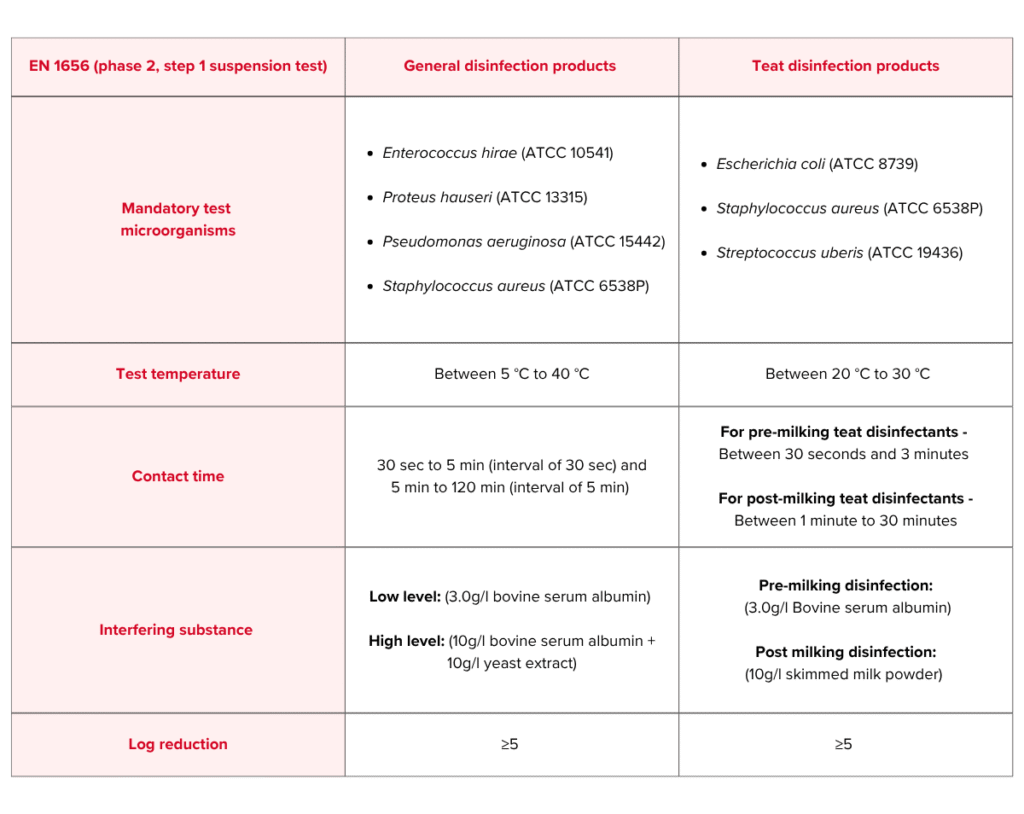
- Enterococcus hirae (ATCC 10541)
- Proteus hauseri (ATCC 13315)
- Pseudomonas aeruginosa (ATCC 15442)
- Staphylococcus aureus (ATCC 6538P)
- Escherichia coli (ATCC 8739)
- Streptococcus uberis (ATCC 19436)
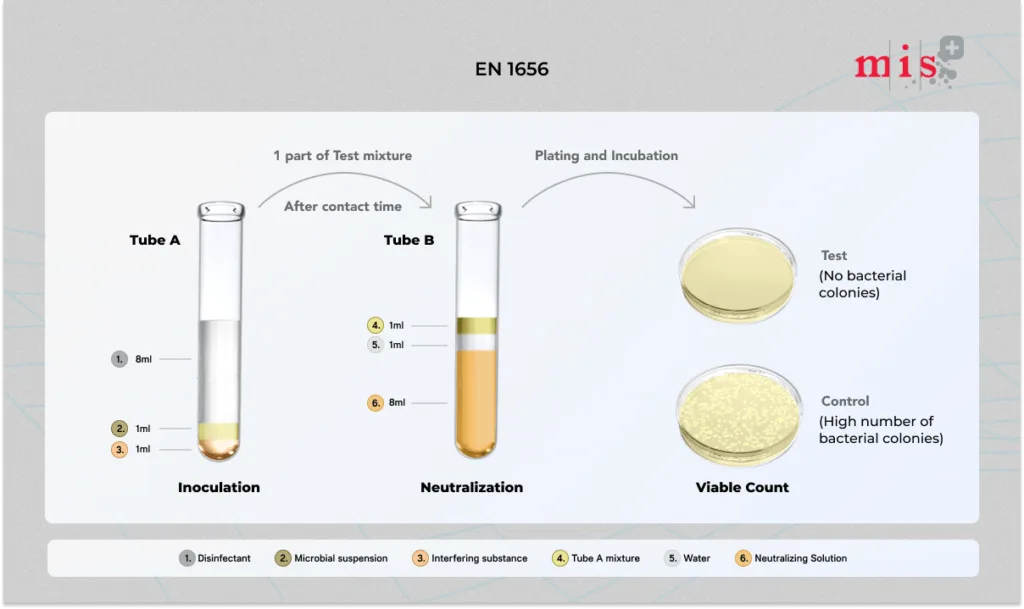
- The test product is challenged with test microorganisms and interfering substance and incubated at specified temperatures and contact times.
- After contact time, the test mixture is neutralized using a neutralizing solution, followed by plating and incubation to determine the number of surviving microorganisms.
- Evaluates the efficacy of products in simulated real-world conditions.
- Helps manufacturers comply with regulations and standards in the veterinary healthcare market
Turnaround Time
Passing criteria
Do you have a product that needs testing?
What is EN 1656?
EN 1656 is a phase 2, step 1 quantitative suspension test, which lays down the practical conditions and testing procedures for evaluating the efficacy of disinfectants and antiseptic products intended to be used in veterinary settings. As per EN 1656 guidelines, efficacy of the product needs to be conducted against different kinds of bacteria.
Scope of EN 1656 standardScope of EN 1656 standard
EN 1656 test method is applicable for different categories of disinfectants and antiseptics that are meant to be used in different veterinary fields such as –
- Animal breeding, husbandry, and production,
- Animal care facilities,
- Transport and disposal of all animals except when in the food chain following death and entry into the processing industry,
EN 1656 standard is also employed to test products used for teat disinfection of the milch animals.
EN 1656 Test Conditions & Requirements
Scope of products that can be tested with EN 1656 guideline
EN 1656 test method is applicable for different categories of disinfectants and antiseptics that are meant to be used in different veterinary fields such as –
- Animal breeding, husbandry, and production,
- Animal care facilities,
- Transport and disposal of all animals except when in the food chain following death and entry into the processing industry,
EN 1656 standard is also employed to test products used for teat disinfection of the milch animals.
EN 1656 Test Method
Test suspension preparation
- The test product is added to the suspension mixture of test microorganisms and interfering substances. As per standard, the maximum concentration of the product tested is 80%; as some dilution is due to the interfering substances and test microorganisms in the reaction mixture.
Contact time & exposure conditions
- The test mixture (disinfectant, microorganism, interfering substance) is kept at a particular temperature and contact time as per the recommendation by the client and EN 1656 guidelines.
Neutralization step
- After contact time, the test mixture is neutralized using a proper neutralizing solution to stop the reaction.
Enumeration & CFU calculation
- The recovered bacteria in the neutralizing medium are then enumerated by serial dilution and plating on a proper growth medium. After neutralization, the mixture is further incubated for 2 days to check if any viable microorganisms are present.
- After 2 days of incubation of the culture plates, bacterial colonies are counted, and the antimicrobial potency of the test product is determined.
Understanding log reduction results
To pass EN 1656, the test product must achieve ≥5 log reduction, in other words at least 99.999% reduction in microbial growth.
Log reduction | Percentage reduction | Efficacy level |
1 log reduction | 90% | Very low |
2 log reduction | 99% | low |
3 log reduction | 99.9% | moderate |
4 log reduction | 99.99% | high |
5 log reduction | 99.999% | Required efficacy according to standard |
EN 1656 vs EN 1276 vs EN 14349
Parameter | EN 1656 | EN 1276 | EN 14349 |
Test Type | Quantitative suspension test (Phase 2, Step 1) | Quantitative suspension test (Phase 2, Step 1) | Quantitative surface/carrier test (Phase 2, Step 2) |
Application Area | Veterinary disinfectants (animal housing, farms, transport) | General disinfectants (food, industrial, domestic, institutional) | Veterinary disinfectants (surface applications) |
Mandatory Test organisms | General veterinary disinfectants: Enterococcus hirae, Proteus hauseri, Pseudomonas aeruginosa, Staphylococcus aureus | Pseudomonas aeruginosa, Escherichia coli, Staphylococcus aureus, Enterococcus hirae | Enterococcus hirae, Pseudomonas aeruginosa, Staphylococcus aureus, Escherichia coli, Klebsiella pneumoniae, MRSA, Salmonella enterica, Candida albicans |
Efficacy Requirement | ≥ 5 log reduction | ≥ 5 log reduction | ≥ 5 log reduction |
Real-World Relevance | Moderate (suspension-based) | Moderate (suspension-based) | High (surface-based, closer to actual use) |
When to Use | When targeting veterinary hygiene claims | When targeting broad-spectrum bactericidal claims | When demonstrating efficacy on surfaces in animal settings |
Why products fail EN 1656?
Products fail EN 1656 testing due to several reasons including:
- Insufficient active concentration at use dilution- The product may be effective in its concentrated form but fails to achieve the required ≥5 log reduction at the recommended in use dilution.
- Inadequate contact time- If the formulation cannot deliver rapid bactericidal action within the claimed exposure time, it does not meet the pass criteria.
- Poor neutralization efficiency –Ineffective neutralization can either continue killing bacteria (false positives) or interfere with recovery, leading to unreliable or failed results.
- Poor performance under organic load – EN 1656 includes “dirty conditions” (proteins, serum, etc.). Many products work well in clean lab conditions but lose efficacy once organic matter is present.
- Formulation instability – Active ingredients may degrade, precipitate, or interact with other components, reducing overall antimicrobial performance.
Regulatory relevance of EN 1656
EN 1656 plays a key role in demonstrating compliance for biocidal products in veterinary hygiene within the European regulatory bodies. It is often required to support disinfectant efficacy claims in animal care environments, ensuring products meet defined performance benchmarks against relevant microorganisms. As a part of broader EN framework for disinfectant testing, it aligns with standardized, scientifically validated methods that regulators and industry stakeholders recognize and trust. This makes EN 1656 essential for regulatory approval and also for supporting biosafety protocols and infection prevention strategies in veterinary and agricultural settings.
When should you choose EN 1656?
Choose this test if your product:
- Intended for veterinary or animal-related environments
- Expected to perform in dirty conditions with organic load
- Targeting bacterial contamination in farms, clinics, or transport systems
- Seeking compliance with European disinfectant standards
Importance of EN 1656
Veterinary sites, if not kept clean, can potentially turn into breeding grounds for highly pathogenic microbes. These microbes have the potential to cause diseases in both humans and animals, which can result in a huge financial loss. Hence, it is crucial to monitor cleanliness and implement appropriate hygiene practices in veterinary settings.
EN 1656 is one of the widely accepted European standards of disinfectant testing for veterinary applications. This standard thus enables the checking of a proposed product to meet the necessary efficacy and safety criteria required to control different critical pathogens found in the veterinary area.
Why choose MIS
At MIS, we conduct EN 1656 tests customized to meet the specific product requirements of our clients.
In an effort to help clients with the development of high-performance antimicrobial products, we have implemented a robust system that tests for quality and precision.
In addition to disinfectant testing for veterinary applications, we offer EN 1276 testing for disinfectants intended for use in food, industrial, domestic, and institutional areas.
To request a quote for EN 1656 testing, contact us now to get a consultation from our microbiology experts.
Frequently Asked Questions

DR. Martinoz Scholtz
EN 1656 test is carried out to measure the bactericidal activity of chemical disinfectants and antiseptics utilized in veterinary areas. This test assesses the effectiveness of the sample product in eliminating mandatory pathogens described as critical in EN 1656 guideline.
EN 1656 is carried out for chemical disinfectants and antiseptic products used for general disinfection in veterinary areas. This test is also applicable to teat disinfectant products.
EN 1656 test usually takes 2 to 3 weeks to complete.
At Microbe Investigations Switzerland, we test for EN 1656 using the following microbial strains: Enterococcus hirae (ATCC 10541), Proteus hauseri (ATCC 13315), Pseudomonas aeruginosa (ATCC 15442), Staphylococcus aureus (ATCC 6538P), Escherichia coli (ATCC 8739) and Streptococcus uberis (ATCC 19436).
EN 1656 test is carried out to measure the bactericidal activity of chemical disinfectants and antiseptics utilized in veterinary areas. This test assesses the effectiveness of the sample product in eliminating mandatory pathogens described as critical in EN 1656 guideline.
To pass EN 1656, the test product must achieve ≥5 log reduction, in other words at least 99.999% reduction in microbial growth.
EN 1656 is designed specifically for veterinary disinfectants and includes test conditions that mimic animal environments, such as the presence of organic soil. In contrast, EN 1276 evaluates general bactericidal activity for disinfectants used in food, industrial, domestic and institutional settings under more generic conditions.
EN 1656 test usually takes 2 to 3 weeks to complete.
EN 1656 is carried out for chemical disinfectants and antiseptic products used for general disinfection in veterinary areas. This test is also applicable to teat disinfectant products.
Interfering substances in EN 1656 include Bovine serum albumin and Skimmed milk powder
While not mandatory, it is often required or expected to support efficacy claims for veterinary disinfectants in the EU.
EN 1656 can be adapted in terms of organisms, contact times and test conditions depending on the intended use.
Meet the best of the blend of
R&D, Efficacy Testing,
Innovation and Passionate
Experts at MIS.





Explore More
Key Takeaways EN 13727 and
Key Takeaways EN 1040 is
Key takeaways EN 1276 is

Antimicrobial testing is important to
Antibacterial efficacy testing is an