Home / Paint & Coatings / antibacterial / ASTM D4783
- Swiss testing laboratory
ASTM D4783
ASTM D4783 Test Method for Resistance of Adhesive Preparations

Hassle-free testing experience
Need to get a product tested? No worries! To and fro logistics are on us; we collect your products, test them and, deliver them back to you.
Summary
ASTM D4783 evaluates the resistance of liquid adhesive preparations to microbial attack in containers by challenging samples with bacteria, fungi, and yeast. The test helps manufacturers to generate data to support their product claim
Related tests for you
What is ASTM D4783 ?
ASTM D4783 was laid down in 2001 by the American Society for Testing and Materials to determine the resistance of liquid adhesive preparations to microbial attacks in a container. Adhesive specimens are challenged with bacteria, yeast, or fungi cultures and checked for their ability to return to sterility.
Quick understanding about ASTM D4783 Test
ASTM D4783-01(2021) - Assessing Resistance of Adhesives Preparations to Microbial attack in container
- Bacteria: Pseudomonas fluorescens, Pseudomonas aeruginosa, Bacillus subtilis, Proteus vulgaris
- Fungi: Aspergillus niger, Aspergillus flavus, Penicillium pinophilum
- Yeast: Candida tropicalis, Candida pseudotropicalis, Kluyveromyces fragilis
- Adhesive samples are inoculated with microbial strains and incubated at controlled temperatures. Microbial growth is monitored on streak plates at specific intervals. If sterility is maintained after four challenges, the sample is considered resistant. Know more
- Evaluates adhesive durability in microbe-exposed environments.
- Ensures uniform quality assurance across all product batches.
- Positive Growth: Light, Medium, or Heavy microbial growth indicates failure.
- Negative Growth: The absence of microbial growth confirms resistance.
Do you have a product that needs testing?
ASTM D 4783 Test Conditions & Requirement
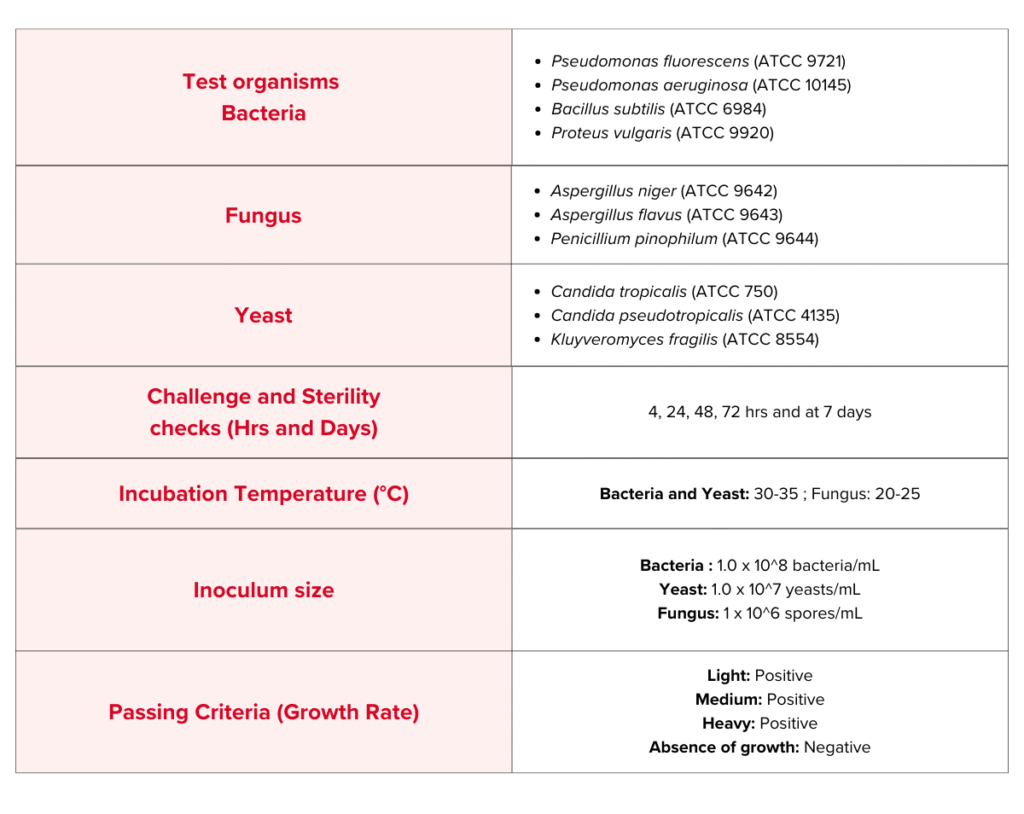
ASTM D 4783 Test Method
- The adhesive specimen is challenged by inoculating a bacteria, yeast, or fungi culture, which may be a single species or a mixed culture of several species.
- The inoculated adhesive specimen is stored at a controlled temperature for definite intervals or days when cultures (streak plates) are made at preset intervals.
- At any point in the series of challenges, the test is discontinued if the inoculated specimen shows microbial growth on the streak plates made during the week following the challenge (indicating that it has not returned to sterility). The sample is reported as not resistant to attack in the container by the species or combination of species used as the inoculum.
- If the culture shows no growth, the test is repeated with up to four challenges. If the specimen tests out as sterile following the fourth challenge, it is reported to be resistant to attack in the container by the specific strains or combination of species of bacteria, fungi, or yeast used in inoculum.
- The time necessary to kill is determined by noting the earliest streak plate to read sterile.
Importance of ASTM D 4783 Test
Liquid adhesives are widely used across industries, and their performance depends on stability during storage and use. If left unprotected, they can easily spoil due to microbial growth, leading to foul odor, discoloration, and loss of bonding strength. The ASTM D4783 test method evaluates how well adhesives resist bacteria, yeast, and fungi. By simulating microbial challenges and measuring whether the adhesive returns to sterility, it helps manufacturers evaluate and optimize biocide systems, choose appropriate preservatives, satisfy regulatory or quality-control requirements, and ensure that products delivered to end users maintain their intended performance and shelf life.
Why Choose MIS for ASTM D4783
Discover the full spectrum of our comprehensive antimicrobial testing portfolio at Microbe Investigations Switzerland (MIS). Our services strictly adhere to international standards, ensuring precise and reliable results. With our team of experts and a certified advanced laboratory setup, we are committed to providing fast turnaround times for all your testing needs, including biocide adhesive samples following ASTM D 4783 guidelines.
For more detailed information on our testing services, turnaround times, or any other inquiries, contact us today.
Frequently Asked Questions on ASTM D4783 Test

DR. Martinoz Scholtz
1. What is the ASTM D4783 test?
ASTM D4783 test is performed to determine the resistance of liquid adhesive preparations to microbial attack in the container. This method involves exposing adhesive specimens to specific cultures of bacteria, yeast, or fungi to assess their ability to withstand contamination and degradation over time.
2. What Products can be tested with the ASTM D4783 test?
This test is applied to liquid adhesive preparations.
3. What is the Turnaround Time for the ASTM D4783 test?
ASTM D4783 test takes 2-6 weeks to complete.
4. On how many microbial strains can your ASTM D4783 testing lab perform tests?
At Microbe Investigations, we test for ASTM D4783 using the following microbial strains: Pseudomonas fluorescens (ATCC 9721), Pseudomonas aeruginosa (ATCC 10145), Bacillus subtilis (ATCC 6984), Proteus vulgaris (ATCC 9920), Candida tropicalis (ATCC 750), Candida pseudotropicalis (ATCC 4135), Kluyveromyces fragilis (ATCC 8554), Aspergillus niger (ATCC 9642), Aspergillus flavus (ATCC 9643), and Penicillium pinophilum (ATCC 9644)
Meet the best of the blend of
R&D, Efficacy Testing,
Innovation and Passionate
Experts at MIS.




Explore More
Microscopic spores of fungi and
Key Takeaways ISO 18184 evaluates

Key takeaways ISO 20743 and


Introduction The Japanese Industrial Standards