Home / Cosmetic Testing / Detection / USP 62
- Swiss testing laboratory
USP 62 Test for Specified Microorganisms in Non-Sterile Products

Hassle-free testing experience
Need to get a product tested? No worries! To and fro logistics are on us; we collect your products, test them and, deliver them back to you.
Summary
USP <62> is used to detect the presence of specific objectionable microorganisms in non-sterile products such as pharmaceuticals, cosmetics and nutraceuticals. The test is qualitative, focusing strictly on presence or absence of defined organisms. It plays a critical role in meeting pharmacopeial standards and ensuring product safety before market release.
Related tests for you
What is USP 62?
USP <62> is a critical qualitative test standard designed to detect the presence of specified in non-sterile pharmaceutical, cosmetic, nutraceutical, and personal care products via enrichment and selective plating. While the complementary test USP <61> focuses on quantifying the total microbial load (bioburden), USP <62> ensures presence/ absence of harmful or spoilage-causing microorganisms in a product. Both tests, defined under the United States Pharmacopeia (USP), ensure microbial quality and safety of products.
Quick understanding of USP 62 Test
USP 62 – Microbiological Examination of Non-Sterile Products
The USP 62 test determines the presence or absence of specific microorganisms in non-sterile products.
- Staphylococcus aureus
- Escherichia coli
- Salmonella enterica
- Pseudomonas aeruginosa
- Clostridium species
- Candida albicans
- Bile-tolerant gram negative bacteria
- Product samples are enriched in growth media.
- The samples are then sub-cultured on selective media and incubated.
- After incubation, colonies are examined for morphological traits and confirmed through biochemical tests.
- Helps identify microbial contamination of the product at early stages.
- Assists in meeting regulatory requirements required for market approval.
Turnaround Time
Passing criteria
Do you have a product that needs testing?
Scope of USP 62 testing
USP <62> defects specific objectionable microorganisms in non-sterile products to ensure they are free from harmful pathogens.
- Non-sterile pharmaceuticals
- Cosmetics and personal care products
- Nutraceuticals and supplements
- Raw materials and finished products
Which Microorganisms are detected in USP 62?
- Staphylococcus aureus (ATCC 6538P)
- Escherichia coli (ATCC 8739)
- Salmonella enterica (ATCC 10708)
- Pseudomonas aeruginosa (ATCC 15442)
- Candida albicans (MTCC 3017)
- Clostridia species
- Bile-tolerant gram negative bacteria
USP 62 Test Procedure
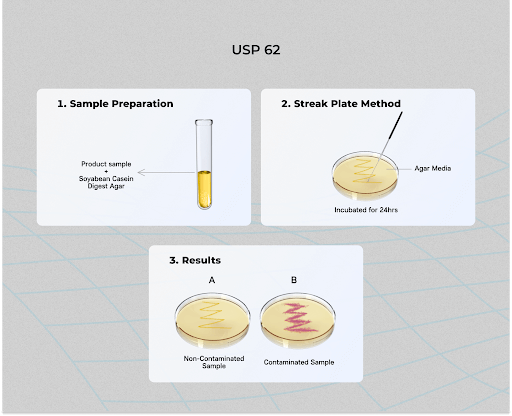
Sample preparation and enrichment
- A defined quantity of the product (usually 10 g or 10 mL) is mixed with suitable enrichment
- The mixture is incubated under specified conditions (30–35 °C for bacteria, 20–25 °C for fungi) to allow any microorganisms present to grow.
Plating
- The aliquots are then transferred from the enrichment broth onto selective media designed for specific target organisms.
Incubation
- The plates are incubated at appropriate temperatures and durations depending on the target microorganism.
Identification and confirmation
- After incubation, colonies are examined for characteristic morphology and to confirm identity through Gram staining, biochemical, or molecular tests to detect presence or absence of each specified microorganism.
Why is suitability testing required for USP 62
Prior to routine specified microorganisms testing in USP 62, suitability testing is completed. This test utilizes neutralization and dilution techniques to ensure that the growth of suspected (tested) microorganisms is not inhibited by antimicrobial agents that may already be present in the given product sample.
Acceptance Criteria for USP 62 Test Standard
The outcome of this test is analyzed based on the acceptance criteria provided under the USP 1111 guidelines. Each microbial strain has a unique colony characteristic feature that is used to identify the presence or absence of a particular microorganism. The product complies with the test if no characteristic colonies are present or if the identification tests are negative.
USP 62 vs USP 61
Parameter | USP <61> (Microbial Enumeration Tests) | USP <62> (Tests for Specified Microorganisms) |
Purpose | To quantitatively determine total aerobic bacteria (TAMC) and total yeast and mold (TYMC) to assess overall microbial load. | To qualitatively detect the presence or absence of specific objectionable microorganisms that may pose health risks. |
Target Microorganisms | Total Aerobic Microbial Count (TAMC) and Total Yeast and Mold Count ( TYMC) | Specific pathogens such as Staphylococcus aureus, Escherichia coli, Pseudomonas aeruginosa, Salmonella spp., bile-tolerant Gram-negative bacteria, Candida albicans. |
Scope of Products | Non-sterile products pharmaceuticals (oral solids/liquids, creams, ointments), cosmetics and personal cate products | Non-sterile products pharmaceuticals (oral solids/liquids, creams, ointments), cosmetics and personal cate products |
Results Interpretation | Quantitative, results are reported as colony-forming units (CFU) per gram or mL and compared to acceptance limits in USP <1111>. | Qualitative, results are based on presence or absence of microbial growth |
Key Difference | Focuses on how many microbes are present (bioburden level). | Focuses on whether specific harmful microbes are present or absent. |
Application by industry
Pharmaceuticals: Ensures absence of harmful pathogens in oral and topical products
Cosmetics: Validates safety for skin and personal care use
Nutraceuticals: Confirms microbiological safety of ingestible supplements
Regulatory relevance
USP <62> test plays an important role in ensuring regulatory acceptance and product quality. It demonstrates that products meet established microbiological safety standards, required for compliance with the U.S Food and Drug administration. It supports adherence to Good Manufacturing Practices by reinforcing robust hygiene practices and contamination control throughout the manufacturing process. Ultimately, USP <62> helps ensure product safety prior releasing into market by identifying and eliminating potential pathogen risks, thereby satisfying the consumers.
Why products fail USP 62?
Failures in USP <62> testing can be due to gaps in different aspects
- Ineffective preservatives – Inability of the preservatives in the formulation to inhibit microbial growth.
- High water activity – Creates an environment that supports microbial growth
- Poor manufacturing hygiene – Poor hygiene practices during production or handling can cause contamination.
- Improper packaging – Any open space or improper sealing allows microbial contamination, failing to protect the product post production
When should you perform USP 62 testing?
Choose USP <62> if your product:
- Is non-sterile
- Requires pathogen detection to rule out contamination
- Needs regulatory approval
- Is part of microbial limit testing
Importance of USP 62 testing
USP 62 testing is essential for detecting microbial contamination early, helping manufacturers avoid costly product recalls and protect their reputation. It supports regulatory compliance by providing necessary data to meet standards set by bodies like the FDA. Additionally, it offers a competitive edge by demonstrating commitment to quality and safety, while also minimizing legal and financial risks associated with contamination-related issues.
Nonsterile Product Testing Services at MIS
At Microbe Investigations Switzerland (MIS), we offer USP <62> and USP <61> testing services to ensure the microbiological quality and safety of non-sterile pharmaceutical, cosmetic, and personal care products. Our expertise delivers reliable, reproducible, and pharmacopeial-compliant results, helping you substantiate microbial quality claims and meet regulatory standards.
To get a quote on USP <61> or for any other information, contact our experts now, contact our experts here.
Frequently Asked Questions on USP 62 Test
DR. Martinoz Scholtz
1. What is the USP 62 test?
USP 62 test is performed to determine the presence or absence of specific microorganisms present in non-sterile samples.
2. What are the products that can be tested with the USP 62 test?
This test is applicable to non-sterile pharmaceuticals and other non-sterile products such as cosmetics and personal care products.
3. What is the turnaround time for the USP 62 test?
The test takes 2-3 weeks to complete.
4.What is the difference between USP 61 and USP 62?
USP <61> test determines Total Aerobic Microbial Count (TAMC) and Total Yeast and Mold Count ( TYMC) while USP <62> detects the presence or absence of specific microorganisms.
5. What organisms are tested in USP 62?
This test detects specified microorganisms, including but not limited to Staphylococcus aureus, Escherichia coli, Candida albicans, Pseudomonas aeruginosa, Clostridium species, Salmonella species and Bile-tolerant gram-negative bacteria.
6. Can the test be used for raw materials and finished products?
Yes, this test is applicable to both raw materials and finished products.
7. What is USP 62 suitability testing?
Suitability test is performed prior to USP <62> to verify that the product properties such as preservatives or any formulation components do not interfere with microbial recovery.
8. Is USP 62 mandatory?
Yes, in most regulated markets USP <62> is required for non-sterile pharmaceutical and certain cosmetic products as part of microbial limit testing.
9. Can this test detect contamination in dietary supplements?
Yes, USP Chapter 62 testing can be used to detect contamination in dietary supplements.
10. How does USP 62 testing differ from USP 61 testing?
USP 61 assesses microbial load, while USP 62 focuses on detecting specific harmful microorganisms.
Meet the best of the blend of
R&D, Efficacy Testing,
Innovation and Passionate
Experts at MIS.
Explore More
In the cosmetics industry, safety
Evidently, with the expanding cosmetics
In the competitive world of