Home / Plastics / antibacterial / ASTM E2180
- Swiss testing laboratory
ASTM E2180 Antimicrobial Test for Hydrophobic & Polymeric Materials

Hassle-free testing experience
Need to get a product tested? No worries! To and fro logistics are on us; we collect your products, test them and, deliver them back to you.
Summary
ASTM E2180 is a quantitative test method used to evaluate the antimicrobial activity of agents incorporated into hydrophobic or polymeric materials such as plastic and coated surfaces. The test compares microbial counts on treated vs untreated samples to determine efficacy, typically expecting significant reductions. It is widely used for validating performance, durability and long-term effectiveness in medical devices, consumer products and industrial materials.
Related tests for you
Quick understanding of the test
ASTM E2180 - Standard Test Method For Determining The Activity of Incorporated Antimicrobial Agent(s) In Polymeric or Hydrophobic Materials
Application
- Staphylococcus aureus( ATCC 6538.)
- Inoculated agar slurry is applied to both treated and untreated hydrophobic samples.
- After 24 hours, microorganisms are recovered using a neutralizing solution.
- Serial dilutions are plated on an agar plate and incubated for a specified duration and colony counts are compared to evaluate antimicrobial activity.
- Provides a reliable, reproducible method to evaluate antimicrobial effectiveness in non-porous materials.
- Assists manufacturers in meeting regulatory standards for antimicrobial products.
Turnaround Time
The antimicrobial efficacy is determined by comparing bacterial colony reductions on treated samples against untreated controls.
Passing criteria
Do you have a product that needs testing?
What is ASTM E2180 testing
ASTM E2180 is a quantitative test method for the evaluation of the antimicrobial efficacy of agents incorporated onto flat (two-dimensional) hydrophobic or polymeric surfaces. This test method is also applicable to assess the “shelf-life” or long-term durability of antimicrobial products.
Scope of ASTM E2180 standard
ASTM E2180 is applicable to polymeric materials and other hydrophobic materials such as vinyl fabrics, shower curtains and medical devices.
Organisms Used in this Method
Pseudomonas aeruginosa (ATCC 15442), Escherichia coli (ATCC 8739), Staphylococcus aureus (ATCC 6538P), Enterococcus hirae (ATCC 10541), Klebsiella pneumoniae (ATCC 4352), MRSA (ATCC 33591), Salmonella enterica (ATCC 10708), Candida Albicans (MTCC 3017).
Advantages of ASTM E2180 test method
Hydrophobic surfaces have either very low or no affinity for water. When water or aqueous solutions are spread over such surfaces, they tend to bead up into a sphere and roll away.
For antimicrobial testing of hydrophobic products, it becomes difficult to layer bacterial inoculum on treated surfaces. This subsequently affects the accuracy of results after antimicrobial evaluation. To overcome this challenge, ASTM E2180 test method is developed to check the antimicrobial activity of hydrophobic surfaces. This test standard utilizes an agar slurry inoculum vehicle which facilitates even contact between microorganisms and antimicrobial-treated hydrophobic surfaces.
ASTM E2180 Test method overview
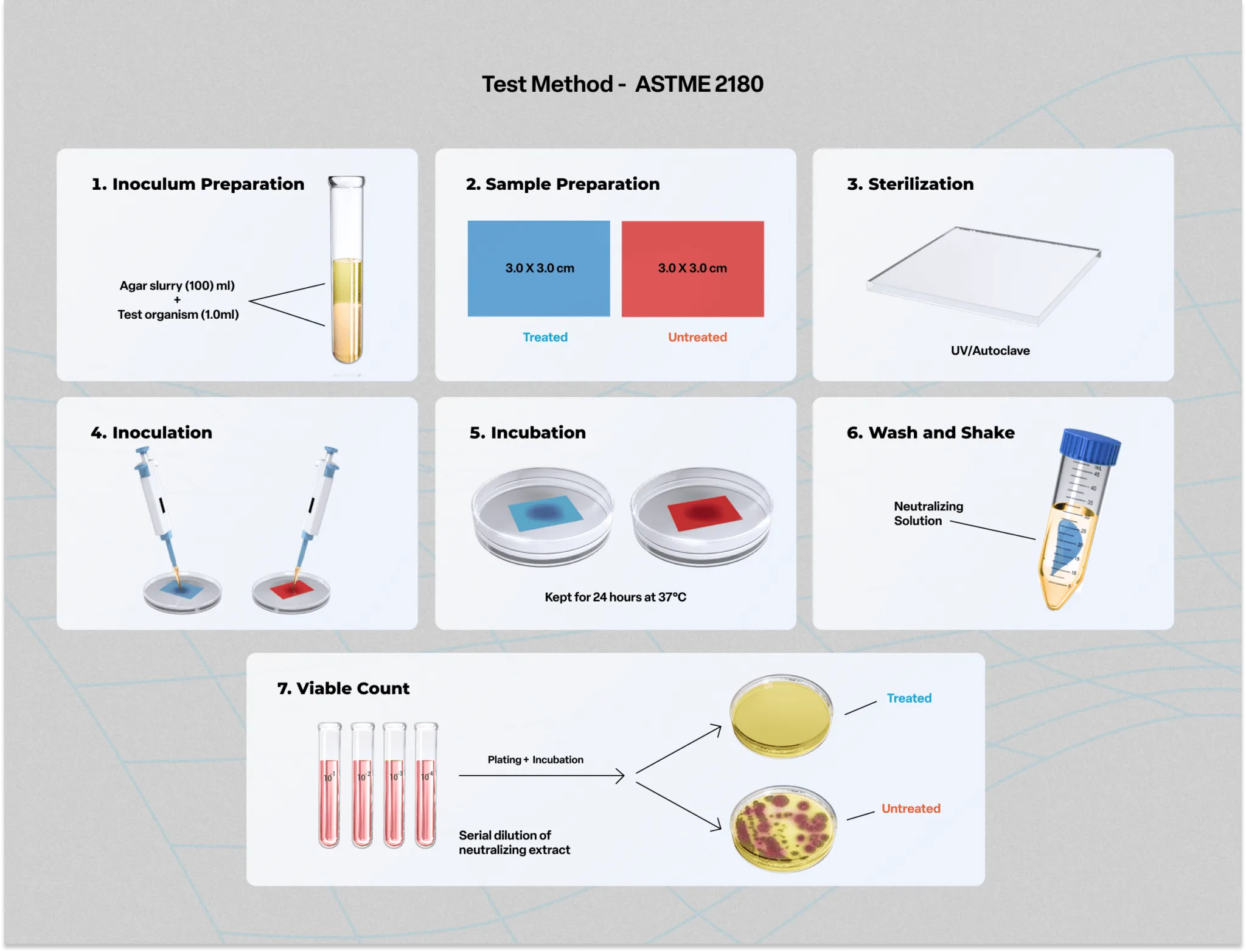
Agar slurry inoculum preparation
- Agar slurry is inoculated with standardized microbial culture.
- Inoculated slurry is spread onto the test (treated) and control (untreated) sample of hydrophobic material.
Contact time & Neutralization
- After a contact period of 24 hrs, microorganisms from both control and test samples are recovered separately using a neutralizing solution.
- Serial dilutions are made and plated on agar medium. These plates are further incubated for 48 hrs under specific conditions optimal for the growth of test organisms.
Recovery & Microbial enumeration
- Antimicrobial activity is calculated by comparing the reduction of bacterial colonies in treated samples with bacteria colonies present on untreated samples.
Understanding log reduction results
To pass ASTM E2180, the test product much achieve significantly higher log reduction value or significant reduction in microbial growth compared to control samples
ASTM E2180 vs ISO 22196 vs JIS Z 2801
Feature | ASTM E2180 | ISO 22196 | JIS Z 2801 |
Purpose | To determine the activity of incorporated antimicrobial agent(s) in polymeric or hydrophobic materials | To determine the antibacterial activity on plastics and other non‑porous surfaces | Same as IS0 22196 |
Standards body | ASTM International | International Organization for Standardization (ISO) | Japanese Industrial standard (basis for the development of ISO 22196) |
Same as ISO 22196 | |||
Mandatory Test organisms | Staphylococcus aureus (ATCC 6538P) Yeast and fungal conidia may be tested | Staphylococcus aureus (ATCC 6538P), Escherichia coli(ATCC 8739) | Same as ISO 22196 |
Inoculation method | Inoculum is prepared using an agar slurry forming pseudo‑biofilm to ensure even contact | Bacterial suspension (liquid inoculum) is placed on the surface and covered with a thin film to ensure even contact | Same as ISO 22196 |
Surface types suited | Best for hydrophobic/polymeric surfaces including textured or difficult‑to‑wet materials | Plastics and other non-porous materials such as coatings, steel, acrylic fiber, glass, metals, ceramics, and tiles, etc. | Same as ISO 22196 |
Result interpretation/Passing criteria | Quantitative reduction of microbes on treated vs. untreated material | Quantitative antibacterial activity (bacteriostatic/bactericidal) compared to control | Same as ISO 22196 |
Why products fail ASTM E2180 testing
Products fail ASTM E2180 due to several reasons including
- Low antimicrobial agent concentration
- Poor distribution of antimicrobial agent within polymer matrix
- Ineffective contact of the material with microbes during testing
- Inadequate neutralization or improper neutralization
Regulatory relevance of ASTM E2180
In United States, ASTM E2180 is one of the widely used and accepted standard to demonstrate antimicrobial efficacy for hydrophobic or polymer-based products incorporated with antimicrobial agents. The data generated can support product validation, marketing claims, and technical documentation submitted during regulatory reviews.
When should you choose ASTM E2180
Choose ASTM E2180 if your product:
- Is hydrophobic or polymer-based
- Contains embedded antimicrobial agents
- Requires quantitative efficacy data
Why choose MIS
Microbial Investigations Switzerland (MIS) offers a wide range of antimicrobial testing services for hydrophobic materials according to international standards. ASTM E2180 is one of the most frequently requested test method by our clients for their antimicrobial hydrophobic formulations. The generated data is clear, reliable, and aligned with industry and regulatory expectations.
To get a quote on ASTM E 2180, contact our experts now.
Frequently Asked Questions

DR. Martinoz Scholtz
ASTM E2180 test is a quantitative method for determining the antimicrobial effectiveness of the agent(s) incorporated in polymeric or hydrophobic surfaces. This test method can also be used to determine “shelf life” or long-term durability of antimicrobial-treated materials by testing both washed and non-wasted samples over a period of time.
An agar slurry is used to ensure uniform contact between microorganisms and the test surface. This is specifically important for hydrophobic materials where direct liquid contact may be inconsistent
The key difference lies in the type of inoculum used and the scope of products. ASTM E2180 uses an agar-based slurry, making it suitable for hydrophobic, textured, or uneven surfaces where liquid cannot spread properly. Whereas, ISO 22196 uses a liquid inoculum and is designed for smooth, non-porous plastic surfaces.
A good result indicates a significantly high log reduction value in the test sample as compared to the control sample.
Yes, ASTM E2180 can be adapted to test fungi in addition to bacteria.
ASTM E2180 typically takes 3-4 weeks. days to complete.
Yes, ASTM E2180 can be used for hydrophobic coatings incorporated with antimicrobial agents.
Yes, it can be used to evaluate durability by comparing antimicrobial performance on washed and unwashed samples over time.
It is not a mandatory requirement but is widely used to support antimicrobial claims and demonstrate efficacy for hydrophobic and polymeric materials.
Meet the best of the blend of
R&D, Efficacy Testing,
Innovation and Passionate
Experts at MIS.





Explore More
Key Takeaways ISO 846 is
Key takeaways Both JIS Z

Key takeaways ASTM D3273 is

The ISO 21702 evaluates the