Home / Cosmetic Testing / Enumeration / ISO 21322
- Swiss testing laboratory
ISO 21322 Test for Coated Wipes and Masks
Microbiological risk assessment of Impregnated or Coated Wipes and Masks

Hassle-free testing experience
Need to get a product tested? No worries! To and fro logistics are on us; we collect your products, test them and, deliver them back to you.
Summary
ISO 21322 is used to assess contamination in impregnated or coated cosmetic products such as wipes, masks and sponge etc. The test involves microbial enumeration of aerobic bacteria, yeasts, and molds to evaluate the microbiological quality of these products.
Related tests for you
What is ISO 21322 ?
ISO 21322 test standard is used for the microbiological testing of impregnated or coated cosmetic products such as wipes and masks. It provides test procedure for the enumeration and detection of microorganisms when the cosmetic formulation is applied to a substrate and cannot be directly sampled.
Quick understanding of the ISO 21322 test
ISO 21322: 2020 - Microbiological risk assessment of Impregnated or Coated Wipes and Masks
- Staphylococcus aureus (ATCC 6538)
- Pseudomonas aeruginosa (ATCC 9027)
- Escherichia coli (ATCC 8739)
- Candida albicans (ATCC 10231)
- Bacillus subtilis (ATCC 6633)
- Differentiates between bacterial and fungal contaminants effectively.
- Ensures product safety and compliance with regulatory standards.
Turnaround Time
Passing criteria
Do you have a product that needs testing?
Products tested under ISO 21322 Test
Products tested under ISO 21322 Test
Impregnated or coated wipes
– These are wipes that have been soaked with a liquid formulation.Masks
– These are masks that have been coated or impregnated with a formulation.
Additionally, the principles and methods outlined in the document can also be applied to similar products, such as
Cushions
Impregnated sponges
Applicators
– This includes brushes, puffs, and other similar items.
Test organisms
The products must be tested against a range of microorganisms including Staphylococcus aureus (ATCC 6538), Pseudomonas aeruginosa (ATCC 9027), Escherichia coli (ATCC 8739), Candida albicans (ATCC 10231), and Bacillus subtilis (ATCC 6633).
ISO 21322 Test method
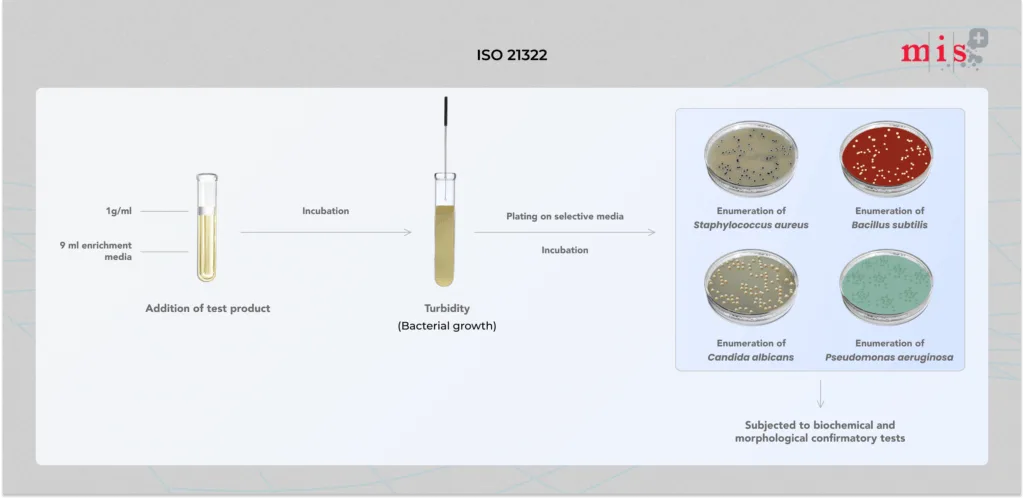
- Sample preparation – 1g of the sample material is taken for testing. If one unit of the sample material weighs less than 1g, either the entire unit or multiple units can be used.
- Immersion – The test samples are immersed in a diluent.
- Microorganism separation – Test samples are subjected to techniques such as stomaching, shaking/stirring, or vortexing to separate microorganisms from the test sample. The frequency and speed of shaking/stirring are recorded.
- Enumeration – The enumeration of aerobic mesophilic microorganisms (including bacteria, yeasts, and molds) is performed using the pour plate technique. The diluent is divided for the separate enumeration of bacteria and yeasts/molds.
Importance of ISO 21322 test
Microbial contamination of cosmetic products occurs during the manufacturing phases due to unhygienic manufacturing, packaging, or storage practices. Thus, standardized microbial testing of impregnated or coated cosmetic products as per ISO 21322 guidelines is an essential part of the quality control and assurance to provide safe and high-quality products to consumers.
Pros of ISO 21322
- Ensures adequate microbiological quality by detecting microorganisms in impregnated or coated products.
- Addresses microbiological sampling and testing challenges in products where the formulation is not directly accessible.
- Increases consumer safety by ensuring products meet stringent microbiological standards.
- Provides a basis for substantiating marketing claims about the microbiological efficacy of products.
- The methods can be adapted for similar products and applicators other than wipes and masks.
Why Choose MIS for ISO 21322 Test for Coated Wipes and Masks
At MIS, we employ state-of-the-art technology and methodologies to offer testing services for a diverse range of cosmetic products. Our cosmetic testing services are strictly adhered to industry standards and regulations. In addition to the ISO 21322 test standard, ISO 21150 and ISO 21149 are other test methods that we perform in our labs.
Our dedicated team of experts works tirelessly to maintain the utmost accuracy in every aspect of our testing processes. To get a quote on ISO 21322 testing, contact our experts here.
Frequently Asked Questions on ISO 21322 Test for Coated Wipes and Masks

DR. Martinoz Scholtz
1. What is the ISO 21322 test?
ISO 21322 is a test method used for determining microbial contamination of pre-moistened or impregnated cosmetic products such as wipes and masks.
2. What products can be tested using this standard?
This standard is an analytical test method that applies to impregnated cosmetic products like wipes and masks. The standard can also be adapted to test other products such as cushions, impregnated sponges, and applicators (brushes, puffs, and more).
3. What is the turnaround time for this test?
This test takes 3-4 weeks to complete.
4. How often should cosmetic products such as wipes or masks be tested according to this standard?
The standard does not provide the exact frequency of testing, but it is advisable to test your product during the initial product development phases and the final product stages.
5. What are the specific microorganisms against which cosmetic wipes are tested?
At Microbe Investigations Switzerland, we perform the test using Staphylococcus aureus (ATCC 6538), Pseudomonas aeruginosa (ATCC 9027), Escherichia coli (ATCC 8739), Candida albicans (ATCC 10231), and Bacillus subtilis (ATCC 6633). Additional strains can be tested at the customer’s request.
6. How does this test address the safety and toxicity of impregnated products?
While this test assesses the microbial contaminations in impregnated cosmetic products, it cannot vouch for the toxicity of the products. Thus, additional tests and international standards must be adopted to assess the toxicity of these products.
7. How does this test impact the marketing claims manufacturers can make about their products?
The standard ensures that the claims made by manufacturers regarding the microbial safety of cosmetic products are indeed true and are scientifically backed by test results. These test results can be used to obtain certifications for their products which provides the manufacturers with credibility during market entry.
8. What steps should manufacturers take to prepare for an ISO 21322 audit?
Manufacturers must adhere to ISO 21322’s microbiological testing methods, conduct risk assessments, maintain accurate records of testing procedures, results, and suitability tests, and prepare documentation to demonstrate adherence to the standard.
9. How can manufacturers use this test to improve their product development processes?
Product developers wishing to ascertain higher levels of quality and safety for their products can use the microbiological testing methods set by this standard. This aids in identifying possible microbial contamination in early development phases, thus allowing them to make necessary changes to their formulations.
10. What are the consequences of non-compliance with the standard for product manufacturers?
Non-compliance with the standard can lead to products failing to meet market standards, increased risk of recalls and consumer complaints, potential legal and financial repercussions, and damage to brand reputation and consumer trust.
11. What are the benefits of ISO 21322 certification for cosmetic wipe manufacturers ?
Benefits of this standard include enhanced credibility, product safety assurance, competitive advantage, and reduced product recall risks and associated costs.
Meet the best of the blend of
R&D, Efficacy Testing,
Innovation and Passionate
Experts at MIS.





Explore More
In the cosmetics industry, safety

Evidently, with the expanding cosmetics

In the competitive world of