Home / Disinfectant Testing / antiviral / EN 16777
- Swiss testing laboratory
BS EN 16777 Virucidal Surface Test for Chemical Disinfectants

Hassle-free testing experience
Need to get a product tested? No worries! To and fro logistics are on us; we collect your products, test them and, deliver them back to you.
Summary
EN 16777 is a Phase 2, Step 2 quantitative carrier test that evaluates the virucidal efficacy of chemical disinfectants on hard, non-porous surfaces in medical environments. The method simulates real-world surface contamination conditions and assesses antiviral performance. Under this test method, a product must achieve a minimum ≥ 4 log reduction in viral titre to pass. EN 16777 is an important standard method to support surface virucidal claims and regulatory compliance for medical disinfectants sold in the European Union.
Related tests for you
Quick understanding of the test
BS EN 16777:2018 - Quantitative non-porous surface test without mechanical action for the evaluation of virucidal activity of chemical disinfectants used in medical area.
EN 16777 is a phase 2 step test used to evaluate virucidal activity of chemical disinfectants used in medical areas on non-porous surfaces without mechanical action.
Application
Applicable to disinfectants used in hospitals, medical centers, dental clinics, nursing homes, and school infirmaries.
- Adenovirus
- Norovirus
- Vaccinia virus
- The viral suspension with interfering substance is applied to discs and is allowed to dry.
- The dried surfaces are treated with disinfectant under specified conditions of temperature and contact time.
- After neutralization, the titre of virus inoculum is determined and reduction in virus titre is compared to the control sample.
- Validates disinfectants for effective viral pathogen reduction, ensuring hygiene and infection control in medical settings.
- Helps manufacturers develop high-quality virucidal products compliant with European standards.
Passing criteria
Do you have a product that needs testing?
What Is EN 16777 Test?
EN 16777 is a phase 2 step 2 European standard used to evaluate the virucidal efficacy of chemical disinfectants on hard, non-porous surfaces. It is applicable specifically to products intended for medical environments, where surface contamination is a major contributing factor in infection transmission. The test verifies whether a disinfectant can inactivate viruses on surfaces under defined, practical conditions and is widely acknowledged for supporting surface virucidal claims in the European markets.
In EN 16777, the disinfectant is applied to a contaminated surface carrier. Phase 2, Step 2 tests are designed to simulate real-world use rather than ideal laboratory conditions. EN 16777 involves the use of a carrier as a test surface. In EN 16777, the disinfectant is applied to a contaminated surface carrier to reflect real usage conditions.
EN 16777 provides a quantitative assessment of disinfectant efficacy, supporting product validation for healthcare environments and ensuring reliable virucidal performance on surfaces.While EN 14476 evaluates virucidal activity in suspension (liquid phase), EN 16777 focuses on surface testing, providing a more realistic assessment of disinfectant effectiveness on non porous surfaces in medical settings.To claim virucidal claims across different use scenarios, a product should meet the efficacy criteria of both EN 14476 (suspension test) and EN 16777 (carrier test)
Spectrum | Viral strains (EN 14476) | Viral strains (16777) |
Virucidal activity against enveloped virus | Vaccinia Virus | Vaccinia Virus |
Limited Spectrum Virucidal activity | Adenovirus, Murine norovirus | Adenovirus, Murine norovirus |
General virucidal activity | Adenovirus, Poliovirus and Murine norovirus | Adenovirus, Murine norovirus |
When is EN 16777 required?
EN 16777 is required when a product makes virucidal claims specifically for surfaces in medical or healthcare environments within the EU. It is commonly expected under the Biocidal Products Regulation (BPR) for surface disinfectants intended for medical use. EN 16777 becomes an important evidence for regulatory acceptance and claim substantiation.
What type of products are tested with EN 16777 test?
The standard covers:
- Ready-to-use or dilutable surface disinfectants
- Products for non-porous medical surfaces
- Disinfectants for medical device surfaces
- Products applied by wiping, spraying, or flooding
- Disinfectants used in healthcare and clinical environments
Test Conditions and Interfering Substances
Parameter | Virucidal Activity | Limited Spectrum Virucidal Activity | Virucidal Activity Against Enveloped Viruses |
Mandatory test microorganisms | Adenovirus and murine norovirus | Adenovirus and murine norovirus | Vaccinia virus |
Test temperature | Between 18°C and 25°C | ||
Additional temperature | Between 4°C and 30°C | ||
Contact time | According to the manufacturer’s recommendation, but no longer than 5 min or 60 min | ||
Interfering substance | Clean: 0.3 g/L BSA Dirty: 3.0 g/L BSA + 3.0 ml/L erythrocytes | ||
Log reduction | ≥ 4 log reduction | ||
EN 16777 Test Method Overview
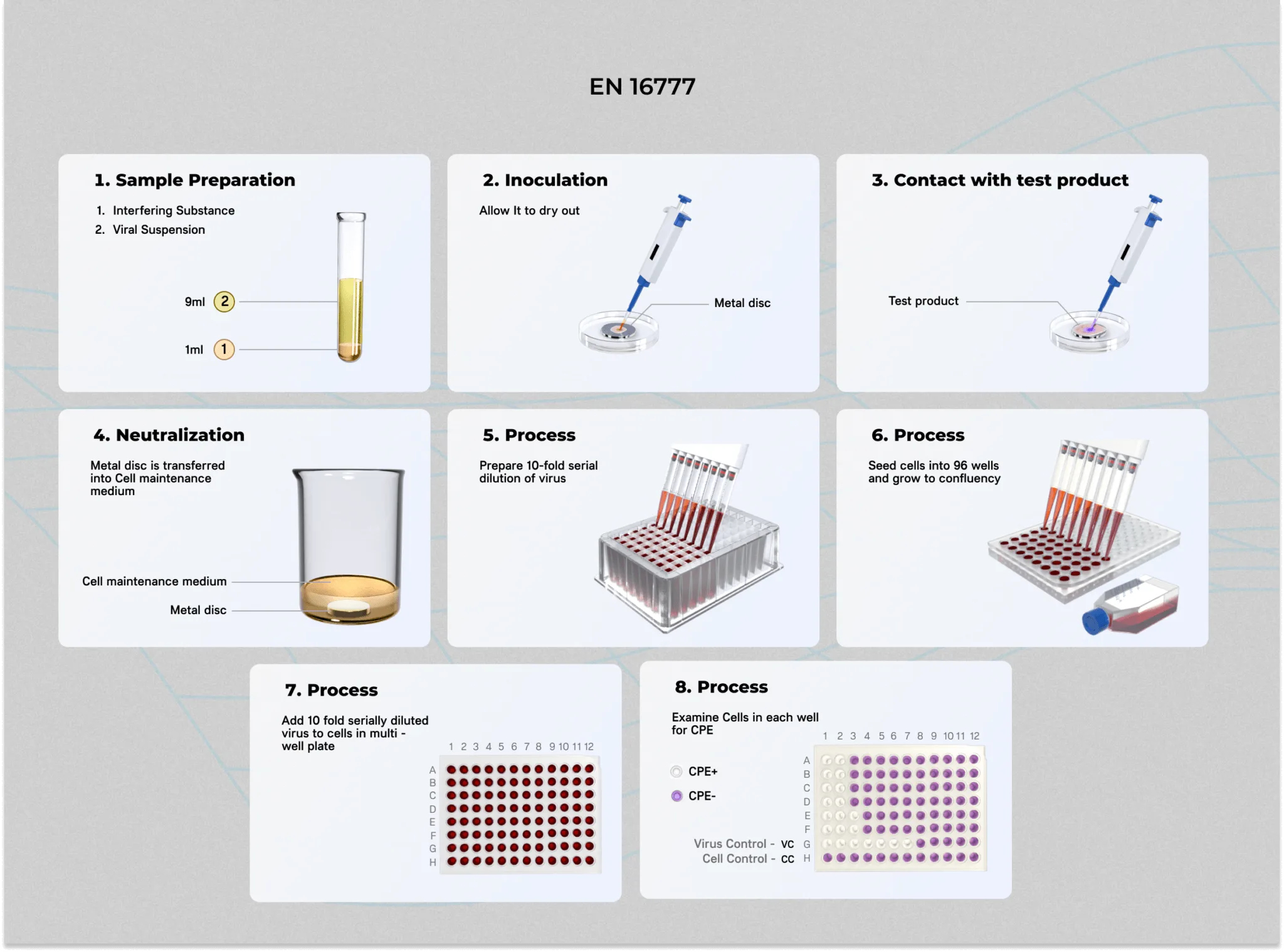
- Virus suspension is mixed with interfering substances (for both dry and clean conditions) and spread over the stainless-steel disc (test surface). Then, surface is allowed to dry out.
- In the next step, disinfectant is applied on the dried inoculated test surface and kept under specific temperature and contact period times.
- At the end of the contact period, treated test surfaces are transferred into the cell maintenance medium to neutralize the reaction.
- Infectious titre of virus recovered from test surface is determined and results are compared with infectious titre of virus from control sample (discs treated with hard water).
- According to EN 16777 standard, a sample product to exhibit virucidal activity or limited spectrum virucidal activity must possess 4 log reduction in virus titre.
Passing Criteria and Log Reduction Requirements for EN 16777
Under EN 16777, a product is considered virucidal on surfaces when it demonstrates a minimum reduction of ≥ 4 log (99.99%) in viral titre under the specified test conditions.
Why EN 16777 Is Critical for Medical Disinfectants
In hospital environments, chemical disinfectants play a pivotal role to reduce the risk of infections by eliminating or reducing pathogenic microbes.
Based on epidemiological studies, contaminated hospital surfaces are one of the major risk factors leading to cross-contamination and nosocomial infections.
The European Standard (EN 16777) is established to check whether virucidal agents used in chemical disinfectants are capable of destroying or inactivating viral pathogens. In addition, this test helps manufacturers to develop high-quality virucidal products that ensure proper hygiene and infection prevention.
EN 16777 vs Other Standards
Category | EN 16777 | EN 14476 |
Purpose | Antiviral | Antiviral |
Test Phase | Phase 2 step 2 (Carrier test) | Phase 2 step 1 Suspension test |
Mandatory test organisms | Adenovirus and Murine Norovirus for general virucidal claims, Vaccinia virus for enveloped virus claims | Enveloped & non-enveloped viruses such as Poliovirus, Adenovirus, Murine Norovirus, Vaccinia virus |
Scope of products | Disinfectants intended for non-porous surface disinfection in medical areas without mechanical action | Disinfectants, antiseptics, hand hygiene products, and textile disinfectants for medical/healthcare applications |
Passing criteria (Log reduction) | ≥ 4 log reduction | ≥ 4 log reduction |
Why Choose Our Lab for EN 16777 Testing
At MIS, we evaluate the virucidal efficacy of chemical disinfectants using both suspension (EN 14476) and carrier (EN 16777) test methods. Our team of experts ensures that testing and analysis are tailored to the specific requirements of each product, delivering accurate and reliable results for our clients.
Partner with MIS to validate your disinfectant formulations, ensure compliance, and generate reliable evidence to support your claims.
Request EN 16777 Testing
Looking for antiviral efficacy testing for medical disinfectants in accordance with EN 16777? Contact us today
Frequently Asked Questions

DR. Martinoz Scholtz
EN 16777 is not mandatory, but it is an important standard to support virucidal disinfectant claims on hard, non-porous surfaces in medical and healthcare settings under the EU Biocidal Products Regulation (BPR).
Yes. EN 16777 results are used to justify surface virucidal claims on product labels and technical documentation in the EU.
Limited spectrum virucidal activity requires efficacy against adenovirus and murine norovirus, while full virucidal activity also requires additional EN 14476 testing, including poliovirus.
No. EN 14476 is a suspension test (Phase 2, Step 1), while EN 16777 is a surface carrier test (Phase 2, Step 2). Both are often required, depending on the intended claims.
EN 16777 test takes 4-5 weeks to complete.
Meet the best of the blend of
R&D, Efficacy Testing,
Innovation and Passionate
Experts at MIS.





Explore More
Key takeaways EN 1276 is
The re-emergence of monkeypox, a
The global threat from viral
The health threats posed by