Home / Cosmetic Testing / Detection / ISO 18415
- Swiss testing laboratory
ISO 18415 Cosmetic Microbiology Testing for Microbial Detection

Hassle-free testing experience
Need to get a product tested? No worries! To and fro logistics are on us; we collect your products, test them and, deliver them back to you.
Summary
ISO 18415 is an international standard used to detect specified and non-specified microorganisms in cosmetic products. It uses an enrichment and culture-based method to identify pathogens. It is widely applied to cosmetic formulations to validate microbiological quality, reduce contamination risks and support regulatory requirements.
Related tests for you
Quick understanding of the test
ISO 18415: 2017 - Detection of specified and non-specified microorganisms in cosmetic products
Mandatory test strains
- Pseudomonas aeruginosa (ATCC 15442)
- Escherichia coli (ATCC 8739)
- Staphylococcus aureus (ATCC 6538P)
- Candida albicans (MTCC 3017)
The test involves diluting cosmetic samples in enrichment broth, followed by incubation to detect microbial growth.
After incubation, an aliquot of the incubated enrichment broth is streaked onto non-selective agar and incubated.
Any present microorganisms are identified using specialized identification kits.
- Validates microbiological safety of products.
- Help manufacturers to meet regulatory safety standards for cosmetic products.
Turnaround Time
Passing criteria
Do you have a product that needs testing?
What is ISO 18415?
ISO 18415 standard describes a test method to identify the presence of any specified microorganisms and anaerobic mesophilic non-specified microorganisms in cosmetic products.
It involves the detection of microbial growth in a non-selective liquid medium (enrichment broth) suitable for detecting microbial contamination. This is further followed by the isolation of microorganisms on non-selective agar media.
Scope of ISO 18415 standard
This test is applicable to a wide range of cosmetic formulations, except those classified as low microbiological risk according to ISO 29621 (e.g., products with low water activity, hydro-alcoholic bases, or extreme pH values). Additionally, it may not be suitable for certain water-immiscible formulations.
Microorganisms detected in ISO 18415
This standard outlines guidelines for the microbiological risk analysis specifically for Pseudomonas aeruginosa, Escherichia coli, Staphylococcus aureus, and Candida albicans.
ISO 18415 Test Method
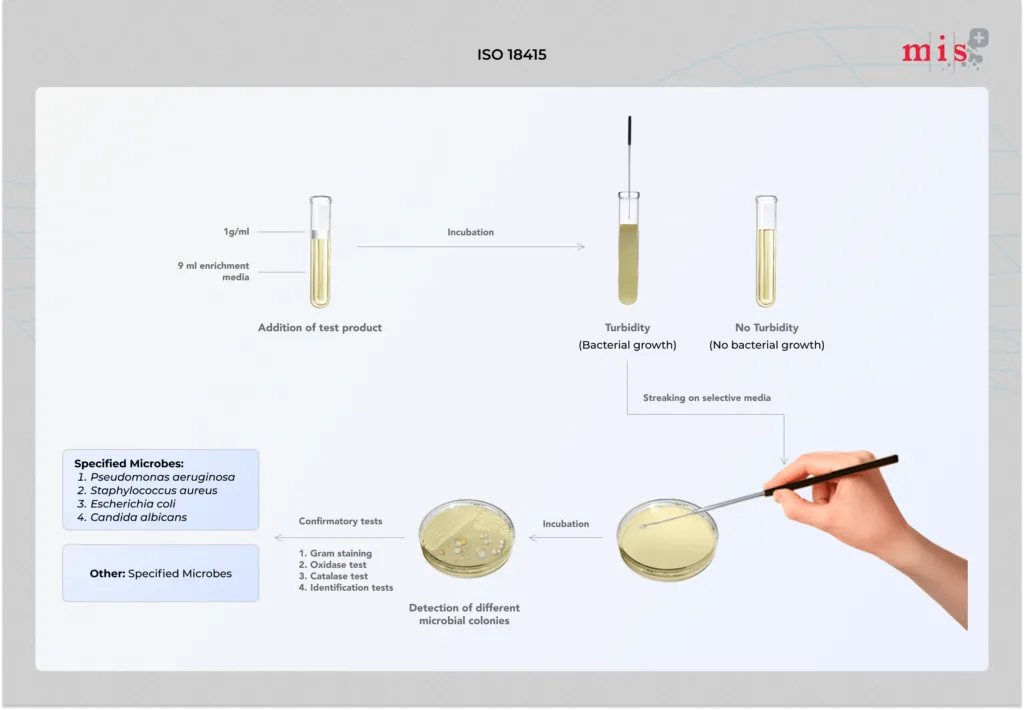
1. Sample dilution
- To perform the test, cosmetic product samples are diluted in enrichment broth to prepare the initial suspension.
- Water-miscible products – 1 ml of product sample is diluted in 9 ml of enrichment broth.
- Water-immiscible products – The product sample is mixed with a dispersing agent (e.g., polysorbate 80) and then added to the enrichment broth.
- Filterable products – The product sample is transferred onto the membrane in a filtration apparatus. After filtration, the membrane is washed using water or diluent. This membrane is transferred into enrichment broth to make an initial suspension.
- Incubation
- This initial suspension is incubated at 32.5 °C for at least 20 h.
- Plating
- After incubation, an aliquot of the incubated enrichment broth is streaked onto the surface of a non-selective agar medium in Petri dishes.
- Petri dishes are inverted and incubated at 32.5 °C for 48 h to 72 h.
- Microbial identification
- Specific tests, such as Gram staining and enzymatic assays, are employed for identification.
Understanding ISO 18415 results
ISO 18415 uses visual growth assessment for passing criteria. To pass ISO 18415, the product must show no detectable growth of specified microorganisms.
ISO 18415 vs ISO 18416 vs USP 62
Parameter | ISO 18415 | ISO 18416 | USP <62> | ||
Purpose |
| Detection of Candida albicans | Detection of specified microorganisms in non sterile products | ||
Organisms identified | Staphylococcus aureus, Escherichia coli, Pseudomonas aeruginosa, Candida albicans | Candida albicans | Specific pathogens such as Staphylococcus aureus, Escherichia coli, Pseudomonas aeruginosa, Salmonella spp., bile-tolerant Gram-negative bacteria, Candida albicans. | ||
Scope of products | Cosmetic formulations (Except for cosmetics classified as low risk) | Cosmetics, especially those prone to yeast contamination | Non-sterile products pharmaceuticals (oral solids/liquids, creams, ointments), cosmetics and personal care products | ||
Result | Qualitative (presence/absence) | Qualitative (Presence/absence of Candida albicans) | Qualitative (Presence/absence) |
Why products fail ISO 18415?
Products fail ISO 18415 due to several issues, including:
- Poor manufacturing hygiene
Contamination can occur during production through unclean equipment, improper handling, or inadequate environmental controls. - Ineffective preservative system
If the preservative system is not properly formulated or compatible with the product, it can cause contamination. Over time, this allows surviving microorganisms to persist and become detectable during testing. - Contaminated raw materials
Raw ingredients, especially water and natural extracts, can carry inherent microbial load. If not properly treated or controlled, these microorganisms can survive processing and be detected during enrichment. - Inadequate packaging protection
Packaging that does not provide sufficient barrier protection can allow microbial ingress during storage or consumer use.
Regulatory relevance of ISO 18415
ISO 18415 supports global cosmetic safety and quality frameworks by aligning with established ISO testing standards. It serves as a reliable method for demonstrating compliance throughout product development and manufacturing. Widely applied in quality assurance, it enables early detection of microbial risks, helping reduce product recalls and ensure consistent consumer safety across different markets.
When should you choose ISO 18415?
Choose ISO 18415 test if your cosmetic product:
- Needs microbial contamination screening
- Requires microbiological safety validation before launch
- Is undergoing stability or QC testing
Importance of ISO 18415 Test
Microbially contaminated cosmetic products can cause skin allergies, irritations, and other significant health concerns to the end users. Therefore, manufacturers/ companies need to ensure their products meet the necessary microbiological safety requirements.
ISO 18415 standard stipulates the test requirements and procedures to identify potential microbial contaminants in cosmetic products. This method plays a vital role in validating the safety of cosmetic products for the well-being of customers.
Why choose MIS
Need assistance with ISO -18415 testing of your cosmetic products! MIS experts are here to help you.
We offer a comprehensive range of customizable solutions for microbiological testing of cosmetic and personal care products. Our testing services encompasses the screening of products at various stages of development including ingredients, semi-manufactured and final products.
Additionally, we also test antimicrobial efficacy of preservatives used in cosmetic products.
In our state-of-the-art testing facilities, we are dedicated to deliver test results of the highest quality and accuracy.
Additionally, we offer a range of other cosmetic testing methods, including USP 61, ISO 21149, ISO 21322, and more
To get a quote on ISO 18416 testing or any other queries related to our cosmetic testing services, reach out to our experts here.
Frequently Asked Questions

DR. Martinoz Scholtz
ISO 18415 is a standard test method for the identification of both specified and non-specified microbial contaminants in cosmetic products. The objective of the test is to ensure that cosmetic products are safe for consumer use.
ISO 18415 test method is applicable to both water-miscible and water-immiscible cosmetic products.
ISO 18415 test takes 1 week to complete.
At Microbe Investigations, we test for ISO 18415 using the following microbial strains:
Pseudomonas aeruginosa (ATCC 15442), Escherichia coli (ATCC 8739), Staphylococcus aureus (ATCC 6538P) and Candida albicans (MTCC 3017).
ISO 18515 is a critical standard to assess microbiological safety of cosmetics and meet the regulatory standards for cosmetic products. In addition, detecting objectionable microbes helps identify hygienic failures in the manufacturing process, preventing contamination risks.
It is widely required by cosmetic manufacturers, quality control laboratories, and regulatory agencies to ensure that products meet microbiological safety standards before market release.
No, it is specifically designed for cosmetic products.
The frequency of testing for compliance with ISO 18415 depends on several factors, including the type of cosmetic formulation, manufacturing process, and specific regulatory requirements in specific regions.
It is a standard test method for the identification of both specified and non-specified microbial contaminants in cosmetic products. The objective of the test is to ensure that cosmetic products are safe for consumer use.
ISO 18415 tests for Pseudomonas aeruginosa, Escherichia coli, Staphylococcus aureus, and Candida albicans. Additional strains can be used upon manufacturer’s requirement.
ISO 18415 is specific to cosmetics and focuses mainly on detecting yeast and mold (especially Candida albicans) as part of overall microbial quality assessment. In contrast, USP <62> is broader and applies to non-sterile pharmaceuticals and some personal care products, targeting a wider range of specified pathogens like Staphylococcus aureus, E.coli, Pseudomonas aeruginosa, and Salmonella spp.
ISO 18415 is not mandatory but is widely accepted as a recognized standard for demonstrating microbiological quality and safety in cosmetics.
ISO 18415 is suitable for many cosmetic products, but it may not be fully applicable to all formulations, especially complex or water-immiscible products. In such cases, the method can be adapted or replaced with alternative validated methods.
A failure indicates the presence of unacceptable levels of microbial contamination. This can be due to several factors, so it requires investigation, problem identification, reformulation and retesting if necessary.
Yes, ISO 18415 testing can be customized based on product type and specific client requirements. At MIS, we offer bespoke testing services, tailoring study design to match your product needs.
Meet the best of the blend of
R&D, Efficacy Testing,
Innovation and Passionate
Experts at MIS.





Explore More
In the cosmetics industry, safety

Evidently, with the expanding cosmetics
In the competitive world of