Home / Cosmetic Testing / Enumeration / ISO 16212
- Swiss testing laboratory
ISO 16212:2017 Enumeration of Yeast and Mold in Cosmetics

Hassle-free testing experience
Need to get a product tested? No worries! To and fro logistics are on us; we collect your products, test them and, deliver them back to you.
Summary
ISO 16212:2017 is a standard test method used to determine the total yeast and mold count in cosmetic products. The test used plate count and membrane filtration methods to quantify fungal contamination (reported as Colony Forming Units (CFU)) after aerobic incubation. This test method is widely used to evaluate the microbiological quality to ensure the safety of cosmetic products.
Related tests for you
Quick understanding of the test
ISO 16212:2017 - Enumeration of yeast and mold in cosmetic samples
Application
Applicable to cosmetic products like creams, emulsions and more.
- Plate Count Method:
- The product sample is diluted in enrichment broth.
- The diluted test product is inoculated onto a specified agar medium and incubated.
- After incubation, the CFU is counted to quantify yeast and mold.
- Membrane Filtration:
- The product sample is filtered using a suitable membrane filter.
- The filter membrane is transferred onto a specified agar medium and incubated.
- After incubation, the colony-forming units are assessed for contamination levels.
- Detects fungal contamination in products and quantifies the level of contamination.
- Ensures products meet stringent microbiological safety standards.
Turnaround Time
Do you have a product that needs testing?
What is ISO 16212 Testing?
ISO 16212 is an international standard for enumerating viable yeast and mold in cosmetics. The test procedure starts with dilution and neutralization of the samples, followed by the plate count or membrane filtration technique, incubation, and the counting of viable microorganisms. This test method is widely used to determine the microbiological quality of cosmetic products and is an important screening method in ensuring the safety and microbiological quality of cosmetic products.
Scope of ISO 16212:2017 Standard
ISO 16212 is not applicable to every cosmetic. It follows a risk-based approach.
When testing is required:
- A risk assessment should determine whether yeast and mold testing is necessary.
- Water-based or moisture-containing products typically require testing
- While low-risk products such as those with very low water activity, extreme pH, high alcohol content, or fully anhydrous formulations (as referenced in ISO 29621) may not need full enumeration if the low-risk status is scientifically justified.
Microorganisms Detected Under ISO 16212
- Yeasts
- Molds
ISO 16212 Test Procedure
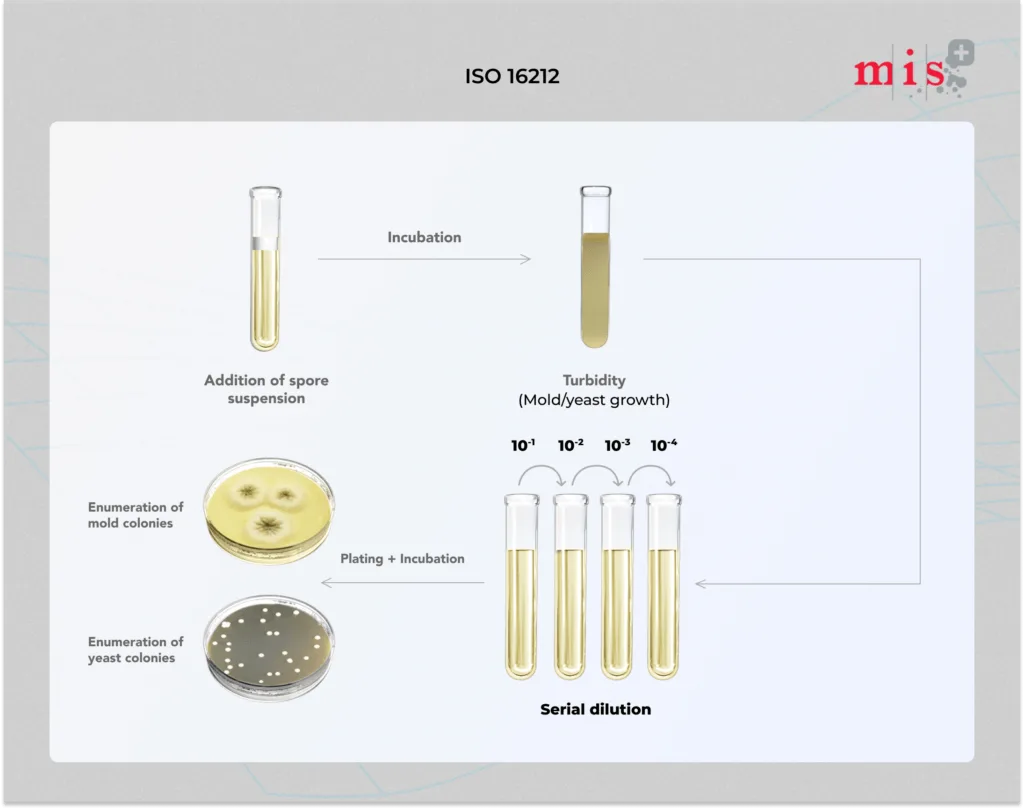
ISO 16212 offers two enumeration methods –
- Plate count method
- Membrane filtration method
Both require neutralization of antifungal preservatives before enumeration.
Sample Preparation & Neutralization
- At least 1 g or 1 mL of product is tested
- Initial suspension is prepared using suitable diluent
- Neutralizers is done if product has antifungal preservatives
It is important to ensure that each product sample is neutralized and checked for its antifungal activity. The antifungal/fungicidal activity of product samples can significantly impact the results of microbial risk assessment.
Plate count method
- Initial suspension of the test product is prepared by diluting 1 g or 1 ml test product into an enrichment broth.
- Initial suspension or dilution of the test product is inoculated on a specified agar medium.
- Inoculated petri plates are subjected to aerobic incubation at 25 °C ± 2.5 °C for 3-5 days.
- After incubation, colony-forming units (CFU) are used as a measure to determine the number of yeast and mold in the product sample.
Membrane filtration
- This method involves a suitable amount of product sample to be passed through a membrane filter using a filtration apparatus.
- After filtration, the membrane filter is transferred onto the surface of the specified agar medium and incubated at 25 °C ± 2.5 °C for 3 – 5 days.
Understanding Yeast and Mold Count Results
Results are expressed as CFU per gram (CFU/g) or CFU per milliliter (CFU/mL).
Interpretation depends on various factors including product category, regional regulatory limits and intended use.
Why products fail ISO 16212 ?
ISO 16212 test failure could be the results of –
- Inadequate preservation
- Raw material contamination
- Manufacturing hygiene issues
ISO 16212 vs Other Standards
Parameter | ISO 16212 – Yeast & Mould | USP <61> Microbial Enumeration | ISO 21149 – Aerobic Mesophilic Bacteria |
Purpose | Quantitative evaluation of yeasts and moulds in cosmetic products. | Quantitative microbial enumeration of non‑sterile products : Total Aerobic Microbial Count (TAMC) and Total Yeast & Mold Count (TYMC). | Quantitative assessment of aerobic mesophilic bacteria. |
Identified microorganisms | Yeasts and moulds | Aerobic bacteria + yeasts and moulds (counts reported separately) | Aerobic mesophilic bacteria. |
Method types | Plate count and membrane filtration for yeast/mould | Plate count (pour/spread), membrane filtration, and MPN methods; includes method suitability/neutralization | Plate counts (agar), membrane filtration, enrichment for presence/absence |
Result interpretation | CFU per gram or millilitre | CFU per gram or millilitre for TAMC and TYMC | CFU per gram or millilitre or presence/absence |
Scope of products | Cosmetic formulations prone to yeast/mould contamination (creams, emulsions) | Non‑sterile products including cosmetics, personal care, pharma | Cosmetic products where bacterial contamination is a concern |
Use case | Cosmetic safety testing for fungal contamination | Broader quality control (manufacturing release, regulatory compliance) | Cosmetic microbiological quality & compliance (bacterial contamination) |
Importance of ISO 16212 Test
High levels of contamination of yeast and mold in cosmetic samples is concerning as it can lead to skin irritations and other serious health issues. Hence, assessing microbiological quality of cosmetic products is a pivotal practice to prevent microbial contamination and ensure safe product development for end users.
To address this concern, ISO 16212 standard outlines a quantitative test method to determine the presence of any yeast or mold contamination within the given cosmetic product. ISO 16212 testing helps to ensure that tested cosmetic samples meet the highest standards of safety.
Why Choose Our Lab for ISO 16212 Testing
At Microbe Investigations Switzerland (MIS), we specialize in ISO 16212:2017 testing to accurately determine the total aerobic microbial count in cosmetic products. With experienced microbiologists and ISO-aligned workflows, MIS helps cosmetic manufacturers demonstrate microbiological quality, support safety assessments, and meet regulatory expectations.
Request ISO 16212 Testing
Contact us today to discuss testing requirements for ISO 16212 testing and ensure your products meet regulatory standards.
Frequently Asked Questions

DR. Martinoz Scholtz
ISO 16212:2017 is an international standard that is used to enumerate aerobic mesophilic microorganisms (total viable count) in cosmetic products.
Samples are diluted, plated or filtered onto the specified medium, incubated typically at ~25 °C for 3–5 days, and colonies are counted as CFU to quantify total yeast and mold contamination.
After performing the procedure, the resulting colonies of yeast and mold are counted and reported as CFU/g or CFU/mL.
ISO 16212 is specific to cosmetics and focuses on the quantitative enumeration of yeasts and moulds, using plate count or membrane filtration. In contrast, USP <61> is a pharmacopeial method for non-sterile products including pharmaceuticals and cosmetics. USP <61> is used to detect both Total Aerobic Microbial Count (TAMC) and Total Yeast Microbial Count (TYMC).
ISO 16212 testing typically takes 4-5 weeks to complete.
ISO 16212 does not specify any defined acceptance limits for yeast and mold count.
Yes. Neutralization is required whenever cosmetic products contain preservatives or antimicrobial substances to prevent inhibition of microbial recovery.
Yes. ISO 16212 can be performed using membrane filtration technique.
While ISO 16212 is not legally mandatory, it is widely recognized and accepted by regulatory authorities of EU, UK, and many international markets.
Meet the best of the blend of
R&D, Efficacy Testing,
Innovation and Passionate
Experts at MIS.





Explore More

In the cosmetics industry, safety

Evidently, with the expanding cosmetics
In the competitive world of