Home / Disinfectant Testing / antibacterial / EN 1276 Test
- Swiss testing laboratory
EN 1276 Bactericidal Efficacy Testing

Hassle-free testing experience
Need to get a product tested? No worries! To and fro logistics are on us; we collect your products, test them and, deliver them back to you.
Summary
EN 1276 is a phase 2 step 1 suspension test that specifies the criteria for the assessment of the bactericidal activity of chemical disinfectants and antiseptics. This antibacterial disinfectant test assures that all products used within the food, industrial, domestic, or institutional environment are effective in reducing bacterial counts or completely eliminating them. The standard is an essential tool for manufacturers to validate the efficacy of their products and ensure compliance with industry regulations.
Related tests for you
Quick understanding about test
BS EN 1276: 2019 - Quantitative Suspension Test for the Evaluation of Bactericidal Activity of Chemical Disinfectant
EN 1276 is a phase 2, step 1 suspension test for assessing the bactericidal activity of chemical disinfectants and antiseptics.
This antibacterial disinfectant test applies to various disinfectant products, including surface disinfectants, hand sanitizers, food industry disinfectants, household cleaners, and industrial cleaning agents.
- Enterococcus hirae
- Escherichia coli
- Pseudomonas aeruginosa
- Staphylococcus aureus
- E. faecium
Additional organisms may be included for R&D or internal validation purposes.
- The test bacterial suspension is mixed with the disinfectant and incubated for the recommended contact time. The mixture is neutralized, plated on agar, and incubated for 20–24 hours. The CFU reduction is calculated to evaluate efficacy.
- Helps meet national and international regulatory standards.
- Provides scientifically backed proof of product efficacy.
The test typically takes 1-2 weeks to complete.
- ≥ 5-log reduction for general purpose disinfection.
- ≥ 5-log reduction for handrubs.
- ≥ 3-log reduction for handwashes.
Do you have a product that needs testing?
What is EN 1276?
EN 1276 is a phase 2 step 1 suspension test that specifies the criteria for the assessment of the bactericidal activity of chemical disinfectants and antiseptics. This antibacterial disinfectant test assures that all products used within the food, industrial, domestic, or institutional environment are effective in reducing bacterial counts or completely eliminating them. The standard is an essential tool for manufacturers to validate the efficacy of their products and ensure compliance with industry regulations.
Which products can be tested under EN 1276?
Surface disinfectants used in food, industrial, domestic, and institutional areas
What EN 1276 does not cover ?
- Disinfectants used for medical or clinical purposes
- Products meant to be applied on the body or living tissues
An exception ?
- Hand hygiene products can be tested only when they are not medical hand rubs and are used in non-medical settings (for example, food handling areas)
EN 1276 test conditions and requirements
| Test conditions | General purpose disinfection | Hand hygiene |
| Mandatory test microorganisms | • Enterococcus hirae • Escherichia coli • Pseudomonas aeruginosa • Staphylococcus aureus • E. faecium (for temp ≥ 40 °C) | • Enterococcus hirae • Escherichia coli K12 (NCTC 10538) • Pseudomonas aeruginosa • Staphylococcus aureus |
| Test temperature | 4 °C – 40 °C | 20 °C |
| Contact time | From 1 min to 60 min (1–5 min at intervals of 1 min; 5–60 min at intervals of 5 min) | 30 s or 60 s |
| Interfering substance | Clean condition: 0.3 g/L Bovine Serum Albumin Dirty condition: 3 g/L Bovine Serum Albumin | Clean condition: 0.3 g/L Bovine Serum Albumin Dirty condition: 3 g/L Bovine Serum Albumin |
| Log reduction | ≥ 5 log | ≥ 5 log for handrubs ≥ 3 log for handwashes |
EN 1276 Test Method (Quantitative Suspension Test)
This test procedure consisted of the following steps:
- The test bacterial suspension containing an interfering substance is mixed with the product sample.
- The suspension is incubated at a set temperature for a contact time as recommended by the manufacturer.
- Aliquots of the sample are taken at the end of the contact time and are immediately neutralized by a neutralizing solution to inhibit its bactericidal activity.
- After 5 minutes of neutralization, 1 ml of the test mixture is plated on Tryptone Soya Agar.
- Plates are incubated for 20 – 24 hrs and the reduction in CFU (colony forming units) is calculated.
Log reduction requirements
To meet the EN 1276 bactericidal efficacy requirement, a disinfectant must demonstrate a minimum of a ≥ 5 log reduction
Procedure for EN 1276 test method
To meet the EN 1276 bactericidal efficacy requirement, a disinfectant must demonstrate a minimum of a ≥ 5 log reduction
EN 1276 vs Other Standards:
| Category | EN 1276 | EN 13697 | EN 14476 |
| Claims | Antibacterial | Antibacterial, Antifungal / Yeasticidal | Antiviral |
| Mandatory test organisms | Pseudomonas aeruginosa, Escherichia coli, Staphylococcus aureus, Enterococcus hirae | Bacteria: Staphylococcus aureus, Escherichia coli, Pseudomonas aeruginosa, Enterococcus hirae Fungi/Yeast: Candida albicans, Aspergillus brasiliensis |
Non-enveloped: Poliovirus type 1, Adenovirus type 5, Murine Norovirus Enveloped: Vaccinia virus |
| Scope | Disinfectants and antiseptics intended for food, industrial, domestic and institutional areas | Disinfectants and antiseptics intended for food, industrial, domestic and institutional areas | Disinfectants and antiseptics for medical and healthcare applications |
| Passing criteria (Log reduction) | ≥ 5 log reduction | ≥ 4 log for bactericidal activity; ≥ 3 log for fungicidal/yeasticidal activity |
≥ 4 log reduction |
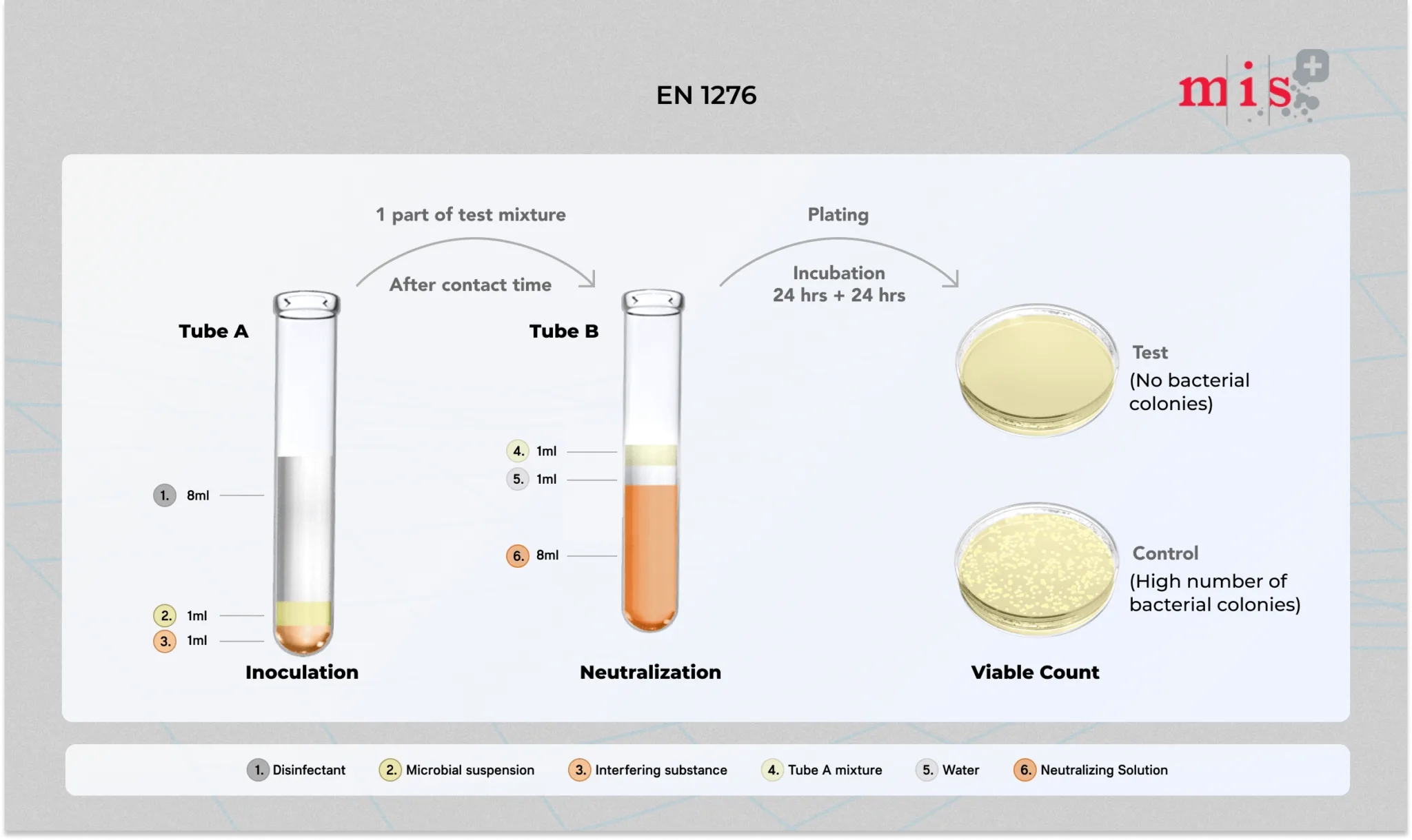
This test procedure consists of the following steps:
- The test bacterial suspension containing an interfering substance is mixed with the product sample.
- The suspension is incubated at a set temperature for a contact time as recommended by the manufacturer.
- Aliquots of the sample are taken at the end of the contact time and are immediately neutralized by a neutralizing solution to inhibit its bactericidal activity.
- After 5 minutes of neutralization, 1 ml of the test mixture is plated on Tryptone Soya Agar.
- Plates are incubated for 20 – 24 hrs and the reduction in CFU (colony forming units) is calculated.
Importance of EN 1276 standard
Antibacterial disinfectant tests are of paramount importance to both public safety and product reliability. Testing disinfectants using this standard guarantees consumers that these products can significantly reduce harmful bacteria and prevent the spread of infections in homes, workplaces, and public spaces. The standard thus ensures that the products work as claimed and give the user confidence in their safety and efficacy.
How MIS can help you with disinfectant efficacy testing services ?
At Microbe Investigations Switzerland (MIS), we understand the importance of reliable and effective disinfection. Our disinfectant testing laboratory is designed to help manufacturers validate the bactericidal activity of their products, ensuring compliance and building consumer trust.
With state-of-the-art facilities and experienced staff, we offer comprehensive disinfectant efficacy testing services that adhere to the highest industry standards. Contact us today to learn more about how we can assist you with your testing needs.
Request EN 1276 Testing
Need to validate the bactericidal efficacy of your disinfectant as per EN 1276? Contact us today to schedule testing and obtain reliable, standards-compliant results.
Frequently Asked Questions

DR. Martinoz Scholtz
The test method typically needs 1-2 weeks to complete.
At MIS, we perform this test using Pseudomonas aeruginosa, Escherichia coli, Staphylococcus aureus, Klebsiella pneumoniae, Enterococcus hirae, Enterococcus faecium, Salmonella typhimurium, Lactobacillus brevis, Enterobacter cloacae. Additional strains can be added on request.
The antibacterial disinfectant test helps ensure that disinfectant products used in food processing and preparation units are effective at controlling bacteria growth that might cause foodborne infections.
Yes, alcohol-based hand sanitizers can be tested using this standard.
Products should be retested periodically when there are changes in the formulation or production processes or if there are new regulatory requirements.
EN 1276 is region-specific and often mandatory for European market claims, while ISO standards are globally recognized and used when products are intended for multiple international markets. The choice depends on where the product will be sold and which regulatory framework applies.
Yes. A product that meets EN 1276 requirements demonstrates a minimum 5-log (99.999%) reduction in viable bacteria under specified test conditions. Such claims must reflect the tested concentration, contact time, and conditions.
EN 1276 is not applicable to support claims for hospital or medical-area disinfectants. Hospital disinfectants can be accessed using standards like EN 13727 , EN 14561 and others..
If a product fails EN 1276, it cannot claim bactericidal efficacy under this standard. Reformulation, concentration adjustment, or retesting may be required before making regulatory or marketing claims.
Meet the best of the blend of
R&D, Efficacy Testing,
Innovation and Passionate
Experts at MIS.





Explore More
Key Takeaways ISO 18184 evaluates

Key takeaways ISO 20743 and

Microscopic spores of fungi and

Introduction The Japanese Industrial Standards