Home / Disinfectant Testing / antibacterial / EN 1040
- Swiss testing laboratory
EN 1040 Bactericidal Efficacy Test for Disinfectants

Hassle-free testing experience
Need to get a product tested? No worries! To and fro logistics are on us; we collect your products, test them and, deliver them back to you.
Summary
EN 1040 is a Phase 1 quantitative suspension test used to evaluate the basic bactericidal activity of disinfectants and antiseptics. As per EN 1040, the product needs to achieve a minimum 5 log reduction against target bacteria under controlled laboratory conditions. It is an initial screening test and is not used to support product claims.
Related tests for you
Quick understanding of the test
BS EN 1040: 2006 - Quantitative suspension test for the evaluation of basic bactericidal activity of chemical disinfectants and antiseptics
EN 1040 is a phase 1 suspension test that evaluates the basic bactericidal activity of chemical disinfectants and antiseptics under standardized conditions.
Application
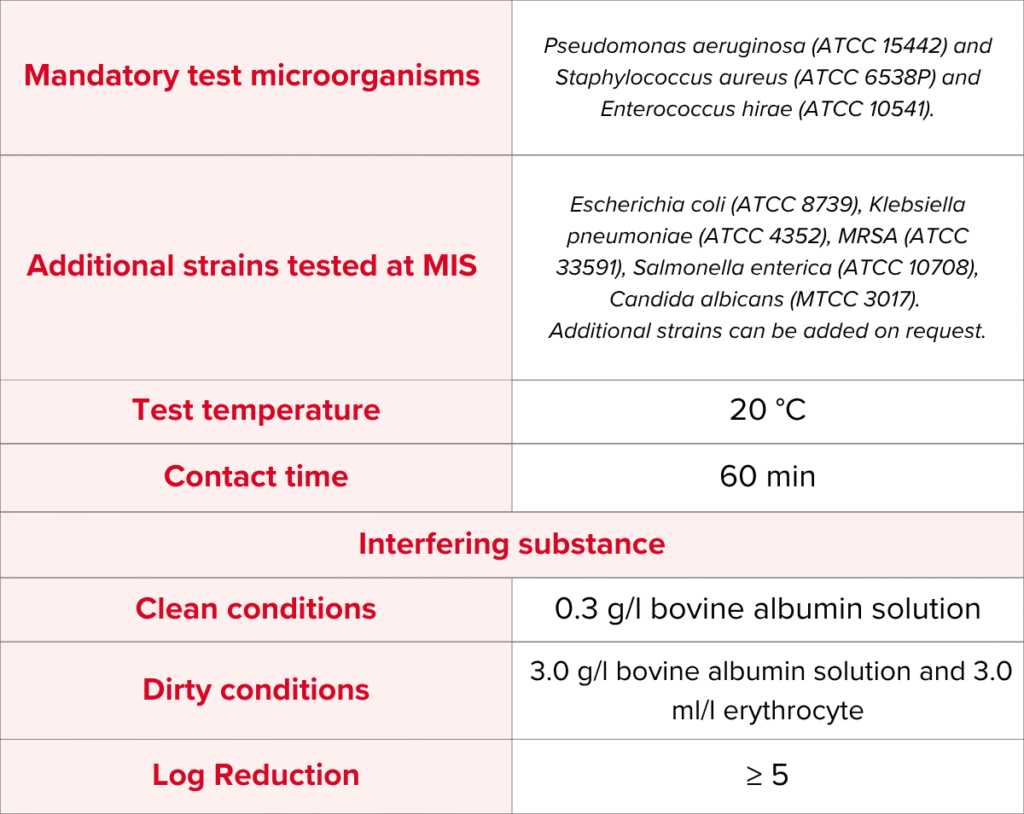
- Pseudomonas aeruginosa (ATCC 15442)
- Staphylococcus aureus (ATCC 6538P)
- The test product is exposed to mandatory test microorganisms for specific contact times, followed by neutralization and plating to enumerate remaining viable bacteria.
- The bactericidal effect is determined by comparing the test product’s performance to a control.
Benefits
- Provides a reliable and standardized method for evaluating basic bactericidal activity.
- Ensures compliance with European regulatory requirements for disinfectant efficacy.
Turnaround Time
Passing criteria
Do you have a product that needs testing?
What is EN 1040?
EN 1040 is a European standard designed to assess the basic bactericidal activity of disinfectants and antiseptics.
EN 1040 is a Phase 1 test that evaluates the bactericidal efficacy of disinfectants under ideal laboratory conditions, without simulating real-use scenarios. Hence, this test can not be used for product claims.
Scope of the products for testing
EN 1040 is applicable for active substances used in antibacterial biocidal products and formulations under development, intended for use in areas like
- food,
- industrial,
- domestic,
- institutional,
- medical, and
- veterinary settings.
EN 1040 Test conditions and test requirements
EN 1040 Test Procedure (Step-by-Step)
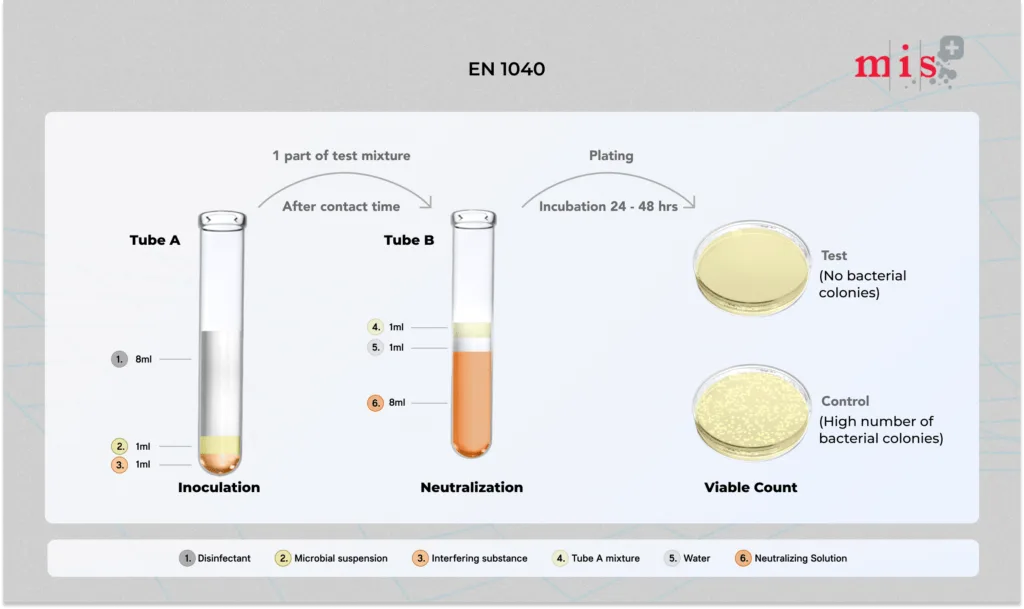
1. Sample Preparation
A sample of the product, usually at 80% concentration or diluted with water, is prepared for testing.
2. Preparation of Bacterial Suspension
A standardized bacterial suspension is prepared for testing.
3. Exposure and contact time
The test product is challenged with the test organism for a specific contact time. In parallel, a control test is performed wherein the test product is added to water.
4. Neutralization & Recovery
Immediately after contact period, an aliquot of the mixture (from both test and control) is transferred to a neutralizing solution to suppress the bactericidal activity.
5. Incubation & Colony Counting
Neutralizing extract is incubated for 2 days to enumerate remaining viable bacteria by using plate count method. The bactericidal effect of the test sample is observed and compared to the control test.
Understanding Log Reduction Results
To pass EN 1040, product needs to demonstrate at least 5 log reductions, meaning 99.999% of bacteria must be killed.
EN 1040 vs EN 1275 vs EN 14347
Parameter | EN 1040 | EN 1275 | EN 14347 |
Test type | Basic bactericidal efficacy test | Basic fungicidal / yeasticidal test | Basic sporicidal activity test |
Test type | Phase 1 suspension test | Phase 1 suspension test | Phase 1 suspension test |
Test microorganisms | Pseudomonas aeruginosa (ATCC 15442), Staphylococcus aureus (ATCC 6538P) | Candida albicans (ATCC 10231), Aspergillus niger (ATCC 16404) | Bacillus subtilis (ATCC 6633), Bacillus cereus (ATCC 12826) |
Log reduction requirement | ≥ 5 log reduction (≥ 99.999%) | ≥ 4 log reduction (≥ 99.99%) | ≥ 4 log reduction (≥ 99.99%) |
Why Products Fail EN 1040
Common reasons include:
- Low active ingredient concentration
- Poor formulation stability
- Ineffective neutralization
- Incorrect dilution or preparation
- Insufficient intrinsic antimicrobial activity
Regulatory Relevance of EN 1040
EN 1040 is not sufficient for regulatory claims on its own. It is primarily used to demonstrate basic bactericidal activity under controlled laboratory conditions and helps manufacturers establish initial antimicrobial performance. While it supports R&D and product screening, regulatory claims for efficacy typically require additional validation methods like Phase 2 step 1 ( e.g. 1276) and Phase 2 step 2 ( e.g. EN 16615).
When Should You Choose EN 1040
EN 1040 is commonly used :
- During early-stage product development
- Screening disinfectant formulations
- supporting R&D decisions
- For Preliminary efficacy validation
Importance of EN 1040 Test
The EN 1040 suspension test is a critical test in evaluating the bactericidal effectiveness of chemical disinfectants and antiseptics. While it does not simulate practical use conditions, it provides a standardized and reliable method to establish the basic antimicrobial potential of a product. For manufacturers, formulators, and regulatory bodies, it is an essential benchmark that guides further product testing, validation, and approval pathways.
Conclusion
At MIS, we perform EN 1040 (phase 1 suspension) test for a range of chemical disinfectants and antiseptic formulations.
For disinfectant testing, our microbiology experts implement both standardized and customized methods that suit all testing needs of our client’s product samples.
In our testing facilities, we are capable of developing and performing other quantitative suspension tests like EN 1276, EN 13697 and EN 14347 for the evaluation of bactericidal activity of chemical disinfectants and antiseptic products.
Contact us now to get a price quote for EN 1040 or any other related information about our microbiology testing services
Frequently Asked Questions

DR. Martinoz Scholtz
EN 1040 is used to evaluate the basic bactericidal activity of disinfectants and antiseptics under controlled laboratory conditions.
No, EN 1040 alone is not sufficient for regulatory approval or product claims. Additional tests such as Phase step 1 and Phase 2 step 2 efficacy tests are required for regulatory submissions and product claims.
It uses Pseudomonas aeruginosa (ATCC 15442) and Staphylococcus aureus (ATCC 6538P) as standard test organisms.
The product must achieve a minimum 5 log reduction, meaning 99.999% bacterial reduction.
Typically, the test takes around 3 – 4 weeks to complete.
A suspension test evaluates antimicrobial activity by directly exposing microorganisms to the test product in a liquid mixture under controlled conditions.
Yes, EN 1040 can be optimized based on the client’s specific needs and product requirements.
It provides an early and reliable indication of a product’s basic bactericidal performance, helping guide formulation development and further efficacy testing.
Meet the best of the blend of
R&D, Efficacy Testing,
Innovation and Passionate
Experts at MIS.





Explore More
Key Takeaways EN 13727 and

Key Takeaways EN 1040 is

Key takeaways EN 1276 is