Quick Insights
- Room test evaluates both mosquito repellent efficacy and knockdown/ mortality rates.
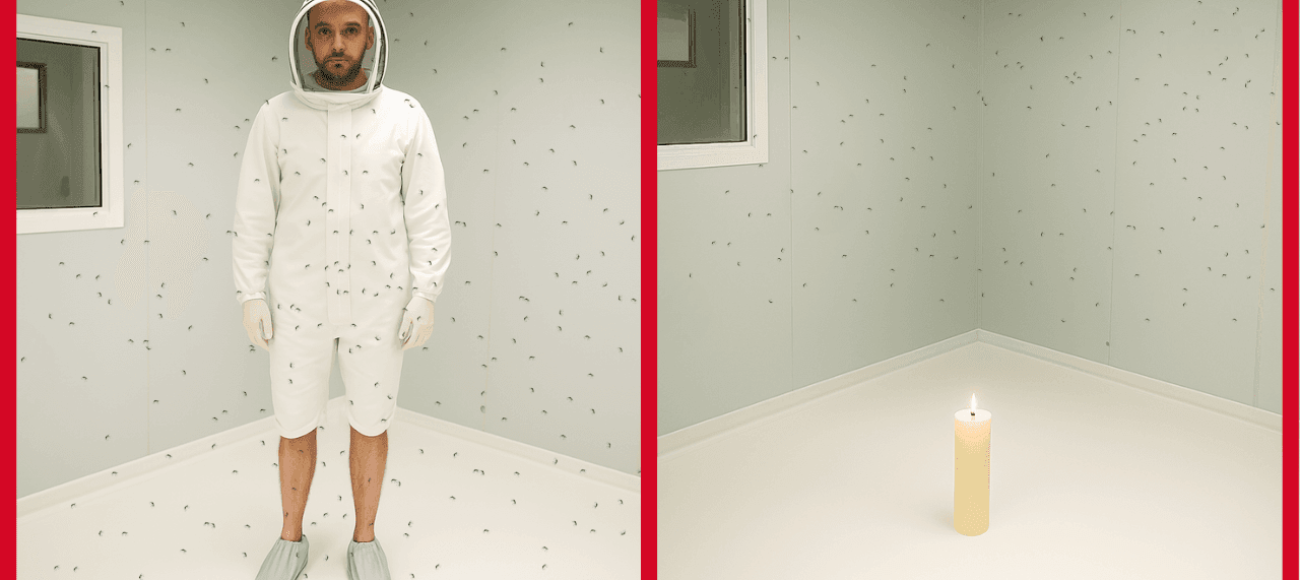
- For topical repellent, room test measures mosquito landing and biting activity by involving human volunteers
- For spatial repellent, the test assesses knockdown and mortality rates without the involvement of human volunteers
- Room test is applicable for creams, lotions, sprays, vaporizers, coils, candles, aerosols, treated fabrics, and wearable repellents.
- Mainly used for product development/ optimization, support regulatory submissions and marketing claims.
Summary
Room test is designed to check the efficacy of topical and spatula mosquito repellents in an enclosed room environment. This repellent testing method helps to understand product performance parameters such as Complete Protection Time (CPT), knockdown, and mortality rates.
Why Room Testing Is Used
Room testing is a performance validation method for mosquito repellent products claiming to prevent landing, bites or kill mosquitos.
Manufacturers/ companies who are involved in making topical mosquito repellent and spatial repellents require this test method to generate reliable efficacy data for product development, performance claim substantiation, and regulatory submissions.
This repellent testing method bridges the gap between highly controlled laboratory assays and real-world conditions, allowing for a more realistic assessment of product performance before field testing or market launch. Unlike small-cage tests, mosquitoes are allowed to fly freely within a test room, creating conditions that more closely resemble real-world use
Which Mosquito Repellent Products Can Be Tested?
Room test is applicable to following product types –
- Topical Repellents such as creams, lotions, sprays, repellent treated textiles bracelets, patches and clips
- Spatial Repellents such as candles, incense sticks, vaporizers and aerosols
Mosquito species used in room testing
- Aedes
- Anopheles
- Culex
Room test methodology overview
Based on product type, room test can be performed in two ways –
- Room Test with Human Volunteers – Applicable for topical mosquito repellents
- Room Test Without Human Volunteers – Applicable for spatial mosquito repellents
Room test methodology overview
Based on product type, room test can be performed in two ways –
- Room Test with Human Volunteers – Applicable for topical mosquito repellents
- Room Test Without Human Volunteers – Applicable for spatial mosquito repellents
1. Room Test with Human Volunteers
- Room setup – A known number of female mosquitoes are introduced in the controlled room where the test is going to be conducted.
- Application of repellent product on volunteers skin – This repellent testing method involves the use of volunteers to check product efficacy.The test product is applied on designated skin areas as per manufacturer instructions. The rest of the body is covered with protective equipment before entering the room.
- Observation period – Mosquito landings and bitings are observed for specific time duration.
- Results – Mosquito landing and biting rates on treated volunteers are compared with controls to calculate repellency performance.
2. Room test without human volunteers
- Spatial repellents testing – This repellent testing method is performed without volunteers
- Test setup – Repellent product ( coils, candles etc) is placed in the room.
- Exposure of mosquitoes to spatial repellents – Mosquitoes are exposed to the product for a defined time period.
- Knockdown rate – After exposure, knockdown rates are noticed.
- 24 hr Observation period – Knocked down mosquitos are transferred into a new chamber and provided with 10% sucrose solution.
- Mortality rates – After 24 hr observation period, mortality rates are assessed.
Key Performance Parameters Measured
- Complete Protection Time (CPT) – Complete Protection Time is the period from product application to the first confirmed mosquito bite.
- Knockdown rate – Knockdown refers to mosquitoes that become incapacitated and cannot fly normally after exposure.
- Mortality Rate – Mortality is determined after mosquitoes have been allowed a recovery period following exposure.
Room Test vs Other Mosquito Repellent Tests
Room Test vs Arm-in-Cage Test
| Parameter | Room Test | Arm-in-Cage Test |
| Mosquito movement | Free-flying within a room | Confined within a cage |
| Results | Complete Protection Time (CPT), Knockdown (KD60) and Mortality rates (M24) | Complete Protection Time (CPT) |
| Scope of products for testing | Topical and spatial repellents | Mainly topical repellents, impregnated textiles, patches, bracelets |
Also read – Arm-in-Cage Test for Mosquito Repellents
Room Test vs Olfactometer Test
| Parameter | Room Test | Olfactometer Test |
| Purpose | Measure bites, landings, CPT, knockdown and Mortality rates (M24) of product | Measure attraction or repellency behavior towards product |
| Mosquito Interaction | Direct interaction with product | Behavioral response only |
| Product tested | Topical and spatial repellents | Mosquito repellents and attractants such as topical and spatial repellents, attractant baits, and trapping lures |
For more details – Y-Tube Olfactometer Test for Mosquito Repellent Behavioral Analysis
Room Test vs Tunnel Test
| Parameter | Room Test | Tunnel Test |
| Purpose | Mosquito repellent efficacy | Efficacy of insecticide-treated materials |
| Test setup | Indoor test, controlled room conditions | Tunnel system with bait source |
| Products tested | Repellents and spatial control products | Nets, fabrics, treated materials |
| Endpoints | Biting activity, CPT, mortality | Blood feeding inhibition and mortality |
Also read – Tunnel Test for Insecticide treated Materials
Room Test vs WHO Cone Test
| Parameter | Room Test | WHO Cone Test |
| Objective | Assess repellency and protection | Assess insecticidal activity |
| Product Types | Repellents, vaporizers, aerosols | Treated nets, coatings, surfaces |
| Mosquito Exposure | Free-flying mosquitoes | Forced contact exposure |
| Key Measurements | CPT, bites, knockdown, mortality | Knockdown and mortality |
Also read – WHO Cone Test | Mosquito Mortality & Residual Efficacy Testing
Regulatory Importance of Room Testing
- Helps supporting product claims – Helps manufacturers to substantiate repellent efficacy claims for their topical and spatial repellent products
- Product development and optimization – Testing helps identify the most effective formulation before commercialization.
- Compliance with regional regulations – As per regional regulatory guidelines, it is mandated to submit the proof of efficacy and meet regulatory efficacy checkpoints before launch. Room test results are used by manufacturers to support regulatory requirements.
- Market launch – Scientific test data helps support marketing claims and strengthens customer trust.
Limitations of Room Tests
- Room test is a controlled laboratory test due to which it cannot fully replicate all real-world environmental factors.
- In room testing, environmental variables such as wind, rainfall, and varying mosquito populations are not fully replicated.
Field testing for mosquito repellent products are used to complement room tests to provide a more comprehensive efficacy assessment.
Choosing the Right Mosquito Repellent Test Method
At Microbe Investigations Switzerland (MIS), we help manufacturers identify the most appropriate mosquito repellent testing method as per their product needs and requirements. From early-stage screening to semi field and field trials, our experts can design and perform efficacy studies tailored to your product’s intended claims and target market.
Our constant focus is to ensure you obtain reliable data for product development and commercialization and regulatory support.
To get more details on the room test , contact our experts here.
Related blogs
- Tick vs Mosquito Repellent Testing: Key Differences
- Tunnel Test vs Arm-in-Cage Test
- Understanding the WHO Cone Test: Evaluating Insecticide-Treated Surfaces and Materials
- Arm-in-Cage vs Field Testing: Which Mosquito Repellent Test Is Better?
FAQs
1. What is Complete Protection Time (CPT)?
Complete Protection Time (CPT) is the time duration measured from repellent application until the first confirmed mosquito bite.
2. Can natural mosquito repellents be tested using a room test?
Yes, room tests can be used to evaluate both natural and synthetic mosquito repellents.
3. What is the difference between a room test and a field study?
A room test is conducted under controlled laboratory conditions, while a field study evaluates product performance in real-world environments.
4. Can room tests evaluate spatial repellents?
Yes.
5. Can room tests measure mosquito mortality?
Yes, room tests can assess mosquito mortality for spatial repellent products claiming insecticidal properties.
6. Are room tests suitable for vaporizers and mosquito coils?
Yes, room tests are commonly used to evaluate vaporizers, mosquito coils, aerosols, and other spatial repellents.