Home / Cosmetic Testing / Detection / ISO 22717
- Swiss testing laboratory
ISO 22717 - Test for Detection of Pseudomonas aeruginosa in Cosmetics

Hassle-free testing experience
Need to get a product tested? No worries! To and fro logistics are on us; we collect your products, test them and, deliver them back to you.
Summary
ISO 22717 is an internationally recognized microbiological test method used to detect the presence of Pseudomonas aeruginosa in cosmetic products. This bacterium is a key concern in cosmetics, especially water-based formulations and can cause skin and eye infections. The method involves enrichment of the sample, selective plating on cetrimide agar, and confirmatory identification of suspected colonies. It is widely used to ensure microbial safety, prevent contamination risks, and support regulatory compliance in cosmetic manufacturing.
Related tests for you
Quick understanding of the test
ISO 22717 : 2015 - Detection of Pseudomonas aeruginosa in cosmetic productsQuick understanding of the test
ISO 22717 provides the guidelines for the detection of Pseudomonas aeruginosa contamination in cosmetic and personal care products.
Application
Mandatory test strains
- Pseudomonas aeruginosa
- Initial suspension is prepared by dispersing the product sample into enrichment broth, followed by incubation.
- The incubated enrichment broth is streaked onto Cetrimide agar medium and re-incubated.
- After incubation, plates are examined for the morphology of Pseudomonas aeruginosa colony, followed by identification tests.
- Enables manufacturers to ensure product safety by identifying potential contamination.
- Prevent products recalls and health risks associated with the use of contaminated cosmetic products.
Turnaround Time
The presence of Pseudomonas aeruginosa colonies indicates positive results, while no detectable contamination indicates negative results.
Do you have a product that needs testing?
What is ISO 22717?
ISO 22717 specifies the test method to determine Pseudomonas aeruginosa contamination in cosmetic products.
ISO 22717 test has two steps. First step entails the detection of Pseudomonas aeruginosa in an enrichment broth. This subsequently leads to the second step i.e. isolation of microbes on a selective agar medium.
Scope of ISO 22717 standard
The ISO 22717 standard is applicable to cosmetic and personal care products, including both water-missible and water-immissible products that generally come in close contact with sensitive areas such as eyes and mucous membranes. The standard can be used to perform a microbiological risk assessment of cosmetic products by considering factors such as product composition, site of application, and intended user demographics (e.g., children under three years).
Target microorganism
This test method specifically detects the presence of Pseudomonas aeruginosa
ISO 22717 Test Method
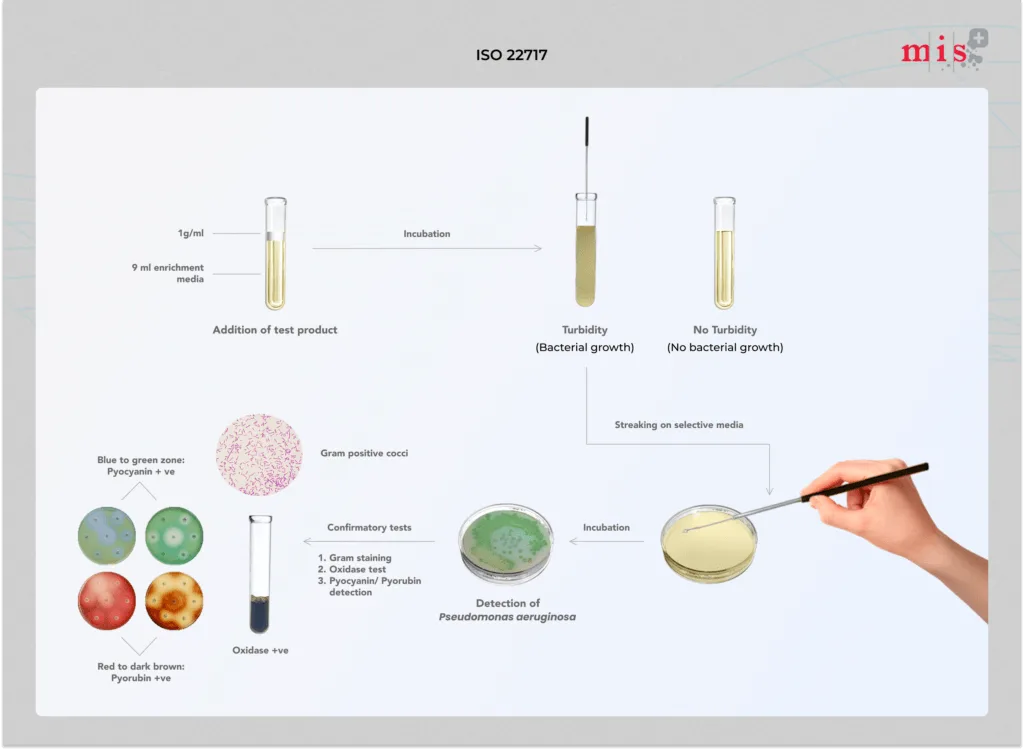
Sample preparation & enrichment
- Initial suspension is prepared by dispersing 1g or 1 ml of product sample into enrichment broth.
- Water-miscible products – 1 ml of product sample is dispersed in 9 ml of enrichment broth.
- Water-immiscible products – 1g of product sample is premixed with a dispersing agent (e.g. polysorbate 80) and then dispersed in 9 ml of enrichment broth.
- Filterable products – Filtration is performed for product samples through the membrane followed by initial suspension preparation.
Incubation
- This initial suspension is incubated at 32.5 °C for 20h and up to a maximum period of 72h.
Selective plating on Cetrimide Agar medium
- An aliquot of the incubated enrichment broth is streaked onto Cetrimide agar medium.
- Streaked plates are incubated at 32.5 °C for 24h and up to a maximum period of 48h.
Identification & confirmation tests
- After incubation, petri plates are examined for the morphology of Pseudomonas aeruginosa colony. Additionally, biochemical tests are performed to confirm the presence of Pseudomonas aeruginosa.
Understanding ISO 22717 results
To confirm the presence of Pseudomonas aeruginosa, their characteristic colonial morphology is checked. If yellow green pigment (pyocyanin) is observed under UV light on petri plates, the presence of Pseudomonas aeruginosa is confirmed.
ISO 22717 vs ISO 18415 vs USP <62>
Parameter | ISO 22717 | ISO 18415 | USP <62> |
Purpose | Detection of Pseudomonas aeruginosa in cosmetic products | Detection of specified and non-specified microorganisms | Detection of specified microorganisms in non-sterile microorganisms |
Organisms identified | Pseudomonas aeruginosa | Staphylococcus aureus, Escherichia coli, Pseudomonas aeruginosa, Candida albicans | Specific pathogens such as Staphylococcus aureus, Escherichia coli, Pseudomonas aeruginosa, Salmonella spp., bile-tolerant Gram-negative bacteria, Candida albicans. |
Scope of products | Cosmetic products, especially with water-based formulations and high-risk formulations | Cosmetic formulations (Except for cosmetics classified as low risk ) | Non-sterile products pharmaceuticals (oral solids/liquids, creams, ointments), cosmetics and personal care products |
Result | Qualitative (Presence/absence) | Qualitative (presence/absence) | Qualitative (Presence/absence) |
Why products fail ISO 22717?
Common reasons for failure of products include:
- Ineffective preservative system
- Contaminated raw materials
- Poor manufacturing hygiene
- Contamination through water contact
- Improper packaging
Regulatory relevance of ISO 22717
ISO 22717 is widely used in cosmetic microbiology as a recognized method for detecting Pseudomonas aeruginosa, a key objectionable microorganism in non-sterile products. As an internationally recognized method, it aligns with microbiological quality expectations under EU Cosmetic Regulation, helping manufacturers demonstrate that products are free from specified harmful microorganisms. By enabling early detection of contamination risks, the method helps prevent product recalls, consumer adverse events, and regulatory non-compliance.
When should you choose ISO 22717?
Choose ISO 22717 if your product:
- Is a cosmetic or personal care product
- Contains water or is prone to microbial contamination
- Requires pathogen-specific safety validation
- Needs compliance with global cosmetic microbiology standards
Importance of ISO 22717 Test
Using cosmetic products contaminated with Pseudomonas aeruginosa can pose serious health risks to the consumers. So it is vital to ensure the safety of cosmetics and personal care products prior to market release.
ISO 22717 standard specifies the testing methods to detect specific microorganisms, such as Pseudomonas aeruginosa in cosmetic products. This testing helps cosmetic companies to understand the microbiological quality of their product and enable them to make necessary improvements to safeguard consumer well-being.
Benefits of ISO 22171 Testing
- Testing ensures cosmetic products are free from Pseudomonas aeruginosa that can cause skin and eye infections.
- The standard aligns with global safety standards, helping manufacturers meet national and international regulations.
- Regular testing helps maintain the microbiological integrity of products, preventing contamination that could lead to spoilage.
- Identifying contamination early allows for corrective measures in manufacturing processes, preventing the distribution of compromised products.
- Complying with the standard opens doors to global markets where microbiological safety standards are mandatory for cosmetic product sales.
- By eliminating microbial contaminants, the test helps preserve the physical and chemical stability of cosmetic formulations.
Why choose MIS
Looking for ISO 22717 testing of your cosmetic products! MIS experts are here to help you.
With the help of our state-of-the-art facilities and cutting-edge technology, our team experts perform testing for a wide range of cosmetic products. Our team of industry specialists execute and closely monitor each step of the testing process to ensure the delivery of reliable and accurate results.
Furthermore, customers can also send their cosmetic product samples for ISO 22718 test.To get a quote on ISO 22717 testing, talk to our experts here.
Frequently Asked Questions

DR. Martinoz Scholtz
ISO 22717 describes methods for microbiological risk analysis of cosmetic products concerning the presence of a specific microorganism, Pseudomonas aeruginosa.
ISO 22717 testing is applicable to cosmetics and personal care products.
ISO 22717 test method takes 1 week to complete.
ISO 22717 is a test method used for microbiological risk analysis of cosmetic products concerning the presence of a specific microorganism, Pseudomonas aeruginosa.
No, ISO 22717 is a qualitative test which confirms the presence/absence of Pseudomonas aeruginosa based on identification of colonial morphology.
It is important because Pseudomonas aeruginosa can survive in water-based cosmetic products and acts as an opportunistic pathogen. If present, it may cause skin or eye infections, especially in sensitive users. Since cosmetics are used directly on the body, even small contamination levels are a safety concern. Testing ensures product safety, confirms preservative effectiveness, and supports regulatory compliance before products reach the market.
ISO 22717 testing typically takes 3-4 weeks to complete.
The need for ISO 22717 testing depends on product type, formulation and regulatory requirements. It is primarily used for cosmetics that require testing for the presence of Pseudomonas aeruginosa, especially water-based or high-risk products.
ISO 22717 is not a mandatory requirement but widely expected for compliance with regulations like the EU Cosmetics Regulation.
Meet the best of the blend of
R&D, Efficacy Testing,
Innovation and Passionate
Experts at MIS.





Explore More

In the cosmetics industry, safety

Evidently, with the expanding cosmetics
In the competitive world of