
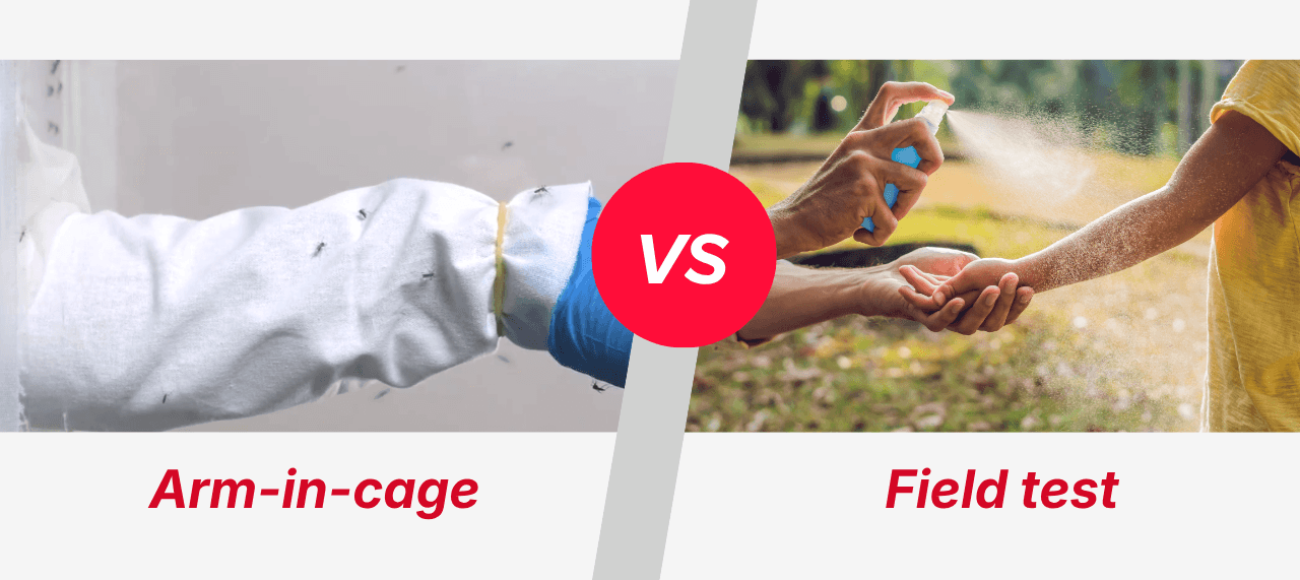
Quick Insights: Arm-in-Cage vs Field Test
- Arm-in-Cage vs field test are two different methods used to evaluate mosquito repellent performance in controlled laboratory conditions versus real outdoor environments.
- Arm-in-Cage testing measures repellency under standardized conditions, while field testing reflects actual usage variability
- Lab results are reproducible and comparable, whereas field results are realistic but influenced by environmental factors
- The most reliable approach is combining lab validation with field confirmation to ensure strong and defensible efficacy data
Summary
Arm-in-Cage vs field test means comparing control versus real-world performance of mosquito repellent products. Arm-in-Cage testing measures how effective a mosquito repellent is under standardized lab conditions, giving precise and reproducible results. Field testing, on the other hand, evaluates how the product performs in real environments with variable factors like weather, mosquito species, and user behavior.
What is Arm-in-Cage Testing?
Arm-in-Cage is a controlled laboratory method used to evaluate the repellency of a product against mosquitoes.
In this test, a human volunteer inserts their arm on which mosquito repellent product is applied into a cage containing a defined number of mosquitoes. The time until the first confirmed landing or bite is recorded. This is typically expressed as Complete Protection Time (CPT).
Arm in cage test parameters and requirements
- Fixed number of mosquitoes
- Known species ( Aedes, Anopheles, Culex species)
- Controlled temperature and humidity
- Standardized exposure conditions
What this test actually tells you
- How effective your formulation is under ideal conditions
- How long the active ingredient remains effective
- Whether formulation changes improve or reduce efficacy
Learn more – Arm-in-Cage Test : How Product Efficacy Is Scientifically Proven
What is Field Testing?
Field testing is done in natural environments where mosquitoes actually live and behave unpredictably.
Volunteers apply the product and expose themselves in mosquito-prone areas. Protection is measured based on landing or biting rates over time.
What makes this method realistic
- Exposure to wild mosquito populations
- Multiple species with different biting behaviors
- Environmental variables like wind, sweat, and temperature
- Real application conditions (not ideal lab scenarios)
What this test actually tells you
- Whether your product works outside the lab
- How environmental stress impacts efficacy
- Whether your claims hold up in real-world use
Arm-in-Cage vs Field Testing: What Really Sets Them Apart
1. Controlled vs Uncontrolled Environment
- Arm-in-Cage testing is done in a controlled lab setting where factors like mosquito number, species, temperature, and humidity are fixed. This helps isolate how well the formulation performs without external interference.
- Whereas, field testing introduces variability to reflect actual usage
2. Mosquito Behavior
- Lab mosquitoes are consistent and predictable
- Wild mosquitoes vary in aggressiveness, species, and activity
3. Data Quality vs Practical Relevance
- Arm-in-Cage testing generates clean, consistent data because conditions are tightly controlled. This makes results easy to compare across formulations
- Field testing produces more variable data since conditions are unpredictable. While this makes comparisons harder, it reflects how the product actually performs in real-world use.
4. Testing Objective
- Arm-in-Cage: Does the formulation work?
- Field Testing: Does it still work outside the lab?
Arm-in-Cage vs Field Testing: Quick comparison
| Parameter | Arm-in-Cage Testing | Field Testing |
| Environment | Controlled lab conditions | Natural, variable environments |
| Mosquito Type | Known species, fixed number | Wild populations, multiple species |
| Conditions | Fixed temperature, humidity, exposure | Influenced by weather, sweat, movement |
| Data Quality | Clean, reproducible, comparable | Variable, harder to standardize |
| Practical Relevance | Shows intrinsic formulation performance | Shows real-world effectiveness |
| Testing Objective | Does the product work? | Does it work outside the lab? |
| Variability | Low | High |
Advantages of Arm-in-Cage Testing
- High reproducibility allows consistent benchmarking
- Fast turnaround compared to field studies
- Cost-effective for screening multiple formulations
- Controlled variables help isolate formulation performance
- Ideal for comparing actives or concentrations
Limitations of Arm-in-Cage Testing
This is where many manufacturers go wrong.
- Does not simulate sweating, friction, or uneven application
- Uses limited mosquito species
- Lacks environmental stress factors
- Can overestimate protection time
A formulation that looks strong in the lab may degrade quickly outdoors.
Advantages of Field Testing
Field testing answers the only question that really matters:
- Reflects real-world usage conditions
- Captures performance across different mosquito species
- Accounts for environmental impact
- Builds credible and defensible product claims
Limitations of Field Testing
Field testing is valuable, but not easy to execute.
- Results are highly variable
- Requires careful study design and statistical interpretation
- More expensive and time-consuming
- Seasonal and location-dependent
- Harder to compare formulations directly
Common Mistakes to avoid
- Not selecting relevant mosquito species – Using the wrong species makes results meaningless for your target market. Testing should match the geography and disease vector you’re targeting.
- Ignoring environmental variability – Relying only on controlled conditions overlooks how factors like temperature, humidity, and sweat impact real-world performance.
- Ignoring regulatory expectations – Different regions expect different levels of evidence. Misalignment can delay approvals or weaken claims.
- Sending early stage or unstable formulations for testing – Early or changing formulations lead to inconsistent results and repeated testing costs.
Know more – Best Mosquito Repellent Efficacy Testing Methods
Why a Combined Testing Approach Works Best
This approach reduces risk, saves cost, and strengthens your claims. You can follow step by step approach –
- Start in the lab with Arm-in-Cage testing to see if your formulation actually works. Once you have solid CPT and efficacy data.
- Once repellent efficacy is confirmed in lab testing, you can proceed with field testing to check how your product holds up under real conditions.
Need Help Choosing Between Arm-in-Cage vs Field Testing?
When it comes to Arm-in-Cage vs field testing, choosing the right strategy is where most product claims succeed or fail.
At MIS, We help manufacturers design a complete repellent efficacy testing approach, starting from controlled lab testing to field testing for real-world validation.
If you’re developing a new repellent or refining an existing formulation, we can help you generate credible data to strengthen your product claims.
Contact our experts now
FAQs
1. What is complete Protection Time ( CPT) ?
CPT is the time between applying a repellent and the first confirmed mosquito bite or landing in a controlled test like an arm in cage test.
2. Do regulatory bodies require field testing for repellents?
It depends on regional regulatory requirements and the type of claim being made. In many cases, standardized lab studies are sufficient, while field data may be needed for stronger real-world efficacy claims.
3. Can a product pass lab testing but fail in the field?
Yes, frequently. Lab tests control variables like species and environment, while field conditions introduce heat, humidity, multiple species, and user behavior, all of which affect performance.
4. How do you select the right mosquito species for testing?
Selection depends on target geography and claim positioning. For example, Aedes aegypti for dengue regions or Anopheles for malaria-prone areas ensures regulatory and real-world relevance.
5. What factors cause variability in field testing results?
Environmental conditions, mosquito density, species diversity, and human behavior all contribute to variability. Even time of day and weather changes can significantly affect outcomes.
6. How many field studies are needed for strong claims?
There’s no fixed number, but multiple studies across different locations and conditions strengthen credibility. Regulators and marketers typically expect repeatable results, not single-site data.
7. What standards govern mosquito repellent testing?
Mosquito repellent testing is generally guided by regulatory frameworks such as EPA OCSPP 810.3700 and WHO guidelines. They outline standardized methods for evaluating efficacy and safety under controlled conditions. Depending on the region, additional local regulatory requirements may also apply.