Home / Disinfectant Testing / antibacterial / EN 17126
- Swiss testing laboratory
EN 17126 Sporicidal Suspension Test for Medical Disinfectants

Hassle-free testing experience
Need to get a product tested? No worries! To and fro logistics are on us; we collect your products, test them and, deliver them back to you.
Summary
EN 17126 is a Phase 2, Step 1 quantitative suspension test used to assess the sporicidal efficacy of chemical disinfectants intended for healthcare environments. The test evaluates a product’s ability to inactivate bacterial spores under defined laboratory conditions, supporting validation of sporicidal performance. EN 17126 is commonly used to support sporicidal claims for healthcare disinfectants sold in the Europe
Related tests for you
Evaluation of virucidal activity against bacteriophages of chemical disinfectants used in food and industrial areas
Evaluation of mycobactericidal activity of chemical disinfectants in the medical area including instrument disinfectants
Evaluation of mycobactericidal activity of chemical disinfectants and antiseptics used in the veterinary area
Quantitative (phase 1 suspension) test for basic sporicidal activity of chemical disinfectants and antiseptics
Evaluation of Sporicidal Activity of Disinfectants
Quantitative test for sporicidal efficacy testing of disinfectants used in food, industrial, domestic and institutional areas
Quick understanding of the test
BS EN 17126:2018 - Quantitative suspension test for the evaluation of sporicidal activity of chemical disinfectants in the medical area (phase 2, step 1)
EN 17126 is a quantitative suspension (phase 2, step 1) test that evaluates the efficacy of sporicidal disinfectants used in medical areas.
Applicable to immersion disinfectants and surface disinfectants, such as wipes, sprays, and cleansers, used in healthcare settings.
- Bacillus subtilis
- Bacillus cereus
- Clostridium difficile
- The test sample is exposed to a suspension of test microbes and interfering substance.
- The test mixture is incubated for a specific contact time.
- At the end of the contact time, the test mixture is neutralized, and the neutralizing solution is plated and incubated to quantify the viable microorganisms.
- This standard ensures that the disinfectants used in medical settings are effective against bacterial spores, which are among the most challenging organisms to eradicate.
- By providing a clear benchmark for sporicidal effectiveness, EN 17126 aids in the development and improvement of disinfectants.
Turnaround Time
Typically, the test takes 2-3 weeks to complete.
The test determines the sporicidal activity of disinfectants by quantifying the log10 reduction in bacterial spores.
Passing criteria
The disinfectant must achieve at least a 4-log reduction in bacterial spores to meet EN 17126 requirements.
Do you have a product that needs testing?
What Is EN 17126 Test?
EN 17126 is a European standard that outlines a quantitative suspension test (phase 2, step 1) test to determine the sporicidal activity of chemical disinfectants and antiseptics used in medical environments. Bacterial spores are highly resistant to ordinary disinfectants. Thus, to eliminate these resilient pathogens, it is necessary to use disinfectant products that specifically claim sporicidal actions. EN 17216 helps validate these claims by providing a standardized method for testing a product’s sporicidal action.
When Is EN 17126 Required?
This test is typically required when:
- A product claims sporicidal activity
- The disinfectant is intended for medical instruments, surfaces, or medical environments
- Efficacy against bacterial spores must be demonstrated as part of EU compliance or product validation
- Supporting data is needed for regulatory submissions under the EU Biocidal Products Regulation (BPR) or medical disinfectant frameworks
Products Applicable for EN 17126 Testing
The standard applies to disinfectant products that are intended for use in medical areas like
- Hospitals,
- Clinics of schools, kindergartens,
- Nursing homes,
- Community medical facilities,
- Dental institutions and more.
The product types include disinfectants used for:
- Instrument disinfection by immersion
- Surface disinfection by wiping, spraying, or flooding
- Textile disinfection
EN 17126 Test Conditions & Requirements
EN 17126 (phase 2 step 1) | Surface disinfection | Instrument disinfection | Textile disinfection | |
Mandatory test microorganisms | Bacillus subtilis (ATCC 6633) Bacillus cereus Clostridium difficile | Bacillus subtilis (ATCC 6633) Bacillus cereus Clostridium difficile | Bacillus subtilis (ATCC 6633) Bacillus cereus Clostridium difficile | |
Additional | Any relevant strain | |||
Test temperature | According to the manufacturer’s recommendation, but at/between | |||
4 °C and 30 °C | 20 °C and 70 °C | 20 °C and 80 °C | ||
Interfering substance – Clean conditions |
0.3 g/l bovine albumin solution |
0.3 g/l bovine albumin solution |
0.3 g/l bovine albumin solution | |
Dirty conditions | 3.0 g/l bovine albumin solution plus 3.0 ml/l erythrocytes | 3.0 g/l bovine albumin solution plus 3.0 ml/l erythrocytes | 3.0 g/l bovine albumin solution plus 3.0 ml/l erythrocytes | |
Log reduction | ≥ 4 log reduction | |||
EN 17126 Test Method
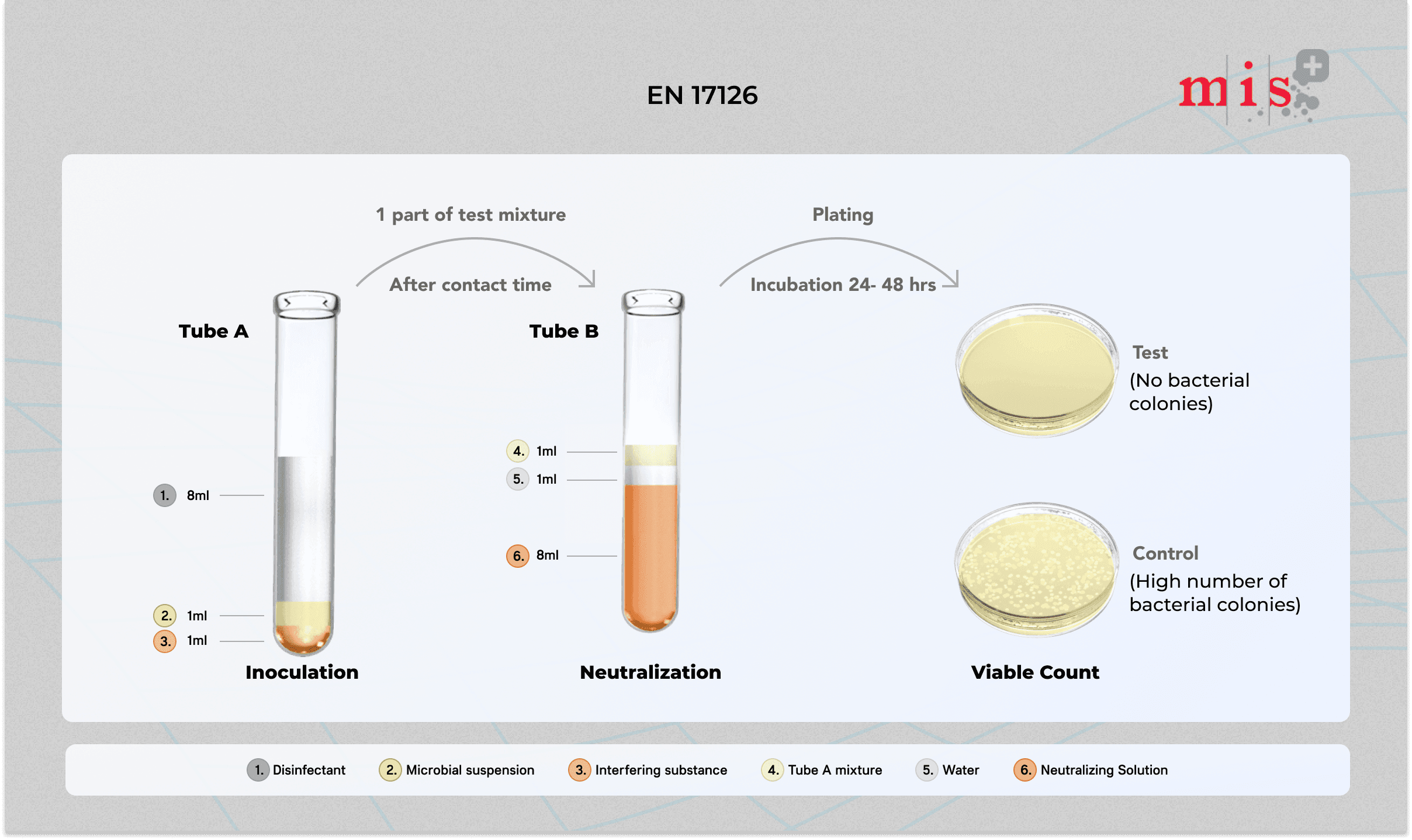
- Test product is challenged with the suspension of the test organism and interfering substance.
- The test mixture is incubated at the defined temperature for a specific contact period as per the test requirements.
- At the end of the contact time, the reaction between the test product and challenged organism is terminated by a neutralizing solution.
- Plating method is used to quantify the viable microorganisms recovered from the neutralizing medium.
- To pass EN 17126, test product must show at least 4 log reduction values against mandatory test microorganisms.
EN 17126 Passing Criteria
To meet the requirements of EN 17126, the product needs to demonstrate a minimum ≥ 4 log (99.99%) reduction of bacterial spores.
Why EN 17126 Is Required for Medical Disinfectants
Disinfectant products are essential in hospitals and other critical healthcare environments to destroy pathogens and minimise the risk of cross-contamination. However, spore-forming bacterial species such as Bacillus and Clostridium are notoriously resistant to standard disinfectants. Their robust protective coatings allow them to survive harsh environmental conditions and persist on surfaces, instruments, and textiles for extended periods, potentially causing severe infections and outbreaks, especially in vulnerable healthcare settings.
To ensure reliable protection against bacterial spores and their associated health hazards, it is vital to use disinfectants with proven sporicidal properties. EN 17126 outlines the test method to determine if a disinfectant is capable of inactivating bacterial spores under practical conditions, thereby verifying that the product can achieve the high level of sporicidal efficacy needed to meet strict hygiene and sterility requirements.
EN 17126 vs Other Sporicidal Test Methods
Parameter | EN 17126 | EN 13704 |
Purpose | Quantitative suspension test to evaluate the sporicidal activity of chemical disinfectants and antiseptics in medical settings | Quantitative suspension test to evaluate the sporicidal activity of chemical disinfectants in non-medical settings |
Mandatory test organisms | B. subtilis (ATCC 6633), B. cereus, C. difficile. | B. subtilis (ATCC 6633) |
Scope of products | Instrument disinfectants, surface disinfectants (e.g., wipes, sprays, cleansers), textile disinfectant products used in healthcare settings. | Disinfectants used in food, industrial, domestic, and institutional settings, excluding medical areas. (Excludes products for use on living tissues except hand hygiene products) |
Passing criteria / Results | Quantitative : ≥4 log reduction (99.99%). | Quantitative : ≥3 log reduction (99.9%). |
Why Choose Our Lab for EN 17126 Testing
MIS performs EN 17126 sporicidal suspension test for disinfectants that are used in medical and healthcare settings, generating reliable efficacy data in line with EU requirements.
Our microbiology testing lab covers antibacterial, sporicidal, antifungal, yeasticidal, and virucidal methods performed according to relevant international standards. Test results can be used to support product validation and regulatory submissions.
Testing is carried out by experienced microbiologists using established stringent protocols, with clear log-reduction data and defined turnaround timelines.
For sporicidal disinfectant products, EN 13704 test is another most frequently requested and performed test method at MIS.
Request EN 17126 testing
Looking to test your disinfectant for sporicidal efficacy under EN 17126? Contact our experts
Frequently Asked Questions

DR. Martinoz Scholtz
EN 17126 test is a quantitative suspension test (phase 2, step 1) for disinfectants used in medical areas. During EN 17126 testing, disinfectant samples are challenged with added to microbes of interest and interfering substances for specific contact times. The tested sample is considered to be effective only if it can achieve 4 log reduction of bacterial spores.
EN 17126 test is applicable to products used for instruments and hard surface disinfection in medical facilities. Product types mainly include immersion disinfectants and surface disinfectants like wipes, sprays, and cleansers.
EN 17126 test takes 2-3 weeks to complete.
At Microbe Investigations Switzerland, we test for EN 17126 using the following microbial strains: Bacillus subtilis, Bacillus cereus, and Clostridium difficile.
EN 17126 is a quantitative suspension test (phase 2, step 1) used to evaluate the sporicidal activity of chemical disinfectants and antiseptics intended for use in the medical area.
EN 17126 is not mandatory for all medical disinfectants. However, in Europe, it is one of the commonly used standards when a medical disinfectant claims sporicidal activity.
The mandatory test organisms include Bacillus subtilis (ATCC 6633) and Bacillus cereus for general sporicidal claims. Clostridium difficile is used when making specific clostridial claims.
To pass EN 17126, the product must achieve a minimum ≥ 4 log₁₀ (99.99%) reduction in viable bacterial spores.
EN 17126 test takes 2-3 weeks to complete.
EN 17126 applies to disinfectants that claim sporicidal activity and is intended for healthcare and clinical settings. Whereas, EN 13704 applies to disinfectants used in food, industrial, domestic, and institutional areas.
EN 17126 test data can be used to support sporicidal efficacy claims and regulatory submissions, as long as the test results match the efficacy criteria for intended use.
Meet the best of the blend of
R&D, Efficacy Testing,
Innovation and Passionate
Experts at MIS.





Explore More

In the cosmetics industry, safety

Evidently, with the expanding cosmetics
In the competitive world of