- Swiss testing laboratory
ASTM D 7907-14 Antibacterial Activity Test for Medical Gloves

Hassle-free testing experience
Need to get a product tested? No worries! To and fro logistics are on us; we collect your products, test them and, deliver them back to you.
Summary
ASTM D7907 is a quantitative test method that determines the bactericidal efficacy of medical examination gloves by measuring bacterial reduction on the inner and/or outer glove surfaces. ASTM D7907 supports antibacterial claims for medical gloves and helps manufacturers demonstrate performance under simulated healthcare contamination scenarios.
Related tests for you
Quick understanding about test
ASTM D 7907-14 - Determination of Bactericidal Efficacy on the Surface of Medical Examination Gloves
This test evaluates the surface bactericidal efficacy of gloves used for medical examination.
Application
- Staphylococcus aureus (ATCC 6538P)
- Pseudomonas aeruginosa (ATCC 9027)
- Klebsiella pneumoniae (ATCC 4352)
- Enterococcus faecalis (ATCC 33186)
- Method A
- A bacterial suspension without organic load is evenly spread onto test and control samples and covered with a coverslip.
- An aliquot from the neutralized extraction is plated on a growth medium.
- After 24–48 hours of incubation, bacterial colonies are counted to assess bactericidal activity.
- Method -B
- A bacterial suspension with organic load is spread onto to samples and covered with a coverslip.
- The samples are subjected to a specified contact time followed by neutralization, plating and incubation. Bacterial colonies are counted to assess bactericidal activity.
Benefits
- Provides a standardized method for manufacturers to verify and substantiate bactericidal claims of gloves.
- Ensures gloves effectively reduce bacterial contamination, enhancing safety.
Turnaround Time
Passing criteria
Do you have a product that needs testing?
What Is ASTM D7907 Test?
ASTM D7907 outlines two test methods (Method A & Method B) to quantitatively examine the surface bactericidal activity of medical examination gloves with integrated bactericidal properties. These tests examine bactericidal action on the outer or inner surface of the glove.
Purpose of ASTM D7907 Antibacterial Glove Testing
This test is particularly important when medical examination gloves are marketed with antibacterial claims or require supporting data for regulatory submissions, helping manufacturers ensure credible antimicrobial performance.
Mandatory Test Bacteria
- Pseudomonas aeruginosa (ATCC 9027)
- Staphylococcus aureus (ATCC 6538P)
- Enterococcus faecalis (ATCC 33186)
- Klebsiella pneumoniae (ATCC 4352)
Products Applicable for ASTM D7907
ASTM D7907 is specifically designed for evaluating the surface bactericidal efficacy of medical examination gloves that incorporate antibacterial or bactericidal agents. Product examples may include –
- Latex examination gloves
- Nitrile examination gloves
- Vinyl (PVC) examination gloves
- Neoprene and synthetic polymer gloves
- Antimicrobial-treated or coated gloves
- Gloves with embedded bactericidal additives
ASTM D7907 Test Method Overview
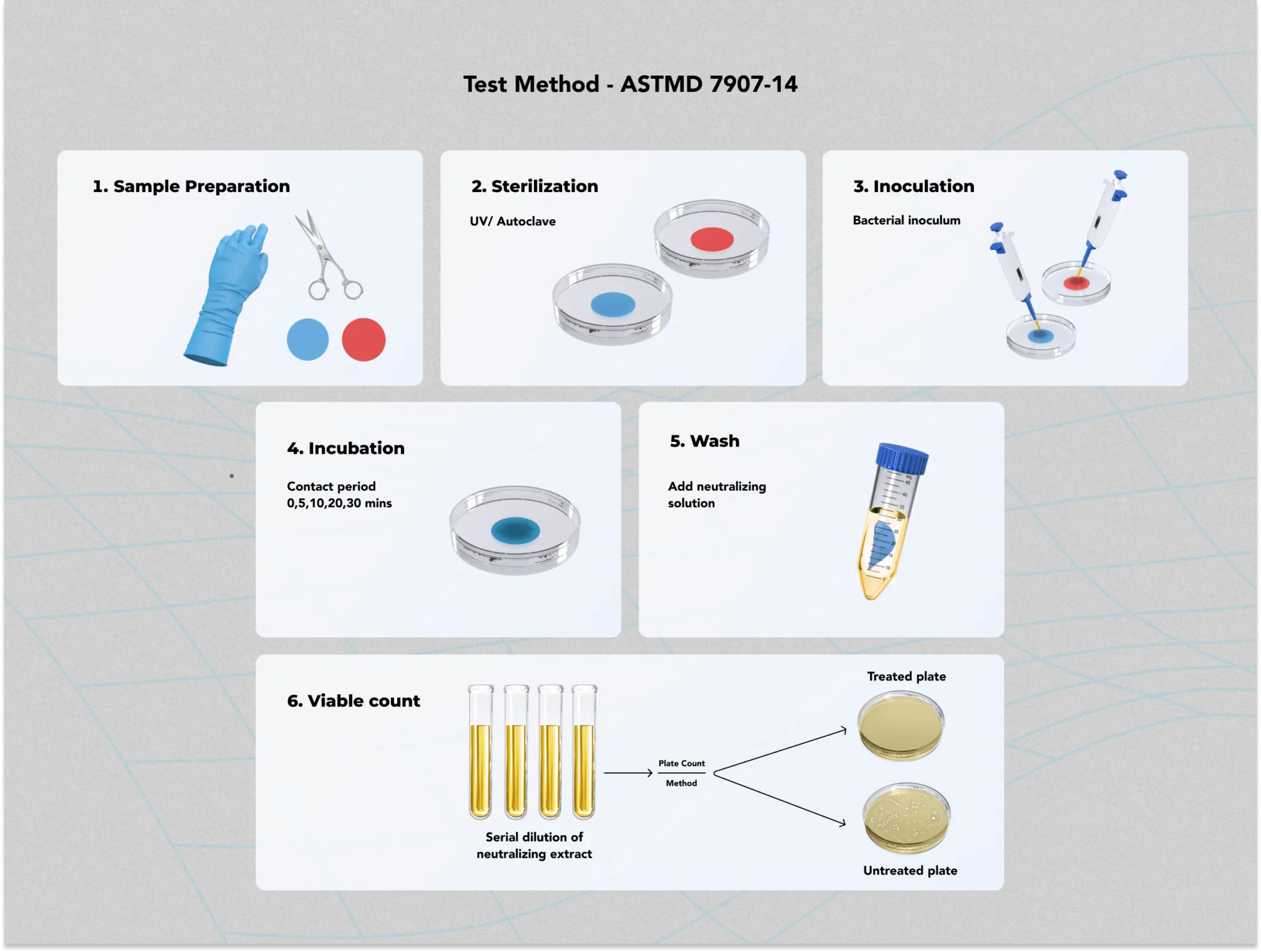
Test Conditions and Contact Times
Parameter | Test conditions |
Mandatory test strains |
|
Contact Time | 0, 5, 10, 20, and 30 minutes ( Three replicates will be tested for each dif bacteria and contact time) |
Interfering Substances | 5% bovine serum albumin ( Method B) |
Method A vs Method B in ASTM D7907
Method A – Determining antibacterial efficacy against test bacteria in a sterile normal or phosphate buffered saline
Method B – Determination of antibacterial efficacy against challenge bacteria in saline or phosphate buffered saline solution with organic load
The most noticeable difference is in the inclusion of the organic load in Method B, duplicating more severe contamination conditions that are typically found in healthcare settings.
ASTM D7907 Test Methods
ASTM D7907 specifies two test methods for quantitative analysis of the bactericidal activity on the surfaces ( inside or outside) of test materials.
Method A
- The bacterial suspension with the titre of 108 CFU/mL is prepared in a sterile standard or phosphate-buffered saline without any interfering substance (organic load).
- 20 ul of bacterial suspension is evenly spread over the test (treated) and control (untreated) samples and covered by a coverslip. The bacterial suspension must contain a minimum titer of 106 test bacteria to ensure that there is enough number of viable cells .
- Both control and test samples are allowed to complete the specified contact times (as per standard guidelines or suggested by the manufacturer).
- Immediately after contact periods, test and control samples without removing the coverslips are transferred into a sterile centrifuge tube containing 10 ml of neutralizing solution. And mixed for 15 seconds using a vortex mixer.
- 0.05 mL aliquot from the neutralization extraction tube is taken and plated on a growth medium.
- After the incubation period of 24 hours – 48 hours, bactericidal activity is determined by the enumeration of bacteria on both test and control samples.
Method B
- 108 CFU/mL bacterial suspension is prepared in a sterile standard or phosphate-buffered saline along with an interfering substance (organic load).
- Both the test (treated) and control (untreated) samples are exposed to the organic load prior to bacterial inoculation.
- 20 ul of bacterial suspension is evenly spread over the test (treated) and control (untreated) samples and covered by a coverslip. The bacterial suspension must contain a minimum titer of 106 test bacteria to ensure that there is enough number of viable cells .
- Similar to method A, all the next steps are followed for the contact period, neutralization, and enumeration of bacteria in both test and control samples.
Interpretation of Results & Log Reduction
Results are reported as log reduction in viable bacteria on treated gloves compared to control gloves. Higher log reduction values indicate stronger bactericidal surface activity
Importance of ASTM D7907
ASTM D7907 plays a significant role in testing the bactericidal effectiveness of medical examination gloves so that they may effectively minimize viable bacteria on their surfaces.
In patient care settings, the hands of healthcare providers and workers are continuously exposed to skin wounds, contaminated surgical equipment, and other inanimate surfaces that serve as a potential risk for infection spread. Hence, wearing gloves is considered a primary preventive measure to avoid transmission of infection within patients and outside places as well. As per evidence, using non-sterile gloves can also pose the risk of microbial contamination, resulting in both nosocomial and community-acquired infections.
The aim of ASTM D 7907-14 test method is to ensure the bactericidal activity of treated medical gloves against a range of pathogenic microorganisms, ubiquitous in hospital environments.
Why Choose Our Lab for ASTM D7907 Testing
At Microbe Investigations, we offer a comprehensive suite of microbiology testing and validation services. Validate the bactericidal efficacy of your gloves to the rigorous ASTM D 7907 standard. Our team of microbiology experts delivers accurate, reproducible results you can trust.
Enhance product safety, build customer confidence, and meet regulatory requirements.
Our aim is to deliver rapid and high-quality results for your products.
Request ASTM D7907 testing
Contact our experts to discuss your test requirements related to ASTM D7907.
Frequently Asked Questions

DR. Martinoz Scholtz
Meet the best of the blend of
R&D, Efficacy Testing,
Innovation and Passionate
Experts at MIS.