Home / Disinfectant Testing / antibacterial / EPA MLB SOP MB-40
- Swiss testing laboratory
EPA MLB SOP MB-40 Antimicrobial Surface Coating Efficacy Testing

Hassle-free testing experience
Need to get a product tested? No worries! To and fro logistics are on us; we collect your products, test them and, deliver them back to you.
Summary
Our laboratory conducts EPA MLB SOP MB-40 testing to evaluate residual antimicrobial performance of surface coatings after simulated wear. MIS conducts EPA MLB SOP MB-40 testing using standardized abrasion, inoculation, and evaluation procedures in accordance with EPA guidance and delivers accurate, reproducible data to support supplemental residual antimicrobial surface claims for product manufacturers.
Related tests for you
Quick understanding of the test
EPA MLB SOP MB-40 - Standard Method to evaluate the efficacy of antimicrobial surface coatings
Application
- Staphylococcus aureus
- Pseudomonas aeruginosa
- Stainless steel carriers are coated with antimicrobial chemicals.
- The carriers are abraded using alternating wet and dry abrasions.
- After abrasion, the carriers are challenged with test organisms for a specified contact time.
- After contact time, carriers are neutralized using a neutralizing solution, and the surviving test organisms are recovered.
- Assesses the durability of antimicrobial properties after physical wear, reflecting real-world usage conditions where surfaces undergo wear and tear.
- The test can be customized to include other microorganisms as well.
Turnaround Time
Passing criteria
Do you have a product that needs testing?
What Is EPA MLB SOP MB-40?
EPA MLB SOP MB-40 is a standardized efficacy test method recommended by the U.S. Environmental Protection Agency (EPA) Office of Pesticide Programs (OPP) to support registration requirements for surface coatings claiming residual antimicrobial efficacy.
The method assesses whether antimicrobial activity is retained after simulated wear and cleaning through defined abrasion cycles, followed by microbial challenge and recovery. This test provides durability-based efficacy data that support supplemental claims showing continued microbial reduction between routine disinfection cycles.
Surfaces and Products Tested under MB-40
EPA MLB SOP MB-40 applies to:
- Hard, non-porous surfaces (e.g., stainless steel) coated with antimicrobial chemistries.
- Residual antimicrobial surface coatings and films used on environmental contact surfaces.
It is not intended for porous materials (such as textiles) unless protocol modifications are approved by EPA.
Applications of EPA MLB SOP MB-40 Testing
EPA MLB SOP MB-40 is applicable to antimicrobial coatings used in environments where surfaces are frequently touched, cleaned, or exposed to chemicals.
Typical applications include:
- Healthcare and clinical surfaces
- Public transportation and infrastructure
- Commercial and institutional buildings
- Food-contact adjacent surfaces (non-direct contact)
- Consumer and industrial antimicrobial coatings
Mandatory and Optional Test Microorganisms
Mandatory Test Organisms
- Staphylococcus aureus
- Pseudomonas aeruginosa
- Viruses
Additional microorganisms can be used upon manufacturer’s requirement
EPA MLB SOP MB-40 Test Method Overview: Abrasion Cycles and Residual Efficacy Evaluation
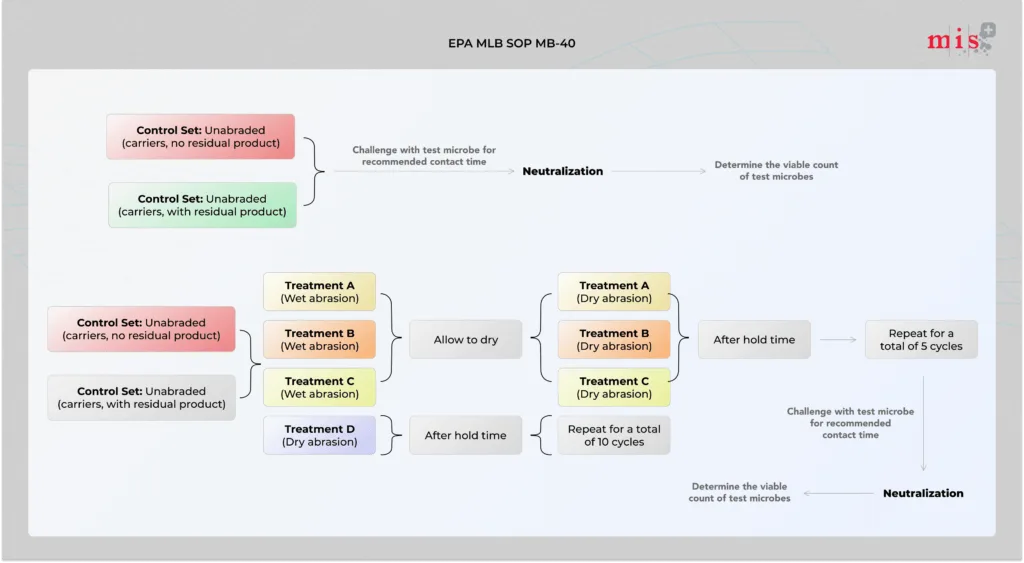
The test has 2 parts –
Part 1: Chemical treatment and physical abrasion
- Stainless steel carriers of size 2.5 sq. cm. are brush coated with the antimicrobial chemicals, with uncoated carriers acting as controls
- The carriers are abraded using 5 cycles of alternating wet and dry abrasions
- An independent 10 cycle dry abrasion treatment is also performed
Part 2: Residual Efficacy Evaluation
- After the completion of the treatment and abrasion, the carriers receive a 20μL mix of the test organism and soil load for 1-2hrs
- Post exposure to the mix, the carriers are neutralised
- The number of viable microorganisms is determined quantitatively
- The log reduction in the viable microorganism on treated and/or abraded carriers is compared to the untreated control carriers
Interpretation of Results and Log Reduction
To support residual antimicrobial claims as per EPA MLB SOP MB-40, test results are evaluated by comparing microbial survival on treated, abraded surfaces to untreated control surfaces after the specified contact time.
A minimum of 3 log (99.9%) reduction in the test microorganisms within 1-2hrs indicates a 1-week residual claim for the antimicrobial surface coating.
Importance of EPA MLB SOP MB-40 for Product Claims
EPA MLB SOP MB-40 is critical for manufacturers seeking to support residual antimicrobial claims, including long-lasting surface protection and continuous microbial reduction between routine cleanings. Without MB-40 data, such claims may not be substantiated during EPA review. The method provides regulatory bodies with scientifically robust evidence that antimicrobial performance is maintained after simulated wear and cleaning, ensuring that product claims reflect realistic conditions of use.
Related EPA and International Test Methods
Criteria | EPA MLB SOP MB-40 | EPA MLB SOP MB-41 | EPA Protocol #01-1A | PAS 2424:2014 | ||
Purpose/ Claims | Residual antimicrobial efficacy for a period of 1 week | Continuous antimicrobial reduction claims | 24-hour residual self-sanitizing efficacy | 24-hour residual bactericidal and yeasticidal efficacy | ||
Mandatory Test Organisms | Staphylococcus aureus, Pseudomonas aeruginosa and viruses | Staphylococcus aureus, Pseudomonas aeruginosa and viruses | S. aureus + Klebsiella pneumoniae or Enterobacter (K. aerogenes), plus optional bacteria | P. aeruginosa, S. aureus, E. coli, Enterococcus hirae, K. pneumoniae (bacteria) and Candida albicans (yeast) | ||
Scope of products | Residual antimicrobial surface coatings and films applied to hard, non-porous surfaces | Hard, non-porous copper surfaces and copper-containing materials | Antimicrobial products intended for use on inanimate, hard, non‑porous, non‑food contact surfaces | Antimicrobial treated articles & surfaces, including coatings and materials | ||
Log Reduction / Passing Criteria | ≥3-log reduction (≥99.9%) | ≥3-log reduction (≥99 .9%) | ≥3-log reduction | ≥3-log reduction (≥99.9%) |
Get a Quote for EPA MLB SOP MB-40 testing
Want to test your product or surface for residual antimicrobial performance? Contact our experts to conduct EPA MLB SOP MB-40 testing and generate regulator-ready data.
Frequently Asked Questions

DR. Martinoz Scholtz
It is a test that evaluates the efficacy of antimicrobial coated surfaces, that are used to supplement standard disinfectants, against test bacteria and viruses.
A residual antimicrobial coating is a surface treatment applied to hard, non-porous surfaces that provides ongoing antimicrobial activity over a period of time after application. Under EPA regulations, these coatings are intended to supplement standard cleaning and disinfection practices by continuously reducing microorganisms on the surface between routine disinfection cycles.
EPA MLB SOP MB-40 is the test method specifically for evaluating residual antimicrobial coatings and films on hard, non-porous surfaces, while MB-41 is the test method used for hard, non-porous copper-containing surface products.
Yes. EPA MLB SOP MB-40 is the designated test method to support supplemental residual antimicrobial surface coating claims. It generates data showing how the antimicrobial activity persists after abrasion and chemical exposure, which is used to substantiate label claims for durability over time.
MB-40 requires carriers to be subjected to alternating wet and dry abrasion cycles with specific chemicals and an independent series of dry abrasion cycles to simulate real-world wear and tear.
To support a residual antimicrobial claim, a minimum 3-log (99.9%) reduction in the test organisms must be achieved.
Yes. MB-40 can be used to evaluate antimicrobial surface coatings and films, which includes paints or coatings that provide residual antimicrobial activity on hard, non-porous surfaces.
Yes. While Staphylococcus aureus and Pseudomonas aeruginosa are the primary bacterial test organisms under MB-40, the method can be adapted to include viruses claimed on the label. The most difficult-to-kill virus claim should be subjected to the durability assessment.
EPA MLB SOP MB-40 is used to support claims for residual antimicrobial surface coatings designed to maintain antimicrobial performance over extended periods, even after repeated exposure to cleaning agents and mechanical wear. The method substantiates supplemental antimicrobial claims, including durable bactericidal and antiviral activity, by demonstrating a minimum 3-log reduction during evaluation.
If a product is intended to make residual antimicrobial activity claims on surfaces, EPA MLB SOP MB-40 data is generally required as part of the registration submission to substantiate those claims. Products without such claims don’t necessarily need MB-40 testing.
Yes. One of the core aspects of MB-40 is assessing how well antimicrobial activity persists after simulated physical wear and exposure to cleaning chemistries.
Yes, coatings include surface paints or films formulated to provide residual antimicrobial activity on hard, non-porous surfaces.
A 3-log reduction means the test system demonstrated that the number of viable microorganisms was reduced by 99.9% on the treated surface compared to the untreated control
At present, Staphylococcus aureus, Pseudomonas aeruginosa and viruses can be tested. The test can be adapted for other microorganisms
Meet the best of the blend of
R&D, Efficacy Testing,
Innovation and Passionate
Experts at MIS.





Explore More
Key Takeaways EN 13727 and
Key takeaways EN 1276 is

Antimicrobial testing is important to