Home / Textiles / antibacterial / ASTM E2149
- Swiss testing laboratory
ASTM E2149 Antimicrobial Activity Testing

Hassle-free testing experience
Need to get a product tested? No worries! To and fro logistics are on us; we collect your products, test them and, deliver them back to you.
Summary
ASTM E2149 is a dynamic contact test method used to assess the antimicrobial effectiveness of non-leaching, surface-bound materials under dynamic contact conditions. The method simulates real-use conditions by maximizing contact between microorganisms and treated surfaces. It is widely applied to treated textiles, plastics, polymers, and antimicrobial coatings where antimicrobial agents do not diffuse into the surrounding environment.
Related tests for you
What Is ASTM E2149 Test?
The ASTM E2149 test method evaluates the antibacterial activity of immobilized antimicrobial agents under dynamic contact conditions. It measures how effectively treated, non-leaching materials reduce viable bacterial counts when exposed to a controlled microbial suspension with constant agitation.
This method provides a quantitative comparison of bacterial reduction between treated samples and untreated controls after a defined contact period.
ASTM E2149 also referred as “shake flask test”. Immobilized antimicrobial agents, such as surface bonded materials, are not free to diffuse into their environment under normal conditions of use. By maintaining continuous agitation during testing, the method ensures consistent contact between the bacteria and the treated surface, allowing for an accurate evaluation of antimicrobial efficacy.
Quick understanding of the ASTM E2149 Antimicrobial Testing
ASTM E2149-25 – Standard Test Method for Determining the Antimicrobial Activity of Immobilized Antimicrobial Agents Under Dynamic Contact Conditions
Applicable to a wide range of products, including fabric, paper, powder, and more.
- Escherichia coli (ATCC 8739)
- Treated and untreated samples are placed in different flasks and inoculated with bacterial suspension.
- The flasks are shaken to ensure good contact between bacteria and fabric samples.
- Microbial concentrations in the flasks containing treated and untreated specimens are measured at specified time intervals to evaluate antimicrobial activity.
- This test simulates real-world conditions by evaluating the effectiveness of antimicrobial surfaces under dynamic contact.
- ASTME 2149 is applicable to a variety of materials, including plastics, coatings, textiles, and more.
Turnaround Time
Passing criteria
In ASTM E2149, a 2-log reduction (99% reduction) or higher is considered effective. Less than 1-log reduction indicates low antimicrobial activity.
Do you have a product that needs testing?
Materials Suitable for ASTM E2149 Testing
Products with non-leaching antimicrobial claims typically require ASTM E2149 testing. The ASTM E2149 test is versatile and can be applied to a wide range of products including
- Hydrophobic fabric
- Paper
- Powder
- Granular materials
- Other solids
These products are characterized by irregular shapes or hydrophobic surfaces that render the use of conventional testing techniques impractical.
Microorganisms Used in ASTM E2149
The test method, ASTM E2149 can validate the antimicrobial claims against the following microorganisms –
Mandatory microorganisms-
Escherichia coli (ATCC 8739)
Additional Microorganisms-
Pseudomonas aeruginosa (ATCC 15442)
Enterococcus hirae (ATCC 10541)
Staphylococcus aureus (ATCC 6538P)
Klebsiella pneumoniae (ATCC 4352)
MRSA (ATCC 33591)
Salmonella enterica (ATCC 10708)
Fungi –
Candida albicans (MTCC 3017)
ASTM E2149 Dynamic Contact Test Method Explained
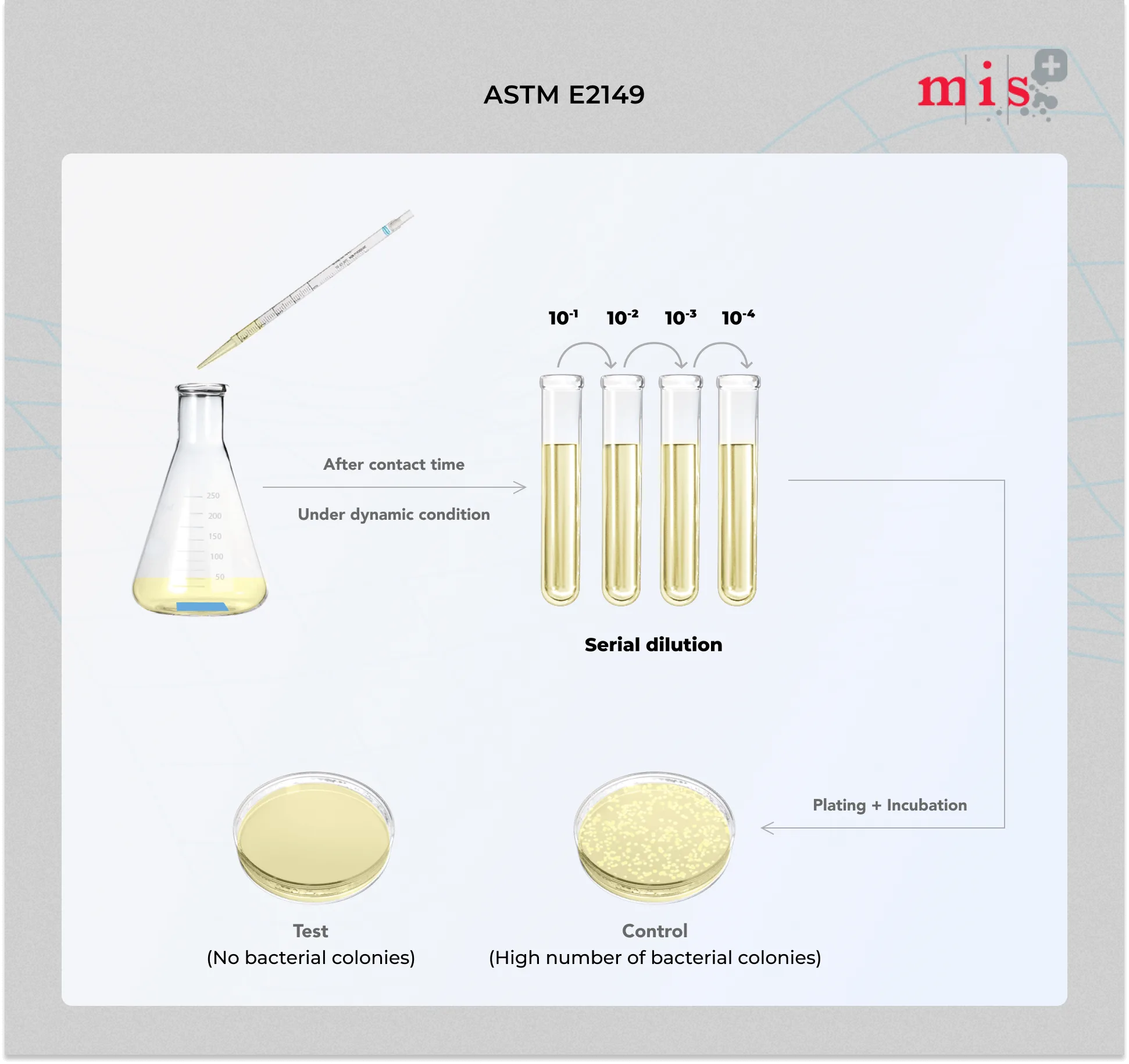
- The test microorganism culture is standardized and diluted to sterile buffer in order to prepare the inoculum.
- A fixed volume of microbial suspension in dispensed into 250 mL flasks placed for treated, untreated and inoculum-only (Blank) specimens.
- Both antimicrobial-treated, untreated specimens are placed in separate flasks and blank has no specimen.
- The flasks are agitated for the specified contact time of 1 hour.
- After contact time, the microorganisms from each flask are enumerated and the reduction is calculated for both treated and untreated samples.
- If the test specimen has substantial reduction in microorganisms related to either inoculum only or untreated specimen, it is concluded that it is antimicrobial.
Log Reduction & Result Interpretation for ASTM E2149
ASTM E2149 results are reported as log reduction, indicating the decrease in viable microorganisms on treated materials compared to untreated controls. Higher log reduction values, stronger is the antimicrobial performance under dynamic contact conditions.
General Interpretation:
- ≥ 2.0 Log (≥ 99%) – Strong antimicrobial activity
- < 1.0 Log (< 90%) – Low or limited antimicrobial activity
Advantages of ASTM E2149 Test
- This is the only test method applicable specifically for evaluating non-leaching materials with irregular surfaces.
- Its applicability to a broad spectrum of products of various shapes and sizes makes it a reliable benchmark for antimicrobial performance comparison.
Limitations of ASTM E2149 Test
- The dynamic shaking conditions may not accurately represent real-world exposure or surface-use scenarios.
- For objects with flat and smooth surfaces, other test methods such as JIS Z 2801, ISO 22196 are recommended over ASTM E2149.
Applications of ASTM E2149 Across Industries
ASTM E2149 is widely applied to evaluate the antimicrobial performance of non-leaching, contact-active materials under dynamic conditions.
Common Industry Applications:
- Healthcare & Medical
- Textiles & Furnishings
- Plastics & Polymers
- Packaging
- Consumer Products
- Coatings & Surface Treatments
Why Choose Our Lab for ASTM E2149 Testing
At Microbe Investigations Switzerland (MIS), we offer ASTM E2149 testing services to evaluate the antimicrobial activity of non-leaching materials under dynamic contact conditions. Our team ensures precise, reproducible, and standardized testing to help you demonstrate the effectiveness of antimicrobial additives and validate product performance.
Partner with MIS to verify your material’s antimicrobial efficacy, enhance product credibility, and ensure compliance with industry standards.
Request ASTM E2149 Testing
Looking for ASTM E2149 dynamic contact antimicrobial testing? Contact us today to discuss your requirements
Frequently Asked Questions on ASTM E2149 Test

DR. Martinoz Scholtz
1. What is the ASTM E2149 test?
ASTM E2149 is a sensitive test used for determining the antimicrobial activity of immobilized antimicrobial agents under dynamic contact conditions. It measures the antimicrobial activity of non-leaching, irregularly shaped, or hydrophobic surfaces.
2. What Products Can Be Tested Using the ASTM E2149 Test?
The test is applicable to measuring the antimicrobial activity of non-leaching (immobilized and not water-soluble), irregularly shaped, or hydrophobic surfaces. Products tested include fabric, paper, powder, granular material, and other solids.
3. What is the Turnaround Time for the ASTM E2149 Test?
The test takes 2-3 weeks to complete.
4. What Types of Microorganisms Are Used in ASTM E2149 Testing?
The microorganisms typically include common bacteria such as Staphylococcus aureus (Gram-positive) and Escherichia coli (Gram-negative). Other microorganisms like Pseudomonas aeruginosa, Klebsiella pneumoniae, and fungi like Candida albicans may also be used depending on the specific requirements of the test.
5. What is the shake flask method?
The shake flask method is used in a laboratory to assess the antibacterial efficacy of treated materials. In this method, treated samples are cultured in a nutrient broth containing a particular microorganism. The flask is agitated to facilitate better contact of the microorganisms with the treated material. After the incubation period, the decrease in microbial count is measured to determine the antimicrobial effectiveness.
6. How Can I Prepare My Product Samples for ASTM E2149 Testing?
Before conducting the test, ensure that the product samples are cut to appropriate sizes according to the protocol. The samples should be in a germ-free state and handled aseptically to reduce interference by unwanted organisms. Follow the specific sample preparation procedures given by the testing laboratory.
7. How Does ASTM E2149 Specifically Assess the Antimicrobial Properties of Textiles?
This test determines the ability of coated or treated textile samples to control microbial growth. It involves exposing the tested material to a microbial growth medium containing viable microbial cells. Each sample-containing flask is shaken to facilitate contact between microorganisms and the treated textile. Subsequently, microbial count is determined, followed by the evaluation of microbial reduction to assess the antimicrobial effectiveness of the textile.
8. What are the acceptance criteria for this test?
The acceptance criteria vary based on the specific test requirements and regulatory demands of the sector. Ideally, at least a 1 log reduction compared to the control sample should be obtained. Higher log reduction signifies higher antimicrobial effectiveness.
9. Are there any industry-specific requirements that make this test essential?
Yes. ASTM E2149 is considered essential in industries where non-leaching, surface-bound antimicrobial technologies are used and static tests are not representative of real performance.
10. How does ASTM E2149 testing ensure compliance with international antimicrobial standards?
ASTM E2149 ensures compliance with international antimicrobial standards by providing standardized, reproducible log-reduction data that aligns with internationally accepted antimicrobial testing principles.
11. When should ASTM E2149 be used instead of AATCC 100?
ASTM E2149 should be used for evaluating non-leaching, surface bound antimicrobial treatments that require dynamic agitation for effective contact between microbes and the treated surface.
12. Is ASTM E2149 suitable for non-leaching antimicrobial agents?
Yes, ASTM E2149 is specifically designed for immobilized, non-leaching antimicrobial agents that can’t diffuse into the surrounding environment.
13. Does ASTM E2149 support antimicrobial efficacy claims?
Yes, ASTM E2149 provides quantitative log reduction data that can be used to support antimicrobial performance and efficacy claims
14. What is the difference between dynamic contact and static tests?
Dynamic contact tests use continuous agitation to keep microorganisms in motion and in frequent contact with the treated surface. Static tests (such as AATCC 100) are used for contact-active, diffusible antimicrobial treatments.
15. Can ASTM E2149 be used for antimicrobial coatings?
Yes, ASTM E2149 is commonly used to evaluate antimicrobial coatings and surface treatments applied to plastics, metals, textiles, and other substrates.
16. What log reduction is considered effective in ASTM E2149 ?
Lorem ipsum dolor sit amet, consectetur adipisicing elit. Optio, neque qui velit. Magni dolorum quidem ipsam eligendi, totam, facilis laudantium cum accusamus ullam voluptatibus commodi numquam, error, est. Ea, consequatur.
17. What is the difference between ASTM E2149 and AATCC 100?
ASTM E2149 uses dynamic contact conditions and is used for hydrophobic surfaces with non-leaching antimicrobial agents. AATCC 100 is a static test method typically used for hydrophilic textiles with leaching or diffusible antimicrobial treatments.
Meet the best of the blend of
R&D, Efficacy Testing,
Innovation and Passionate
Experts at MIS.





Explore More

Antimicrobial textiles have recently gained

Key takeaways ISO 20743 and

Picture a fabric that goes

Introduction The Japanese Industrial Standards