Home / Textiles / antibacterial / AATCC 100
- Swiss testing laboratory
AATCC 100 Antimicrobial Fabric Testing

Hassle-free testing experience
Need to get a product tested? No worries! To and fro logistics are on us; we collect your products, test them and, deliver them back to you.
Summary
AATCC 100 evaluates the antimicrobial performance of treated textiles and porous fabrics. It is applicable to manufacturers and R&D teams seeking to validate antibacterial claims. Our lab provides reliable testing and detailed results to support product efficacy and compliance needs..
Related tests for you
Determination of Antibacterial Activity of Textile Products
Dynamic Shake Flask Test
What is the AATCC 100 Test Method?
The AATCC 100 test method is a quantitative test method to determine the efficacy of antibacterial finishes applied to textile materials. Fabrics treated with antibacterial finishes offer protection to the users from harmful bacteria meanwhile reducing the risk of transmission of diseases.
AATCC 100 test method provides the evaluation of the bactericidal (bacterial killing) and bacteriostatic (inhibition of bacteria growth) activity of fabric material over a contact period of 24 hours against the test bacteria. In this method, microbial concentrations are standardized, and bacteria are provided with nutrients throughout the incubation period. If the test fabrics do not have strong antimicrobial potential, then this will allow bacteria to flourish and grow.
In addition to AATCC 100, ISO 20743 and JIS L 1902 are also used for antibacterial testing of textiles, as per client needs.
Quick understanding of AATCC 100 Antimicrobial Fabric Testing
AATCC 100 – Test Method for Antibacterial Finishes on Textile Materials
- Staphylococcus aureus (ATCC 6538P)
- Klebsiella pneumoniae (ATCC 4352)
Methodology
- The test is performed on both treated (test) and untreated (control) fabric samples.
- Samples are inoculated with 1.0 ± 0.1 mL bacterial suspension to allow easy enumeration at 0 contact time.
- A neutralizing solution is added to half the samples at 0 contact time; the remaining samples were incubated at 37 ± 2°C for 18–24 hours.
- After incubation, neutralized samples are shaken, serially diluted, and plated to quantify viable bacteria.
- Antibacterial activity is assessed by comparing bacterial reduction between treated and untreated samples. Know more
Benefits
- Provides precise measurement of microbial reduction for accurate antimicrobial evaluation.
- Ensures compliance with quality and regulatory standards for antibacterial textile products.
Turnaround Time
It typically takes 1-2 weeks
Results
Do you have a product that needs testing?
Mandatory Test Organisms for AATCC 100
- Staphylococcus aureus (ATCC 6538P),
- Klebsiella pneumoniae (ATCC 4352)
On customer demand, additional bacterial strains can also be tested to meet specific requirements
- Escherichia coli (ATCC 8739)
- Pseudomonas aeruginosa (ATCC 15442)
- Enterococcus hirae (ATCC 10541)
- MRSA (ATCC 33591)
- Salmonella enterica (ATCC 10708)
Products that can be tested with AATCC 100 test
The AATCC 100 is a quantitative test method used to determine the antibacterial effectiveness of a textile or porous material, such as
- Woven textile fabrics
- Knitted textile fabrics
- Nonwoven materials
- Wound dressings and medical gauze
- Bandages and healthcare textiles
- Bedding and home textiles
- Uniforms and performance apparel
How we perform AATCC 100 Testing
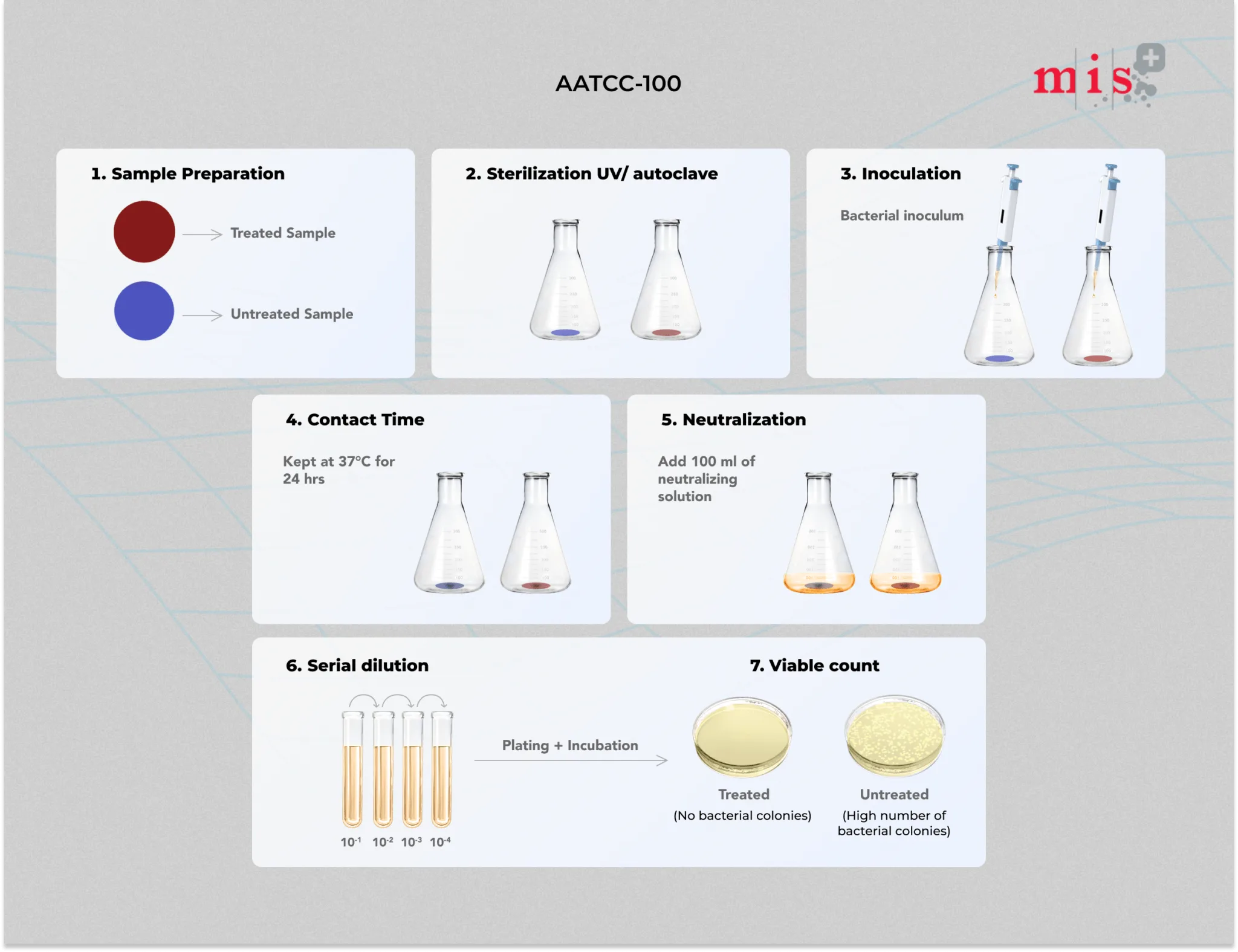
- AATCC 100 test is performed with both the antibacterial treated (test) and non-treated (control) samples of the fabric material.
- The amount of inoculum used for this test is 1.0 ± 0.1 mL. This ensures the easy enumeration of bacteria at “o” contact time for control.
- After inoculation (0 contact time), a neutralizing solution is added to half of the samples to suppress the bactericidal action and to maintain the right pH balance. And remaining samples are incubated at 37 °C ± 2 °C for 18 h to 24 h.
- After incubation, neutralizing solution is added to the samples. Components are shaken either by using hands or a vortex to ensure proper mixing.
- Serial dilutions of neutralizing solution are made and plated to enumerate the remaining bacteria.
AATCC 100 Test Results and Reporting
In this test method, antibacterial activity is evaluated by comparing the reduction in viable bacterial counts on the treated textile against an untreated control. The method assesses both bacteriostatic activity (inhibition of bacterial growth) and bactericidal activity (destruction of bacteria) of the antimicrobial treatment.
Industries Using AATCC 100 Testing
- Apparel & Clothing
- Healthcare & Medical Textiles
- Home Textiles
- Hospitality & Commercial Textiles
- Protective Textiles (e.g., masks, uniforms)
AATCC 100 vs Other standards
Category | AATCC 100 | ISO 20743 | AATCC 147 |
Claims | Antibacterial | Antibacterial | Antibacterial (qualitative) |
Mandatory test organisms | Staphylococcus aureus, Klebsiella pneumoniae | Staphylococcus aureus, Klebsiella pneumoniae | Staphylococcus aureus (primary), Klebsiella pneumoniae |
Applicability
Scope of products | Mainly applicable for US, widely used for product claims Hydrophilic textile and other porous textile materials | International standard, recognized for global compliance Hydrophilic textile and miscellaneous goods | Mainly applicable for US, early-stage testing of textiles Diffusible antimicrobials on treated textile surfaces |
Passing criteria | % reduction of bacteria compared to control | % reduction of bacteria compared to control | Presence of zone of inhibition around the specimen |
MIS expertise
We provide testing services around the globe in the fields of bacteriology, virology, entomology, and odor testing using advanced testing techniques to run our testing procedures efficiently. Our constant focus is to provide fast and accurate results at an affordable price.
Request AATCC 100 Testing (CTA)
Need to validate the antimicrobial efficacy of your treated textile as per AATCC 100?
Contact us today to schedule testing and obtain reliable, standards-compliant results
Frequently Asked Questions on AATCC 100 Antimicrobial Fabric Testing
DR. Martinoz Scholtz
1. What is the AATCC 100 test method?
The AATCC 100 standard test method is used to quantitatively determine the efficacy of antibacterial finishes applied to textile materials.
2. What are the Products that can be tested with AATCC 100 test?
The AATCC 100 is a quantitative test method used to determine the antibacterial effectiveness of all textile products such as cloth, wadding, thread, bedclothes, home furnishings, and miscellaneous goods. This test method applies to all textile products such as cloth, wadding, thread, bedclothes, home furnishings, and miscellaneous goods.
3. How long does it take to run the AATCC 100?
The AATCC 100 test takes 1-2 weeks to complete.
4.What is the difference between bacteriostatic and bactericidal results in AATCC 100?
Bacteriostatic results show the antimicrobial treatment inhibits bacterial growth, while bactericidal results indicate the treatment kills the bacteria as quantified by reduction in viable counts.
5. Can AATCC 100 testing be done after washing or laundering the fabric?
Yes, manufacturers often request the fabric be washed/laundered before testing to evaluate the durability of the antimicrobial finish under real use conditions.
6. How should samples be prepared and submitted for the AATCC 100 test?
For AATCC 100, the standard test sample size is typically circular pieces of about 4.8 ± 0.1 cm in diameter (approximately 48 × 48 mm) . Both treated and untreated control samples should be submitted in this size for accurate antimicrobial testing.
7. Can AATCC 100 be used to assess antiviral activity on textile materials?
No, AATCC 100 is specifically an antibacterial test, antiviral activity of textile can be checked using different standards such as ISO 18184.
8. Why is a neutralizer used in the AATCC 100 test, and how does it work?
A neutralizer is used to stop the antimicrobial action after incubation so that the surviving bacteria can be recovered and counted accurately.
9. How is antimicrobial effectiveness calculated in AATCC 100?
Effectiveness is calculated by comparing the reduction in viable bacterial count on the treated sample versus the untreated control, typically expressed as percent reduction.
Meet the best of the blend of
R&D, Efficacy Testing,
Innovation and Passionate
Experts at MIS.

Explore More
Key Takeaways ISO 18184 evaluates
Key takeaways ISO 20743 and
Introduction The Japanese Industrial Standards