Quick insights
- EN 16777 test method is a quantitative carrier test used to determine the virucidal efficacy of chemical disinfectants.
- Categorised as phase 2 step 2 test, it evaluates disinfectant performance against dried contaminated carrier surfaces to simulate practical use conditions
- The test method is intended for disinfectants used on hard, non-porous surfaces in medical and healthcare settings.
- In europe, EN 16777 is widely and practiced standards to meet regulatory compliance under the EU Biocidal Products Registration (BPR)
- To pass the test, a disinfectant must achieve a minimum of 4 log reduction in viral titre
Summary
EN 16777 test method is a quantitative carrier test (phase 2 step 2) used to evaluate the virucidal efficacy of disinfectants used on hard, non-porous surfaces. Testing involves the contamination of carrier surfaces with target viruses before treating with disinfectant samples in order to replicate real-use conditions. This method is important to meet regulatory approval under BPR afor surface disinfectants used in healthcare and industrial hygiene areas.
What is EN 16777?
EN 16777 is a phase 2 step 2 European standard that evaluates the virucidal efficacy of chemical disinfectants used on hard, non-porous surfaces. It is intended for disinfectants used in medical environments, as surface contamination is a major contributing factor in transmitted infections in these areas. EN 16777 uses a carrier as a test surface to replicate real-world contamination conditions. The test provides a quantitative assessment of disinfectant efficacy, supporting product validation.
How does EN 16777 fit within european disinfectant testing standards?
In Europe, products intended for healthcare and medical settings cannot claim antiviral effectiveness without evidence. The European Committee for Standardization (CEN) provides a structured testing framework through which the efficacy of disinfectants must be validated under specific test conditions and passing efficacy criteria by using methods as EN 16777.
This helps ensure that products perform well under stipulated test conditions that reflect real-world use. Such testing standards help to generate the efficacy data that helps meet the requirements of the Biocidal Products Regulation (BPR) before products can be launched into the market.
Why does EN 16777 matter for surface disinfectants?
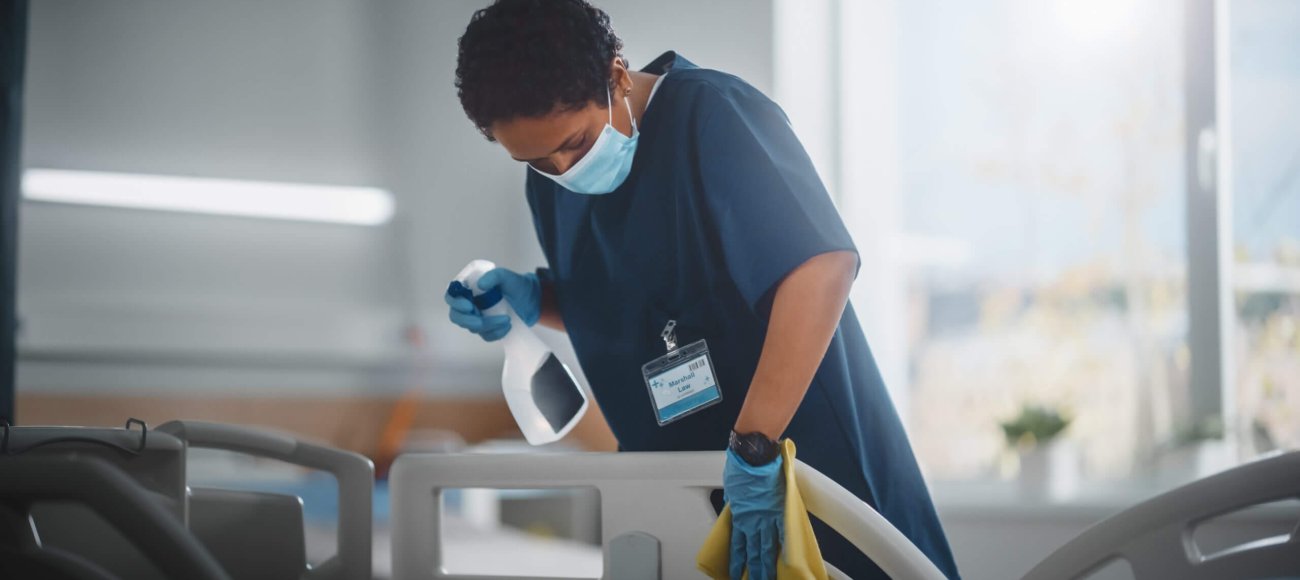
Viruses can remain infectious inanimate surfaces such as door handles, bed rails, medical equipment, and countertops for hours or even days since they are touched frequently. A disinfectant that performs well in suspension test may not necessarily perform on the same level once viruses have dried onto a surface.
EN 16777 addresses this difficulty by assessing efficacy of disinfectants under real-world surface conditions. The test quantifies how effectively a product inhibits the growth of viruses on hard, non-porous surfaces, demonstrating a realistic performance validation.
Also read
Scope of EN 16777 testing
EN 16777 is applicable to:
- Ready-to-use or dilutable surface disinfectants
- Products for non-porous medical surfaces
- Disinfectants for medical device surfaces
- Products applied by wiping, spraying, or flooding
- Disinfectants used in healthcare and clinical environments
EN 16777 test procedure
- A defined volume of virus suspension mixed with interfering substance is applied onto stainless steel discs (carriers) and allowed to dry.
- Disinfectant is applied on the dried inoculated surfaces
- After defined contact time, neutralization is performed to stop the disinfectant activity
- After neutralization, the remaining titre of virus is determined and reduction in virus titre is compared to the control sample.
Test viruses used in EN 16777 test method
- For general virucidal claims – Adenovirus, Murine Norovirus
- For enveloped virus claims – Vaccinia virus
EN 16777 test conditions
The EN 16777 test method is performed under defined conditions
| Parameter | Virucidal activity | Limited spectrum virucidal activity | Virucidal activity against enveloped viruses |
| Mandatory test organisms | Adenovirus and murine norovirus | Adenovirus and murine norovirus | Vaccinia virus |
| Test temperature | Between 18°C and 25°C ( Additional temp – Between 4°C and 30°C) | ||
| Contact time | According to manufacturer’s recommendation, but no longer than 5 min or 60 min | ||
| Interfering substance | Clean conditions – 0.3 g/L BSA
Dirty conditions – 3.0 g/L BSA + 3.0 mL/L erythrocytes |
||
EN 16777 passing criteria and log reduction requirements
Under EN 16777 test method, a products is considered to pass if it achieves –
A minimum of 4 log reduction (99.99%) in viral titre under the defined test conditions.
EN 16777 vs other test standards
| Parameter | EN 16777 | EN 14476 | ASTM E1053 |
| Claim | Antiviral | Antiviral | Antiviral |
| Test phase | Phase 2 Step 2 Carrier test | Phase 2 Step 1 Suspension test | Phase 2 step 2 carrier test |
| Mandatory test organisms | Adenovirus and Murine Norovirus for general virucidal claims, Vaccinia virus for enveloped virus claims | Enveloped and non-enveloped viruses such as Poliovirus, Adenovirus, Murine Norovirus and Vaccinia virus | Virus selected based on claim |
| Scope of products | Disinfectants intended for non-porous surface disinfection in medical areas without mechanical action | Disinfectants, antiseptics. hand hygiene products and textile disinfectants for medical/healthcare applications | Disinfectants such as liquids, trigger sprays, aerosols etc used in high-touch surfaces |
| Passing criteria | ≥ 4 log reduction | ≥ 4 log reduction | ≥ 4 log reduction |
Also read
- EN 14476 Virucidal Efficacy Testing
- ASTM E1053 Virucidal Activity Test for Disinfectants on Nonporous Surfaces
EN 16777 testing for BPR compliance
Under the European Biocidal Products Registration (BPR), disinfectants must demonstrate efficacy through recognized standards. The EN 16777 test method is one of the key requirements for supporting surface virucidal claims. Manufacturers must provide validated data from accredited laboratories to support product authorization and market entry in the EU.
How to prepare for EN 16777 testing
Preparing for EN 16777 test method involves following crucial steps –
- Select appropriate test viruses based on claim scope
- Ensure product formulation is stable and representative
- Define intended use conditions (contact time, dilution specifications)
- Conduct preliminary screening using suspension tests
Choosing the right laboratory for EN 16777 testing
We are a CRO and independent testing laboratory specializing in disinfectant efficacy testing. At MIS, we perform EN 16777 virucidal surface testing to produce reproducible results that help your product support regulatory compliance and quality assurance.
Contact MIS to discuss your virucidal disinfectant testing requirements.
Other related blogs
- Difference Between EN 1276 and EN 14476: Bactericidal vs Virucidal Standards Explained
- Why 4 Log Reduction is Mandatory for EN 14476? Requirements and Testing Explained
- ISO 21702 vs ISO 18184 vs EN 14476 – Which Antiviral Test Is Right for Your Product?
FAQs
1. Is EN 16777 a suspension test or a surface test?
EN 16777 is a surface carrier test. It evaluates how effectively a disinfectant inactivates viruses that have dried onto hard surfaces, making it more representative of real-world surface disinfection conditions.
2. What is the required log reduction for passing EN 16777?
A product must achieve a minimum of 4 log reduction to pass EN 16777 test method
3. What products can be tested according to EN 16777?
Surface disinfectant, sprays, and wipes designed for non-porous surfaces
4. What are clean and dirty conditions in EN 16777?
Clean and dirty conditions refer to low and high organic load conditions simulating real-world contamination.
5. How long does EN 16777 testing take?
EN 16777 typically takes 4-5 weeks to complete
6. Can disinfectant wipes be tested using EN 16777?
Yes, disinfectant wipes can be tested under EN 16777
7. What is the difference between EN 16777 and EN 14476?
EN 14476 is a suspension test, while EN 16777 is a carrier test that evaluates disinfectant efficacy using carrier surfaces contaminated with test virus strains.
8. Why are viruses dried onto surfaces before testing?
This step is performed to simulate real-world environmental contamination conditions
9. Which viruses are required for EN 16777 testing?
EN 16777 test method mainly uses Adenovirus, Murine norovirus and Vaccinia virus
10. Can a product pass EN 14476 but fail EN 16777?
Yes, carrier tests are often more challenging than suspension tests, even if the product performs well in the suspension test, there is a chance it might fail in the carrier test.