Home / Disinfectant Testing / antibacterial / EN 1499
- Swiss testing laboratory
BS EN 1499: 2013

Hassle-free testing experience
Need to get a product tested? No worries! To and fro logistics are on us; we collect your products, test them and, deliver them back to you.
Summary
EN 1499 is a phase 2, step 2 European standard used to evaluate the bactericidal efficacy of hygienic handwash products under practical-use conditions. The test measures the reduction of transient microorganisms on artificially contaminated hands of human volunteers and compares the test product’s performance against a reference formulation to verify the effectiveness when used in healthcare and other hygiene-important settings.
Related tests for you
What is EN 1499?
Hygienic hand wash products must undergo rigorous testing and meet stringent regulatory standards to ensure their safety and efficacy before they are launched in the European market. BS EN 1499 plays a crucial role in this evaluation process. It is a phase 2 step 2 quantitative suspension test used for evaluating the efficacy of hygienic hand wash products in reducing transient microbial flora. This test simulates real-world conditions to provide a reliable measure of how well these products perform in reducing microbial load.
Quick understanding of the BS EN 1499 test
BS EN 1499: 2013 – Chemical Disinfectant and Antiseptics. Hygienic Handwash (phase 2, step 2 test)
- Escherichia coli K12
- Volunteers’ hands are washed to remove impurities.
- Hands are artificially contaminated with a microbial suspension.
- Pre-values of viable bacteria are determined.
- Contaminated hands are washed with the test product for the specified contact time.
- After the contact time, fingers are placed in a neutralizing solution.
- The neutralized extract is plated and incubated to determine the remaining viable microorganisms.
- By using human volunteers, the test demonstrates the product's effectiveness under practical usage conditions.
- Provides a quantitative analysis of the product’s efficacy rather than qualitative results.
Turnaround Time
Passing criteria
Do you have a product that needs testing?
Products tested
EN 1499 standard is applicable for antimicrobial handwash products intended for use in areas and/or situations where disinfection is medically indicated such as –
- In health care settings such as hospitals, in community medical facilities, and in dental institutions
- In clinics of schools, of kindergartens, and of nursing homes
- Other areas like laundry and catering service providing direct product supply for patients
- May also occur in workplace and in home
BS EN 1499 Test Conditions & Requirement
BS EN 1499 Test Method
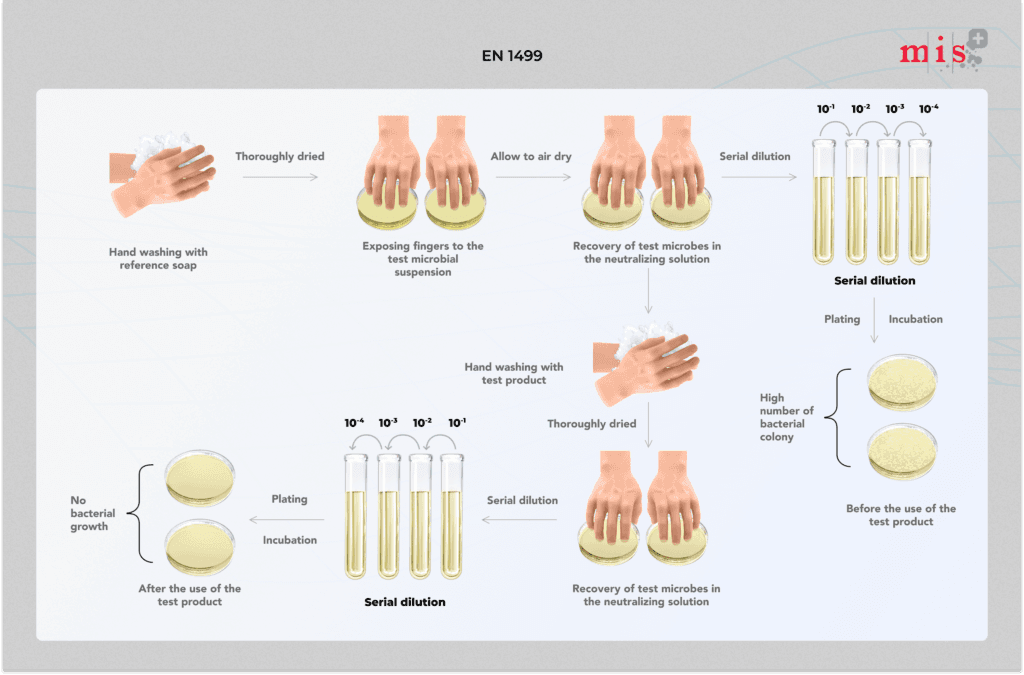
Preparation
Before contamination, the hands of both groups (control and test) are washed to remove dirt and other impurities.
Contamination
Hands are immersed in microbial suspension and dried. Pre-values of viable bacteria are determined by dipping fingertips into tryptic soy broth (TSB).
Handwashing
Contaminated hands are washed with the hand wash product for 30-60 seconds or as per the manufacturer’s recommendation.
Neutralization
After the specified contact time, fingers are placed in a neutralizing solution to recover the remaining viable microorganisms.
Incubation and counting
A portion of the neutralized extract is plated and incubated to determine the remaining viable microorganisms.
Result analysis
Results are analyzed by comparing the number of microorganisms isolated from contaminated hands that were washed with the test product to the microorganisms recovered from contaminated hands that were washed with unmedicated liquid soap.
Passing Criteria
To pass the EN 1499 test, the mean reduction in the release of microbes achieved by the hygienic handwash with the product under test should be larger than that achieved by a specified reference hygienic handwash (unmedicated liquid soap).
Importance of BS EN 1499 Test
Proper hand hygiene in healthcare is important in order to avoid the direct transmission of pathogenic microorganisms. Hand wash products with antimicrobial agents provide a further step in protection against injurious microbes. EN 1499 has been specifically developed to test such products for efficacy to ensure that, when used, they are strong enough and reliable for medical environments. Hand wash products conforming to EN 1499 standards will ensure reduction in microbial contamination, thus protecting healthcare workers and patients from harmful microbes.
EN 1499 vs EN 1500
Parameter | EN 1499 | EN 1500 |
Purpose | To evaluate the bactericidal efficacy of hygienic hand wash products (soaps and hand washes) | To evaluate the bactericidal efficacy of hygienic hand rubs (alcohol-based hand sanitizers) |
Mandatory test strains | Escherichia coli K12 (NCTC 10538) | Escherichia coli K12 (NCTC 10538) |
Test phase | Phase 2 step 2 | Phase 2 step 2 |
Reference product for comparing efficacy | Standard soft soap | 60% propan-2-ol |
Scope of products | Hygienic hand wash products intended for healthcare and other medical settings | Hygienic hand rubs intended for healthcare and other medical settings |
Passing criteria | The mean microbial reduction achieved by the test product must be greater than that of the reference product | The product must achieve a significant microbial reduction equivalent to or greater than 60% propan-2-ol under test conditions |
EN 1499 vs ASTM E1174
Parameter | EN 1499 | ASTM E1174 |
Purpose | To evaluate the bactericidal efficacy of hygienic hand wash products (soaps and hand washes) | To evaluate the antimicrobial effectiveness of healthcare personnel hand wash formulations against transient microorganisms |
Mandatory test strains | Escherichia coli K12 (NCTC 10538) | Serratia marcescens Escherichia coli |
Scope of products | Hygienic hand wash products intended for healthcare and other medical settings | Hand wash agents, alcohol-based hand rubs and leave-in formulations |
Passing criteria | The product must demonstrate a significant log reduction in microbial load than a reference product | The product must demonstrate a significant log reduction in microbial load than a a reference product |
Regulatory significance | Supports efficacy claims for antimicrobial handwash products under European hygiene and biocidal regulations | Supports efficacy claims for companies developing hand hygiene products for the North American market |
Benefits of Performing BS En 1499 Test
Regulatory compliance:
Testing helps manufacturers meet international regulatory requirements thus ensuring their products are safe and effective for use.
Builds consumer trust:
Products that pass the test are trusted to provide reliable protection against harmful microorganisms. This aids in enhancing consumer confidence.
Supports market access:
Compliance with this standard can be a requirement for market entry in various regions. Thus, compliance facilitates wider distribution and acceptance of the product.
Contact MIS for EN 1499 testing services
At Microbe Investigations Switzerland (MIS), we offer EN 1499 testing services for hygienic handwash products under all the mandatory parameters such as standardized contamination scenarios, controlled washing procedures, and precise microbial reduction measurements. Our laboratory provides reliable, reproducible, and fully compliant results that help you substantiate your hygiene claims with confidence.
In addition to EN 1499, we also perform EN 1500 testing for hygienic hand rubs and EN 14476 for virucidal activity, ensuring your formulations meet the highest standards for antimicrobial performance.
Contact MIS today to discuss your testing requirements and ensure your products meet the most critical European hygiene benchmarks.
Frequently Asked Questions on BS EN 1499

DR. Martinoz Scholtz
1. What is the EN 1499 test?
The BS EN 1499 is a phase 2 step 2 quantitative suspension test. This test simulates practical conditions to check whether hand wash products are capable of inactivating transient microbial flora on artificially contaminated hands of volunteers.
2. What types of hand wash products can be tested using this standard?
The test applies to hygienic hand wash products designed to be used in areas where disinfection is medically indicated.
3. What is the turnaround time for this test?
It takes 2-3 weeks to complete the test.
4. What specific microorganisms are targeted in the test?
At Microbe Investigations Switzerland, we perform this test using the following microbial strains: Escherichia coli (ATCC 8739). Additional stains can be added at the customer’s request.
5. How does the test evaluate the effectiveness of hygienic handwash products?
The effectiveness of hygienic handwash products is evaluated by contaminating the volunteers’ hands with E. coli. The number of bacteria released from the fingertips into sampling fluids is measured before and after handwashing with the test product. The reduction in microbial count indicates the product’s efficacy.
6. What are the key criteria for a hand wash product to pass this test?
To pass this test, the mean reduction in the release of microbes achieved by the hygienic handwash with the product under test should be larger than that achieved by a specified reference hygienic handwash (unmedicated liquid soap).
7. Can the test be used to compare the effectiveness of different hand wash formulations?
Yes. The test can compare the efficacies of different handwashes by testing them under the same conditions and comparing their microbial reduction results.
8. What kind of report will I receive after the completion of the test?
Your test report provides information on the microbial counts before and after handwashing, the reduction in microbial load, and an evaluation of the product’s efficacy against the reference handwash.
9. Can the test results support product claims and regulatory compliance?
Yes. The test results support product claims and regulatory compliance by providing scientifically validated evidence of the product’s antimicrobial efficacy.
10. How often should hand wash products be tested?
Testing the product depends on regulatory requirements, product formulation changes, and quality assurance protocols. Regular testing is recommended to ensure continued compliance.
Meet the best of the blend of
R&D, Efficacy Testing,
Innovation and Passionate
Experts at MIS.





Explore More
Key Takeaways EN 13727 and

Key Takeaways EN 1040 is
Key takeaways EN 1276 is

Antimicrobial testing is important to
Antibacterial efficacy testing is an