Home / Disinfectant Testing / antibacterial / AOAC 960.09
- Swiss testing laboratory
AOAC 960.09 Germicidal and Detergent Sanitizer Test for Food Contact Surfaces

Hassle-free testing experience
Need to get a product tested? No worries! To and fro logistics are on us; we collect your products, test them and, deliver them back to you.
Summary
AOAC 960.09 is a standardized test method used to evaluate the effectiveness of sanitizers on pre-cleaned, non-porous food-contact surfaces. It measures whether a product can achieve a ≥ 5 log (99.999%) reduction of key bacteria such as Staphylococcus aureus and Escherichia coli under controlled conditions. Recognized by U.S. EPA, this method is essential for supporting food-contact sanitizer claims and regulatory submissions.
Related tests for you
Quick understanding of the test
AOAC 960.09 - Germicidal and Detergent Sanitizing Action of Disinfectants
Application
Mandatory test strains
- Escherichia coli
- Staphylococcus aureus
- The test suspension is inoculated into a flask containing the test product and allowed to interact for a specified contact time.
- The initial concentration of the microorganisms is determined by inoculating the test suspension into a flask containing a non-antiseptic buffer.
- After contact time, the mixture is neutralized, followed by plating and incubation.
- After incubation, the reduction in viable microorganisms is determined and compared to the control.
- Provides a comprehensive assessment of the product by testing representative microorganisms.
- Reduces the risk of foodborne illnesses by ensuring germicidal efficacy of sanitizers.
Turnaround Time
Passing criteria
Do you have a product that needs testing?
What is AOAC 960.09?
AOAC 960.09 method is employed to determine the minimum concentration of chemicals that can be used for sanitizing precleaned, nonporous food contact surfaces.
AOAC 960.09 is an EPA-specified method that is particularly applicable for dilutable sanitizers that do not utilize halogens like chlorine and bromine.
Scope of AOAC 960.09 standard
This standard applies to:
- Food contact surface sanitizers
- Detergent disinfectants
- Industrial and institutional cleaning products
It is specifically designed for pre-cleaned, non-porous surfaces in food processing environments.
Test microorganisms used in AOAC 960.09
- Staphylococcus aureus
- Escherichia coli
AOAC 960.09 Test method overview
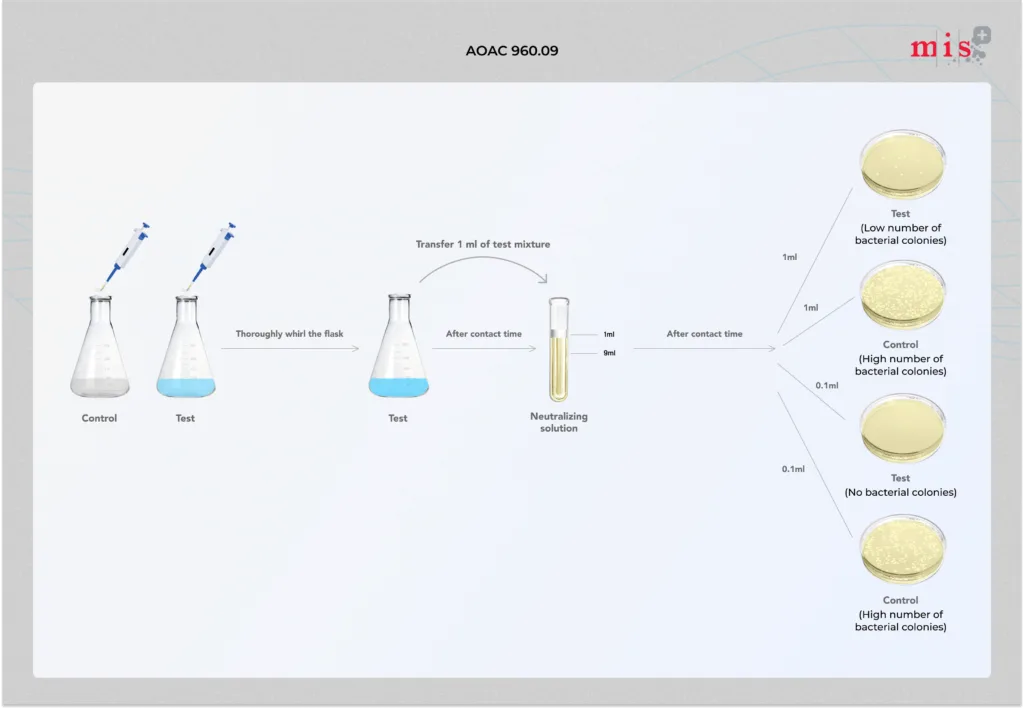
1.Test suspension preparation
- Culture of test microorganisms (gram + ve / gram -ve) are cultivated in appropriate broth and then standardized to 1 x 10^10 cfu/ml.
2.Exposure of test microorganisms to the sanitizer
- For each microorganism, 1 ml of test suspension is inoculated into an Erlenmeyer flask containing 99 ml of test product. This is allowed to interact for the specified contact time.
- For control test, 1 ml of test suspension is inoculated into an Erlenmeyer flask containing 99 ml of a non-antiseptic buffer to determine the initial concentration of microorganisms.
3.Neutralization step
- At the end of contact time, a small portion of (product + test suspension) is added to neutralizing solution and followed by dilution and plating to determine surviving microorganisms.
4.Enumeration and CFU calculation
- After the incubation period, reduction in microbes found in the test sample is compared with microbes obtained from the control sample.
Understanding log reduction results
Under AOAC 960.09, the test product must be able to kill more than 99.999% of both Gram-positive and Gram-negative microorganisms which is equivalent to achieving at least 5 log reduction.
Log reduction value | Percentage reduction | Efficacy level |
1 log | 90% | Very Low |
2 log | 99% | Low |
3 log | 99.9% | Moderate |
4 log | 99.99% | High |
5 log | 99.999% | Standard required sanitization efficacy |
AOAC 960.09 vs AOAC Use Dilution vs AOAC 961.02
Parameter | AOAC 960.09 | AOAC 961.02 | AOAC Use dilution test ( (AOAC 955.14, 955.15, 955.17, 964.02) |
Purpose | To evaluate the sanitizing effectiveness of disinfectants intended for pre-cleaned food contact surfaces | To evaluate the germicidal disinfectant efficacy of ready-to-use spray products on hard, non-porous surfaces | To evaluate the antimicrobial efficacy of disinfectants intended for use on inanimate, hard, non-porous surfaces |
Test strains | Staphylococcus aureus and Escherichia coli | Staphylococcus aureus, Pseudomonas aeruginosa, Salmonella enterica | Salmonella enterica, Staphylococcus aureus, Trichophyton mentagrophytes, Pseudomonas aeruginosa |
Test type | Suspension test | Carrier-based test | Carrier based test |
Passing criteria | Quantitative reduction criterion : ≥ 5 log (99.999%) reduction | Qualitative pass/fail assessment based on presence or absence of microbial growth on treated carriers | Qualitative pass/fail based on number of carriers showing no growth |
Applications of AOAC 960.09 test
AOAC 960.09 is widely used for germicidal and disinfectant products used for sanitizing pre-cleaned, nonporous food contact surfaces.:
- Food processing facilities
- Commercial Kitchens
- Dairy and beverage industries
- Dairy and beverage production units
- Surface sanitizer product development
Why products fail AOAC 960.09
Failure in AOAC 960.09 testing often indicates gaps in formulation, application, testing errors or real-world use of sanitizer. Understanding these failure points is essential for improving product performance and ensuring compliance.
- Low active ingredient concentration – If the antimicrobial agent is below the effective threshold, the sanitizer cannot achieve the required microbial reduction
- Incorrect dilution – Over-dilution of the product during use can significantly reduce efficacy, especially in industrial settings where manual preparation is common.
- Insufficient contact time – Sanitizers need a defined exposure period to work effectively, cutting this short leads to incomplete microbial kill.
- Poor neutralization – Inadequate neutralization during testing can skew results, making the sanitizer appear less effective than it actually is.
Regulatory relevance of AOAC 960.09
AOAC 960.09 holds strong regulatory importance, particularly in industries where sanitation claims must be scientifically validated and compliant with regulatory authorities. It is recognized by the U.S. Environmental Protection Agency as a reliable method for evaluating food-contact sanitizers, making it essential for products seeking regulatory approval.
The test supports broader food safety compliance by helping manufacturers meet established hygiene and sanitation requirements. It is also widely used to substantiate high-level efficacy claims such as 99.999% (5-log) microbial reduction, which is often necessary for both regulatory submissions and marketing.
When should you choose AOAC 960.09?
Choose AOAC 960.09 if your product
- Is a food contact sanitizer used on non-porous surface requiring sanitization claims (5-log reduction)
- Needs EPA-compliant validation
Importance of AOAC 960.09 Test
Maintaining proper hygiene in food preparation areas is of paramount importance to ensure the quality of food products and public health safety. Food contact surfaces serve as potential reservoirs of pathogenic microorganisms due to their frequent contact with raw ingredients, utensils, and workers.
Proper sanitization of surface areas helps in reducing the number of microorganisms, subsequently minimizing the risk of foodborne illnesses. AOAC 960.09 lays down efficacy criteria and test requirements to check the efficacy of the chemical used in the food industry for sanitizing precleaned food contact surfaces.
Why choose MIS
At MIS, we offer AOAC 960.09 testing services to support our clients in validating the efficacy claims of their products.
Our testing facilities are equipped with cutting-edge technology which enable us to guarantee the utmost level of accuracy and precision in our test reports.
Furthermore, we also perform AOAC 961.02 efficacy test for germicidal spray products as disinfectants.
Request AOAC 960.09 test
To get a quote on AOAC 960.09 test, contact our experts now.
Frequently Asked Questions

DR. Martinoz Scholtz
AOAC 960.09 is a standard method used to evaluate the efficacy of (germicidal and/or bactericidal products) intended for sanitizing pre cleaned, non- porous food contact surfaces. To meet AOAC 960.09 efficacy criteria, the test product must kill >99.999% of both the gram-positive and gram-negative test microorganisms.
The test requires a minimum 5-log (99.999%) reduction in target microorganisms. This ensures a high level of sanitization suitable for food safety applications.
It applies to hard, non-porous food-contact surfaces.
AOAC 960.09 test is applicable for germicidal and disinfectant products designed for the sanitization of precleaned food contact surfaces, providing results as quantitative log reduction values. Whereas, Use Dilution Test is used to evaluate the antimicrobial efficacy of disinfectants intended for use on inanimate, hard, non-porous surfaces, providing qualitative results based on presence or absence of microbial growth on treated carriers.
The primary test organisms are Staphylococcus aureus and Escherichia coli
Yes, it is recognized by the U.S. Environmental Protection Agency for validating food-contact surface sanitizer claims.
Yes, certain parameters like contact time or product dilution may be adjusted based on intended use conditions. However, modifications must align with regulatory expectations.
Failures typically result from ineffective concentration, insufficient contact time, over-dilution and testing errors.
Meet the best of the blend of
R&D, Efficacy Testing,
Innovation and Passionate
Experts at MIS.




Explore More
Key Takeaways EN 13727 and
Key Takeaways EN 1040 is

Antimicrobial testing is important to
Antibacterial efficacy testing is an