Home / Disinfectant Testing / Fungicidal & Yeasticidal / EN 1275
- Swiss testing laboratory
BS EN 1275: Evaluate Fungicidal activity of Disinfectant

Hassle-free testing experience
Need to get a product tested? No worries! To and fro logistics are on us; we collect your products, test them and, deliver them back to you.
Summary
EN 1275 is a phase 1 quantitative suspension test used to evaluate the basic fungicidal or yeasticidal activity of chemical disinfectants and antiseptics. It provides an insight of antimicrobial efficacy during product development and before phase 2 testing required for regulatory approval and market launch.
Related tests for you
What is EN 1275?
EN 1275 is a European standard developed to assess the basic fungicidal and yeasticidal activity of chemical disinfectants and antiseptics. It outlines a quantitative suspension test method that evaluates whether a product can effectively reduce the number of viable yeast and mould organisms under defined laboratory conditions. EN 1275 is Phase 1 suspension test, hence it helps with initial screening of products that are under development. It forms the basis for further testing required for product approval and regulatory compliance.
Quick understanding of the test EN 1275 Evaluate Fungicidal activity of Disinfectant
BS EN 1275: 2006 – Quantitative suspension test for the evaluation of basic fungicidal or basic yeasticidal activity of chemical disinfectants and antiseptics (phase 1)
EN 1275 is a Phase 1 quantitative suspension test. It is used to evaluate the basic fungicidal or yeasticidal activity of chemical disinfectants and antiseptics.
Application
- Candida albicans ( ATCC 10231)
- Aspergillus niger( ATCC 16404 )
- A product sample is mixed with a fungal suspension and allowed to interact for a specified time.
- Post contact times, the mixture is transferred to a neutralizing solution and incubated for specific times.
- Viable yeast or fungal colonies are enumerated and compared with control samples.
- Ensures consistent testing procedures across different laboratories, providing reliable and comparable results for basic fungicidal and yeasticidal efficacy.
- Validates products for use in diverse environments, including healthcare, domestic, and industrial settings.
Turnaround Time
Results are evaluated by comparing the reduction in fungal or yeast colonies in the test sample to control samples.
Passing criteria
Do you have a product that needs testing?
Scope of products for EN 1275 testing
EN 1275 test standard is applicable to active substances / antifungal biocides and formulations under development intended to be used in various settings such as –
- Food,
- Industrial,
- Domestic,
- Institutional
- Medical and
- Veterinary areas.
EN 1275 Test Conditions & Requirements
Mandatory test microorganisms – Candida albicans (MTCC 3017) and Aspergillus niger (ATCC-16888)
Temperature – 20 ± 1°C
Contact time – 15 mins
Pass criteria – Test must achieve atleast 4 log reduction to pass the EN 1275 Test.
EN 1275 Test Method
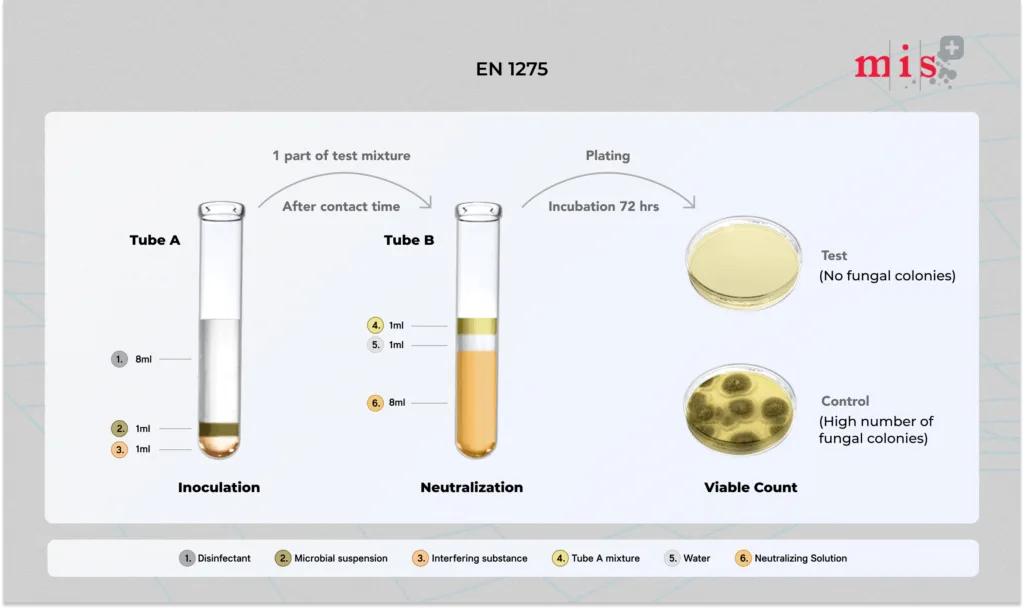
- Test product is challenged with microbial suspension.
- The mixture is allowed to interact for a specific period of time.
- After contact time, the test mixture is further transferred to a neutralizing solution to suppress fungicidal or yeasticidal activity.
- After neutralization, mixture is further incubated for 3 days to check if any viable microorganisms are present.
- Yeast or fungal colonies are enumerated and compared to control samples.
EN 1257 Pass Criteria Explained
To pass EN 1275, the test product must achieve a minimum of 4 log reduction (99.99%) in the number of viable fungal or yeast cells within the specified contact time and product concentration.
EN 1275 vs EN 13624 vs EN 1650
Parameter | EN 1275 | EN 1650 | EN 13624 |
Purpose | A phase 1 quantitative suspension test to evaluate the basic fungicidal or yeasticidal activity of chemical disinfectants and antiseptics | A phase 2 step 1 quantitative suspension test to evaluate the fungicidal or yeasticidal efficacy of disinfectants or antiseptics | A phase 2 step 1 quantitative suspension test to evaluate the fungicidal or yeasticidal efficacy of disinfectants and antiseptics |
Test phase | Phase 1 quantitative suspension test | Phase 2, step 1 quantitative suspension test | Phase 2 step 1 quantitative suspension test |
Mandatory test strains | Candida albicans (ATCC 10231) , Aspergillus niger (ATCC 16404) | Candida albicans, Aspergillus brasiliensis | Candida albicans (MTCC 3017), Aspergillus brasiliensis (ATCC 16888) |
Scope of products | Disinfectants and antiseptics intended for food, industrial, domestic, institutional, medical and veterinary applications | Disinfectants and antiseptics used in food, industrial, domestic and institutional environments | Medical disinfectants including –
|
Passing criteria | ≥ 4 log reduction | ≥ 4 log reduction | ≥ 4 log reduction |
EN 1275 vs EN 1276
Parameter | EN 1275 | EN 1276 |
Purpose | To evaluate the basic fungicidal or yeasticidal activity of chemical disinfectants and antiseptics | To evaluate the bactericidal activity of chemical disinfectants and antiseptics |
Test phase | Phase 1 quantitative suspension test | Phase 2 Step 1 quantitative suspension test |
Mandatory test strains | Candida albicans (ATCC 10231) , Aspergillus niger (ATCC 16404) | Enterococcus hirae, Escherichia coli, Pseudomonas aeruginosa, Staphylococcus aureus, E. Faecium |
Scope of products | Disinfectants and antiseptics intended for food, industrial, domestic, institutional, medical and veterinary applications | Disinfectants and antiseptics intended for food, industrial, domestic and institutional areas |
Passing criteria | ≥ 4 log reduction | ≥ 5 log reduction for general purpose disinfection and handrubs, ≥ 3 log reduction for handwashes |
When Is Additional Testing Required After EN 1275?
EN 1275 confirms the basic fungicidal or yeasticidal activity of a disinfectant but not alone sufficient to validate efficacy claims under practical use conditions. Tests under phase 2 step 1 and phase 2 step 2 better replicate real-world use conditions. Depending on the product’s intended application, additional standards are generally required.
Application of the product | Recommended phase 2 test |
Disinfectants & antiseptics intended for food, industrial, domestic and institutional settings | EN 1650 (Phase 2, Step 1) |
Surface disinfectants used on non-porous surfaces | EN 13697 (Phase 2, Step 2) |
Disinfectants used in medical settings | EN 13624 (Phase 2, Step 1) |
What Is the Difference Between Phase 1, Phase 2 Step 1, and Phase 2 Step 2 Disinfectant Tests?
Disinfectant testing under European testing guidelines classify efficacy testing into different phases which evaluate the disinfectant effectiveness from a laboratory conditions to simulated real-use conditions.
Feature | Phase 1 | Phase 2 Step 1 | Phase 2 Step 2 |
Purpose | Basic screening of antimicrobial activity | Evaluates efficacy under simulated practical conditions | Confirms efficacy under real-use conditions |
Testing Environment | Quantitative suspension test | Quantitative suspension test with interfering substances | Quantitative carrier test |
Mimic real world conditions | No | Partially | Yes |
Organic load Included | No | Yes | Yes |
Examples of Standards | EN 1040, EN 1275 | EN 13697, EN 16615, EN 1499, EN 16777 | |
Regulatory Significance | Provides preliminary efficacy data but is not sufficient for marketing claims | Required to support efficacy claims for many disinfectant products | Often required for surface disinfectants and products making practical-use claims |
Importance of EN 1275 Test
EN 1275 is important because it provides a standardized method for evaluating the basic fungicidal and yeasticidal activity of disinfectants. As a Phase 1 suspension test, EN 1275 does not assess product performance in real-world scenarios, instead it serves as an essential preliminary screening step to verify the product’s efficacy. It provides crucial efficacy data which is required by manufacturers to proceed further with testing under simulated real-world conditions. Furthermore, since this test is conducted during early stages of formulation development, any negative results obtained during testing can be used by the manufacturers to reform/ make essential improvements in the formulation to ensure better efficacy.
Conclusion
At MIS, our EN 1275 testing services are perfectly curated and executed as per customer requirements. With the help of latest technology and highly qualified professionals, we are able to provide time bound, reliable, and accurate testing services to our clients.
Our antifungal/yeasticidal disinfectant testing portfolio also includes EN 13624 and EN 1650 testing.
You can contact us here in case of any query regarding EN 1275 test or any other relevant method. Our microbiology experts are happy to assist you.
Frequently Asked Questions on EN 1275 Evaluate Fungicidal activity of Disinfectant

DR. Martinoz Scholtz
1. What is EN 1275 test?
EN 1275 test is a suspension test (phase 1) which helps to determine the basic fungicidal or basic yeasticidal activity of chemical disinfectants and antiseptics.
2. What are the Products that can be tested with EN 1275 test?
EN 1275 test is performed for antiseptics and disinfectant products intended for use in agri-food, industrial, domestic, institutional, medical and veterinary fields.
3. What is the Turnaround Time for EN 1275 test?
EN 1275 test takes 3-4 weeks to complete.
4. On how many (microbial strains) can your EN 1275 testing lab perform tests on?
At Microbe Investigations Switzerland, we test for EN 1275 using the following strains Candida albicans (MTCC 3017) and Aspergillus niger (ATCC-16888).
5. Can EN 1275 results be used to support product marketing claims?
EN 1275 results can support basic fungicidal or yeasticidal performance claims. Additional phase 2 testing is generally preferred to support claims related to practical product use or specific applications
6. Is EN 1275 sufficient for regulatory compliance?
EN 1275 might not be sufficient alone for regulatory compliance. Depending on the intended use, additional phase 2 testing under standards EN 1650, EN 13624 or EN 1276 is required
Meet the best of the blend of
R&D, Efficacy Testing,
Innovation and Passionate
Experts at MIS.





Explore More

The selection of a suitable
Fungicidal disinfectant testing plays an
Various methodologies may be used
Fungal contamination is a major
Disinfectant testing against Trichophyton Trichophyton

Trichophyton mentagrophytes is a dermatophytic